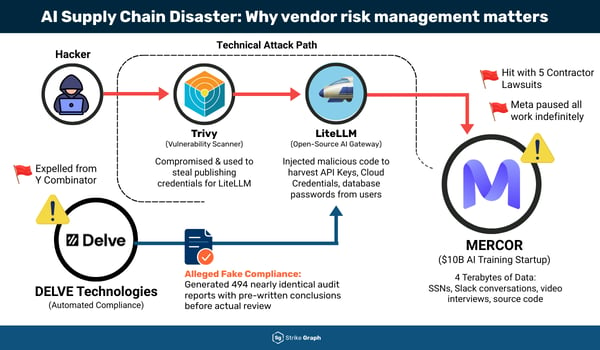
There's a conversation finally happening in the compliance industry right now that honestly is probably a little overdue.
The compliance automation market has grown fast over the last five years, and with that growth has come a pretty wide range of opinions on what "getting compliant" actually means. Some platforms prioritize real program-building. Others prioritize the appearance of compliance over the substance of it. The difference matters more than most buyers realize. A SOC 2 report isn't just a badge, it's a legal document. It helps establish trust between businesses, but it carries real liability for misrepresentation that would land on you, not the platform that helped you produce it.
This distinction matters, not just for the integrity of our own business, but for the integrity of InfoSec compliance across the board. Strike Graph was born out of desire to help strengthen trust between companies, and we can’t do that if the integrity of our industry is in question.
You can’t do "Compliance in Days"
When a compliance team promises to get you “SOC 2 certified” in days, with minimal effort, it's worth pausing to ask a simple question: what exactly is being compromised to make this impossible timeline happen?
Industry wonks know that SOC 2 audits come in many different shapes and forms, but the two to be the most concerned about are SOC 2 Type 1 and SOC 2 Type 2. Throwing numbers and acronyms around tends to make things more confusing, but simply put: a Type 1 is a point in time review of the design of your compliance program, and a Type 2 is a test of its operation over a period of time.
You could argue that if you’re a mature company with strong security and data privacy protections in place already, you could prepare for a Type 1 pretty quickly. But what actually needs to happen in the days before your Type 1 audit? You need to confirm configuration settings, put in place multiple policies and procedures (or at least review them for alignment with SOC 2, conduct training with your staff, align your activities to control designs… We optimistically give a 6-week timeline, if you have a fully dedicated team member available for the project. Then you have to get in front of an auditor, give them time to review your work, ask follow ups, and issue a report.
A SOC 2 Type 2 audit, in comparison, requires an observation period, typically at least three months, during which your security controls are in operation and evidence of that operation is collected. Most organizations choose to have their controls operate for a full year before having them audited. And then a Type 2 also requires getting in front of an auditor, providing them with the evidence that you’ve collected, and they need time to assess if your controls actually reflect how your organization operates, ensuring you’re not just inheriting a generic template with no idea of the operational aspects of your compliance commitments.
Neither of these paths can be compressed into a few hours, unless someone is mindlessly clicking "Accept" on pre-populated policies, forms, screenshots, outcomes, etc. And so if someone is telling you they can get you “certified” in days not weeks, something important is being skipped — and the risk of that shortcut lands on you, not the platform or provider.
The independence standard is non-negotiable
SOC 2 audits operate under independence requirements that exist for good reason. The AICPA (who governs SOC 2 assessments) writes in AT-C Section 205 that the auditor must maintain independence from the subject matter they're assessing. The Public Company Accounting Oversight Board (PCAOB) is even more direct: "To be independent, the auditor must be intellectually honest; to be recognized as independent, he must be free from any obligation to or interest in the client, its management, or its owners."
This independence isn't a bug, it’s a feature. It’s not an obstacle to overcome, it's the entire basis on which an audit opinion, for any framework, has any meaning or authority whatsoever. A report signed by someone who didn't independently examine the evidence, or who simply countersigned conclusions without their own review, isn't an audit report in any meaningful way.
Obviously auditors, just like the rest of us, are allowed (and should probably be encouraged) to find efficiencies in their work. It’s not unheard of for auditors to use automations, start from templates, etc. But a worthwhile auditor would never issue the exact same conclusion (word for word including grammatical errors) across multiple reports. In fact, it’s almost impossible to do.
How Strike Graph's process works
While we didn’t start out with an integrated audit process, we quickly built one when we saw early on how some auditors were treating our customers. Overbilling, requiring duplicative work, unwilling to work with technology… It all started feeling like ‘compliance as a checklist’ and so we built our own process around a principle that we think should be obvious but turns out isn’t necessarily universal: the people issuing the opinion should be genuine, repeatable, technology informed, and the work papers they rely on should accurately reflect real customer environments, including the customized controls and evidence that allows each organization to demonstrate their unique approach to meeting compliance requirements.
Here's what this looks like in practice:
Customers build their own programs. Strike Graph provides the platform, including control templates and evidence guidance as a starting point, but once a company signs in, it’s their content to own. They are expected and encouraged to edit that content to reflect their actual activities. The control language in a Strike Graph report belongs to the customer, not to us. This is a substantive differentiator that we have held onto as a core tenant of our software: every company is unique, and they need the flexibility to design and operate a compliance program that reflects their uniqueness.
Internal audit is not a step to skip. Before anything reaches a CPA, our internal audit team, which operates separately from customer success and with minimal direct contact with the companies being audited, performs a thorough review of the evidence, controls, and their mappings to SOC 2 criteria. This is the first firewall of independence that we put in place. Every control assessment is peer-reviewed by a second auditor, and this team is staffed and led by professionals holding certifications from ISC2, ISO, CompTIA, and EC-Council. Unfortunately, this review step is missing from some audit practices, but we recognize that this is real audit work and not just a quality check on form submissions.
The CPA must be genuinely independent. The Certified Public Accountants who issue opinions on audit engagements cannot be Strike Graph employees, managers, or owners. This would break the other independence firewall that should be in place. The final opinion must come from someone with no true vested interest in our business, nor our customers' business. They are individually registered, in good standing with the AICPA, and their name and license number appear on every report we issue, so anyone can verify their standing independently. There’s credibility in slapping a firm’s name and logo on a report, but this added level of individual accountability, with the CPA themselves attaching their credentials, goes beyond what most firms provide.
The CPA is not handed conclusions; they're handed evidence. Our internal audit work produces a complete Audit Workbook: all controls, all evidence, all test results, all discrepancies noted. The CPA receives this workbook in full, through industry-approved secure channels, and is free to review, re-test, or challenge any element of it before forming their opinion. Their methodology is their own. We don't pre-write their conclusions, and we don't expect them to simply ratify ours.
The CPA is protected from undue influence. Because our CPA partners aren't required to engage directly with customers, they're shielded from the dynamics that can compromise independence at traditional firms, such as the pressure that comes from financial relationships, personal rapport, or a customer's desire for a particular outcome. Independence requires structural protection, not just good intentions, and this is the third and final firewall that we have in place.
Fraud shouldn’t be the default
Let’s be direct about why this matters beyond just competitive positioning.
A SOC 2 report, like many audit attestations, is a legal document. The Management's Assertion, which is signed by an executive inside the organization, states that the security measures described in the report are accurate and that an independent audit was conducted. If either of those things turn out to be not true, the signatories may be carrying liability they didn’t intend to and probably don't even know about.
For companies operating under state, federal, or international regulations, the stakes are even higher: willful neglect of the requirements can carry hefty fines and even criminal penalties. For companies processing data of EU residents, for example, GDPR fines can reach up to 4% of global annual revenue. A compliance report that doesn't reflect reality doesn't protect you from those exposures; instead, it potentially deepens your liability by creating a paper trail of misrepresentation.
So again, the right question to ask of any compliance platform isn't just "how fast can you get me compliant?" It's "does this help make our compliance practice stand up to scrutiny by making compliance easier to manage?"
That's the bar we set for Strike Graph to meet.
Strike Graph’s ongoing commitment
We believe that transparency validates independence. The compliance industry is at an inflection point. Software that streamlines assessments is becoming visible… and exposing shortcuts in the process. The consequences of those shortcuts are unfortunately falling on the customers who trusted the platforms that promised the fastest path.
We built Strike Graph to be the alternative to that: a platform where getting compliant means actually being compliant, and where the report you receive reflects work that will hold up under scrutiny.
You can bring your own auditor to the Strike Graph platform;, in fact, we believe that it’s important to allow that. It allows our customers to flex their independence whenever desired, and it also lends authenticity to our product: if a customer can easily pass an audit with their own auditor, then we can feel confident that we are meeting our goals of making compliance better, not just faster, for companies of all shapes and sizes.
That is the harder thing to build. It’s the harder thing to sell, because we can’t promise compliance without any work at all. But this is the future we envision, one where organizations can effortlessly design, operate, and measure their security and compliance programs with the technology they need to meet their compliance needs.
We think it's the only thing worth building.

.png)




/ebook-ctas_340x500_in-house-ai-compliance.webp)
/demo-ctas_340x500_strategic-advisor-atlas.webp)

.png?width=600&height=600&name=Blog%20Featured%20Image%20600x350px%20(19).png)