Why smaller AI models win in compliance
General-purpose AI was built for everything. Compliance requires something different.
This white paper reveals how purpose-built, fine-tuned small models outperform large commercial LLMs on the tasks that matter most in GRC — at a fraction of the cost.
Small Models, Big Results
The AI that compliance actually needs
Large language models are capable. But in compliance, "capable" isn't the same as "reliable." When recall drops below 50% on complex mapping tasks, or a single framework analysis costs hundreds of dollars in API fees, a technology becomes a proof of concept — not a product.
Strike Graph took a different path. Instead of prompting larger models to be more accurate, we fine-tuned small, task-specific models on real compliance reasoning. The result: models that are 17–23x smaller than leading commercial LLMs and match or exceed their accuracy across three core GRC tasks. In this white paper, you'll find:
Benchmark results across query generation, control mapping, and evidence search
The training pipeline that produced expert-level models for hundreds of dollars
Why Strike Graph optimized for recall — and what that means for human-in-the-loop compliance
Small models. Big results.
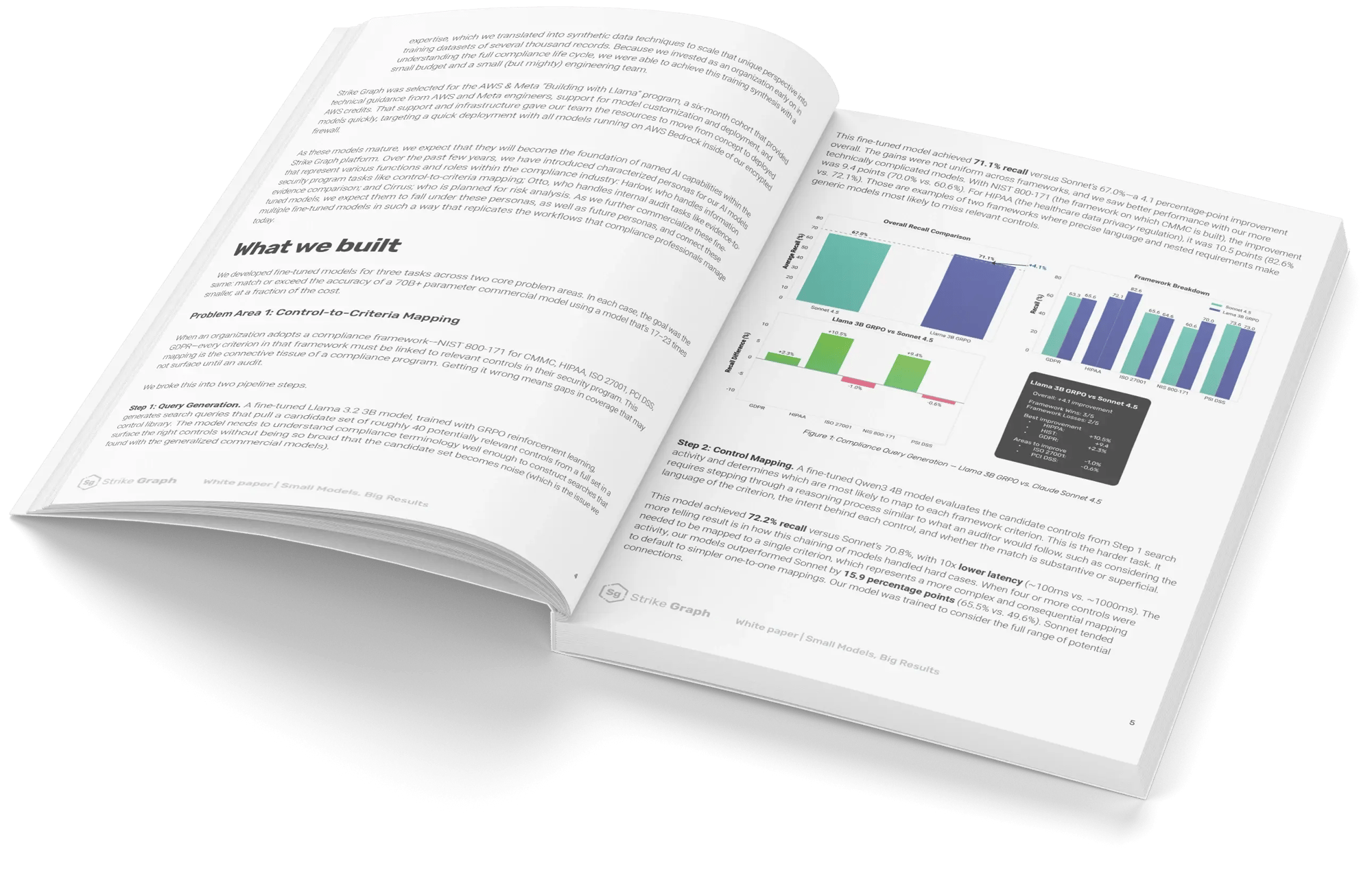
Strike Graph's AI team fine-tuned Llama 3B and Qwen3 4B models on compliance-specific tasks — without using any customer data — and deployed them on AWS Bedrock inside an encrypted environment. The results challenged assumptions about what it takes to build production-grade AI.
Strike Graph gets you certified fast.
Forget traditional auditing firms. Strike Graph takes you all the way to certification faster and more affordably than traditional solutions.
STEP 1
Design
Assess risk and design a strong security program that fits your business with Strike Graph’s extensive repository of policy templates, audit-tested controls, and educational articles.
STEP 2
Operate
Use the compliance dashboard to distribute ownership of risks, security controls, and evidence automation across the whole team, ensuring your organization meets its security contributions efficiently and effectively.
STEP 3
Measure
Easily measure and monitor the status of your controls so you’re always in compliance and ready for audit.
STEP 4
Certify
Give your partners and customers confidence you’re operating in compliance with all relevant regulations and industry-standard security frameworks with a Strike Graph compliance report.
10x
lower latency on control mapping
8.6 pts
recall improvement over Claude Sonnet on evidence search
17-23x
smaller than leading commercial models
The AI-native GRC platform built for how compliance actually works.
Multi-frameworks
Tackle robust compliance programs with pre-mapped security controls and evidence across 30+ frameworks. Start fast, scale without starting over.
Risk-based compliance
Identify and prioritize the risks that matter most to your organization — not a generic checklist.
Compliance dashboards and reporting
A single view of your controls, risks, and evidence — for leadership and your compliance team alike.
AI-native compliance tools
Our patent-pending AI reviews your evidence and identifies gaps before auditors do — so there are no surprises on audit day.
Enterprise Workspaces
Manage compliance across multiple business units, locations, or product lines — with shared controls and centralized oversight.
Audit success management
Dedicated compliance expertise built into your engagement, so your team isn't navigating the audit process alone.
Trusted by hundreds of fast-growing companies

How Strike Graph builds compliance AI
How domain expertise becomes better AI than throwing more parameters at the problem.

Define
Expert-curated ground truth, not generic training data
Strike Graph's in-house compliance experts mapped controls to criteria across NIST 800-171, HIPAA, ISO 27001, PCI DSS, and GDPR — creating a labeled dataset that reflects real auditor reasoning, not web-scraped approximations.

Train
Small models, task-specific fine-tuning
Each model is trained for a single stage of a compliance workflow — query generation, control mapping, or evidence retrieval — using supervised fine-tuning and GRPO reinforcement learning where it matters most.

Deploy
On-demand, inside Strike Graph's encrypted environment
Models run on AWS Bedrock with no always-on GPU infrastructure. Customer data stays inside the firewall. No third-party data exposure, ever.
Stay ahead of compliance AI.
The field is moving fast. Get the latest research, benchmarks, and product insights from Strike Graph's AI and compliance teams — delivered straight to your inbox.
Frequently asked questions about AI in GRC
Is customer data used to train Strike Graph's AI models?
No. All training was performed on Strike Graph's own compliance mappings and synthetically generated data built from our in-house experts' knowledge. No customer data was used in any training run, and our models are deployed on AWS Bedrock inside an encrypted environment, so data processed by the models never leaves Strike Graph's firewall. This was a deliberate architectural decision, not an afterthought. For a deeper look at how we approached data privacy in the training pipeline, the full methodology is detailed in the white paper.
Can small language models really outperform large LLMs on compliance tasks?
In general-purpose tasks, larger models have the advantage. But compliance reasoning isn't general-purpose. It requires precise understanding of framework language, control hierarchies, and auditor logic — the kind of domain-specific knowledge that doesn't emerge reliably from broad pretraining. Strike Graph's fine-tuned Llama 3B and Qwen3 4B models outperformed Claude Sonnet 4.5 across all three core compliance tasks we tested, including a 15.9 percentage point advantage on complex multi-control mapping — the hardest and highest-stakes task. Smaller models, trained on the right data, win on the problems that matter most.
What compliance frameworks does Strike Graph's AI support?
Strike Graph's platform supports more than 30 frameworks, including SOC 2, ISO 27001, CMMC, HIPAA, GDPR, PCI DSS, FedRAMP, and NIST 800-171. The fine-tuned models described in this white paper were trained and benchmarked specifically on NIST 800-171, HIPAA, ISO 27001, PCI DSS, and GDPR — the frameworks where precise language and nested requirements make generic models most likely to miss relevant controls. For a full list of supported frameworks, visit the Strike Graph frameworks page.
How is Strike Graph's AI different from other GRC platforms that also claim to use AI?
Most GRC platforms that incorporate AI are prompting general-purpose commercial models — sending your compliance data to a third-party API and hoping a 70B+ parameter model trained on the internet can reason about your specific control environment. Strike Graph built and fine-tuned its own models from the ground up, trained on real compliance expertise, deployed inside our own encrypted infrastructure, and benchmarked against the leading commercial models available. The difference shows up in the results: better recall, lower latency, and no customer data leaving your environment. For more on how Strike Graph's AI capabilities work across the platform, see Verify AI and our AI Security Assistant.
Can’t find the answer you’re looking for? Contact our team!