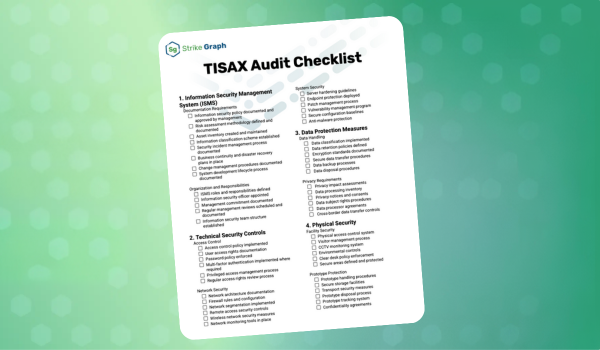
Whether through policy templates, "compliance-in-a-box" solutions, or the siren song of a "SOC 2 in 5 days," the security industry has increasingly embraced a dangerous fiction: that your company's security can be copy-pasted from a template.
It can't.
Every organization has its own architecture, its own risk profile, its own business context. A 50-person fintech startup handling payment data faces fundamentally different security challenges than a 200-person healthcare SaaS company managing PHI. The controls that protect one may be meaningless—or even counterproductive—for the other.
Yet for years, an uncomfortable truth has lurked beneath the surface of the compliance industry: not all SOC 2 audits are created equal. Some have devolved into little more than expensive rubber stamps.
The events of the past few weeks have brought this uncomfortable truth into the harsh light of day. And if the industry doesn't respond with meaningful reform, CISOs will once again be left to their own incredibly inefficient devices to assess vendor security.
The Google Drive scandal: Security theater exposed
In December 2025 and January 2026, what industry insiders are now calling the "SaaS Audit Leak" or the "Google Drive Audit Scandal" ripped the curtain away from practices many suspected but few could prove.
Here's what happened: An employee at a high-growth compliance automation platform accidentally shared a Google Drive link in a customer Slack channel. That link led to a publicly accessible folder containing something damning—hundreds of draft SOC 2 reports for different companies that were nearly identical, word-for-word, except for the company name and dates.
The leaked documents revealed:
- Template-generated reports: Nearly identical SOC 2 reports produced for vastly different organizations, suggesting automated generation rather than actual assessment
- Phantom controls: Documentation for security controls—like hardware-based MFA or specific encryption standards—that the audited companies didn't actually have in place
- Pre-approved sign-offs: Evidence that partner CPA firms had already "approved" certain sections of reports before the audit period had even concluded
The implications are staggering. Companies were receiving SOC 2 reports that looked legitimate on paper, even though the controls behind them may not have existed or been properly verified.
The root cause: A poisoned power dynamic
This scandal didn't emerge from a vacuum. It's the predictable result of a power dynamic that has slowly corrupted the compliance industry.
Companies that have raised enormous amounts of capital at multi-billion dollar valuations burn tens of millions of dollars to acquire leads. Then, to deliver on impossible unit economics, they force CPA firms, consultants, and partners to swallow impossible costs and timelines. The math doesn't work unless corners get cut. So corners get cut.
These platforms are addicted to the money—the venture capital, the growth metrics, the valuation multiples. But it's a slow poison, killing the very thing that makes a third-party audit valuable: its independence and rigor. When the platform controls the customer relationship, sets the price, and dictates the timeline, the CPA becomes a vendor fulfilling a deliverable rather than an independent professional rendering a professional judgment.
The result? Audits that exist to satisfy a checkbox, not to verify security.
The warning signs were there all along:
- The "7-Day Audit" Promise: Any platform claiming they can complete a SOC 2 Type II audit—which requires 3-12 months of control monitoring—in less than a week is promising something that defies the very nature of the assessment.
- No Auditor Interaction: If you're told you'll never need to speak with a human auditor, that's not efficiency—it's a red flag that no one is actually verifying your controls.
- Locked-in Auditors: When you're required to use the platform's internal auditor and cannot bring your own independent firm, there's an inherent conflict of interest.
As one industry observer noted, "If the 'industry standard' is a SOC 2 Type 2 report 'without deviations noted' and that's the barrier to entry and to unlocking business, we are actually saying that security compliance simply has an entry tax of $9,000. If so, what does that say about our industry and what it has become?"
The specter of regression
Here's what keeps me up at night: without clear guidance from the AICPA and meaningful industry reform, we risk a complete collapse of trust in third-party attestations.
And if that happens, we know exactly where we'll end up—because we've been there before.
CISOs will retreat to the only tools they have left: lengthy security questionnaires, custom assessment processes, and endless back-and-forth with every vendor in their supply chain. We'll return to a world where every enterprise maintains its own bespoke vendor assessment program, where a 300-question spreadsheet is the price of admission for every deal, where security teams spend more time filling out forms than actually securing systems.
This is catastrophically inefficient. It doesn't scale. And ironically, it doesn't even produce better security outcomes—it just produces more busywork for everyone involved.
The entire point of frameworks like SOC 2 was to create a common language, a trusted third-party verification that could be relied upon across the market. When that trust erodes, we don't get better security. We get fragmentation, redundancy, and a massive tax on commerce that falls hardest on smaller companies who can't afford dedicated compliance teams.
What the industry must get right
The path forward requires the industry to recommit to principles that should never have been negotiable in the first place.
Auditor independence must be real
Independence isn't just a word in a standards document. It has to mean something in practice. Auditors must be:
- Not employees, managers, or owners of the platforms facilitating the audit
- Willing to provide personal attestation of their work and identify themselves by professional credential
- Operating without limitations on time or area of assessment
When a CPA's livelihood depends on keeping a platform happy, and that platform's business model depends on fast, cheap, frictionless audits, independence is already compromised. The structure itself creates the pressure. We need models where the auditor's professional obligations aren't in tension with their economic incentives.
Transparency must be the default
Fraud thrives in darkness. The audit process needs to be transparent enough that all parties—the company being audited, the auditor, and ultimately the relying parties—can see what was actually tested and how.
This means complete audit workbooks showing the standard being assessed, the mappings to specific controls, the evidence reviewed, and the testing outcomes. It means creating a record that can be examined, questioned, and verified.
Security programs must be right-sized
Perhaps most importantly, we need to abandon the fiction that security is one-size-fits-all.
The compliance industry has drifted toward standardization for efficiency's sake, but taken too far, standardization becomes its own form of theater. When every company is assessed against the same template, using the same controls, producing the same reports—regardless of their actual risk profile—we're not measuring security. We're measuring conformity to a template.
Effective security compliance should help organizations design controls that match their actual operations, focus on risks that are actually relevant to their business, and produce evidence that reflects their real security posture—not a generic checklist.
Evidence must be evidence-based
This sounds tautological, but it's been forgotten: the point of evidence is to provide proof that controls actually exist and function.
Screenshots can be faked. Templates can be copied. The industry needs to move toward evidence-based verification that can actually demonstrate operational effectiveness—not just the existence of a policy document, but proof that the policy is followed; not just a claim that MFA is enabled, but verification that it's actually enforced.
The flight to quality
The scandal has triggered what industry observers are calling a "flight to quality" in early 2026. Third-party risk management teams at Fortune 500 companies are reportedly starting to reject SOC 2 reports issued by "high-volume" firms, asking instead for live walkthroughs of controls during vendor onboarding.
The AICPA itself has reportedly been pressured to investigate audit firms that specialize in automation-heavy, low-cost audits. Independent auditors are rejecting "screenshots only" as evidence and demanding live demonstrations to prove they aren't rubber-stamping.
This is a healthy correction—one that was long overdue.
But market pressure alone won't be enough. We need the AICPA to provide clear guidance on what constitutes acceptable audit practices in an era of automation. We need audit firms to recommit to professional standards even when it means walking away from lucrative platform partnerships. And we need the buyers of these reports—the CISOs and procurement teams relying on them for vendor risk decisions—to demand better.
A different path is possible
When we built Strike Graph, we did so because we believed a different model was possible—one that could deliver efficiency without sacrificing rigor, that could use technology to reduce friction without eliminating the human judgment that makes an audit meaningful.
We're not perfect, and we don't have all the answers. But we've tried to build around principles that we believe should be non-negotiable: genuine auditor independence, complete transparency in the audit process, and the flexibility for each organization to build a security program that fits their actual business rather than a predetermined template.
These aren't proprietary innovations. They're choices any platform could make. The question is whether the economics of venture-backed growth allow for those choices—or whether the pressure to scale inevitably leads back to the shortcuts we've just seen exposed.
The bottom line
The SOC 2 framework itself isn't broken. It remains a legitimate and valuable framework for evaluating an organization's information security program. What failed was how some chose to exploit trust in the process.
Automation didn't cause this fraud. Poor incentives, lack of auditor independence, and a shortcut-driven compliance culture did.
The companies that emerge stronger from this moment will be those that understand a fundamental truth: compliance should be about business enablement through trust. But if the journey to enablement comes at the expense of integrity, credibility, and actual security, then the associated risk is unacceptable.
Security is not one-size-fits-all. It never has been. The question now is whether our industry will have the courage to act like it.

.png)



/Blog%20Graphic%20%5BAI-and-automation-tag-banner-SG%20blog-Oct2024%5D.png)
.png?width=600&height=600&name=Blog%20Featured%20Image%20600x350px%20(9).png)
.png?width=600&height=600&name=Blog%20Featured%20Image%20600x350px%20(25).png)