Summary
- AI-native platforms outperform AI-enhanced ones because they’re built with AI at the architectural core, enabling machine-readable controls, continuous evidence collection, and real-time validation rather than periodic, document-driven checks.
- Compliance AI depends on three performance pillars: accuracy, active AI participation, and strong data security. AI-native designs support these with structured validation rules, autonomous monitoring, and self-hosted models that protect sensitive evidence.
- AI-native architecture delivers measurable advantages across audit readiness, multi-framework mapping, and consultant dependence. That results in continuous compliance, full-population testing, faster implementation, and significantly lower long-term cost.
How to measure ‘good’ AI performance in compliance
Three categories define effective AI performance in compliance operations: accuracy, active AI participation, and security. If any part is lacking, performance suffers. And in each category, we can drill down to individual key factors for evaluation.
1. AI compliance accuracy: the foundation of trust
Accuracy in compliance AI refers to the system's ability to correctly determine control states, match evidence to requirements, identify gaps, and assess risk. Unlike consumer AI applications, where users can easily spot errors, compliance determinations have regulatory and business consequences.
Good AI performance in compliance means:
High precision: When AI flags a control as non-compliant, it's correct 95%+ of the time
High recall: AI catches 90%+ of actual compliance gaps, not just obvious ones
Contextual understanding: AI correctly interprets technical evidence (logs, configurations, policies) in the context of specific control requirements
Consistent application: AI applies the same standard across similar situations without drift
Explainable reasoning: AI can articulate why it reached a determination with specific evidence citations
Conversely, poor AI performance results in:
- False positives: System flags compliant controls as failing, creating audit work and eroding trust
- False negatives: System misses actual gaps, creating compliance risk and audit failures
- Surface-level matching: AI matches keywords rather than understanding substantive compliance
- Inconsistent standards: Similar evidence receives different determinations based on irrelevant factors
- Black box decisions: AI provides determinations without traceable reasoning, making audit defense impossible
A single missed control gap can result in failed audits, lost contracts, or regulatory penalties. Conversely, excessive false positives create "alert fatigue," leading teams to ignore AI findings. Compliance AI must operate at near-human-expert accuracy to be trustworthy.
2. Active participation: AI as a proactive partner
Active participation measures whether AI passively waits for human input or continuously monitors, validates, and alerts without human prompting. In compliance, this is the difference between a quarterly manual audit and continuous control monitoring.
Good AI performance in compliance manifests as:
- Autonomous evidence collection: AI automatically gathers evidence from integrated systems without human intervention
- Continuous validation: AI constantly assesses control states, detecting drift as it happens
- Proactive alerting: AI identifies emerging risks and control failures before scheduled reviews
- Predictive insights: AI forecasts future compliance issues based on patterns (e.g., "certificate expires in 14 days")
- Self-updating: AI adapts to new evidence types and control changes without manual retraining
Meanwhile, poor AI performance results include:
- Request-response only: AI only acts when explicitly prompted by users
- Batch processing: AI analyzes evidence weekly or monthly rather than continuously
- Passive monitoring: AI observes but doesn't alert until humans check dashboards
- Static rules: AI requires manual updates when frameworks or controls change
- Human-dependent: AI cannot operate without constant human direction and input
Compliance is dynamic. Employees change configurations, certificates expire, vendors are acquired, and new vulnerabilities emerge. Active AI transforms compliance from periodic snapshots to continuous assurance, catching issues when they're easy to fix rather than during audit season.
3. Security for sensitive compliance data
Security in AI systems encompasses data protection, model integrity, model ownership, access controls, and audit trails. Compliance platforms handle highly sensitive information, including security configurations, vulnerability data, personnel records, financial controls, and proprietary business processes.
Good AI performance in compliance results in:
- Self-hosted models: AI models are owned and operated by the platform provider, not dependent on third-party AI services. This ensures:
- Complete control over data processing and retention
- No external API calls with customer compliance data
- Ability to guarantee data never leaves the compliance platform infrastructure
- Protection from third-party AI provider policy changes or security incidents
- Compliance with data residency and sovereignty requirements
- Elimination of the third-party AI provider as an additional audit scope
- Data minimization: AI processes only necessary data with proper scoping and tokenization
- Encryption throughout: AI works with encrypted data at rest and in transit
- Model isolation: AI models cannot be poisoned or manipulated through user inputs
- Granular access control: AI respects role-based permissions and data classification
- Complete audit trails: Every AI decision, data access, and model inference is logged for forensic review
- Compliance with regulations: AI handling meets SOC 2, ISO 27001, GDPR, and relevant data protection standards
- Model security assurance: Direct control over model training data, versioning, and security patches without dependency on external vendor timelines
- Poor AI performance, on the other hand, manifests as:
- Third-party model dependency: AI relies on external services (OpenAI, Anthropic, etc.), requiring:
- Sending sensitive compliance data to external APIs
- Dependence on third-party security practices and certifications
- Exposure to third-party provider data breaches or policy changes
- Additional vendor risk assessment and ongoing monitoring burden
- Potential regulatory concerns about data processing locations
- Lack of control over model updates that may affect accuracy or behavior
- Vendor lock-in to specific AI provider pricing and terms
- Overprivileged access: AI requires broad access to function, violating least-privilege principles
- Unencrypted processing: AI models process sensitive data in clear text
- Model vulnerabilities: AI is susceptible to prompt injection, data exfiltration, or adversarial attacks
- Inadequate logging: Cannot trace what data AI accessed or how determinations were made
- Inconsistent controls: AI security controls vary by feature or module
- Regulatory gaps: AI implementation creates compliance risks rather than reducing them
 “Using AI to achieve compliance while creating new security or privacy risks is counterproductive. Auditors increasingly scrutinize AI systems themselves. How they handle data, where that data is processed, and whether they can be manipulated,” says Kenneth Webb, Director of Assessments at Strike Graph.
“In practice, that means organizations should focus less on whether a platform ‘uses AI’ and more on where that AI runs, who owns the models, and how compliance data is isolated, audited, and controlled end-to-end.”
Together, accuracy, active participation, and security determine whether an AI system is fit for real-world compliance, not just impressive in demos.
How AI-native compliance architecture differs from AI-enhanced
The distinction between AI-native and AI-enhanced architectures is not about which vendor has “better AI” or “more AI features.” It's about whether AI is the foundation of the platform or an add-on.
To understand this distinction, ask: If you removed the AI tomorrow, would the core product still function as designed?
- AI-enhanced application: Yes, the product would still work, just less efficiently. Users would manually do what AI was automating.
- AI-native application: No, the product would be fundamentally broken. The AI isn't augmenting workflows; it IS the workflow.
This seemingly simple question reveals profound architectural differences that cascade through every aspect of performance. Let's examine a non-compliance example to understand these architectures without getting mired in GRC-specific complexity.
AI-enhanced example: document management system
Let’s say that pre-AI, a traditional document management system was designed for human users to:
- Upload files (PDFs, Word docs, images) into folder hierarchies
- Navigate folder trees to find documents
- Open documents and read them with human eyes
- Manually tag documents with metadata
- Search by filename, folder, or manually-entered tags
- Share documents via permissions on folders
AI-enhanced data model for a document management system
Document {
id: string
filename: string
folder_path: string
file_size: number
upload_date: timestamp
uploaded_by: user_id
binary_data: blob
tags: string[] // manually entered
} |
This data model assumes humans will interact with files as opaque binary objects.
The system is fundamentally a storage and retrieval mechanism.
Years later, the vendor adds AI features:
- OCR to extract text from scanned documents
- NLP summarization to create document summaries
- Semantic search to find documents by content, not just filename
- Auto-tagging to suggest metadata
- Classification to route documents automatically
These AI features are valuable, but the underlying architecture constrains them:
- AI must work with documents as files, not structured data
- The folder hierarchy (designed for human navigation) is irrelevant to AI, but cannot be removed
- AI processing happens asynchronously after upload. Users still interact with raw files first
- AI-extracted insights are stored separately from core document records (bolt-on metadata)
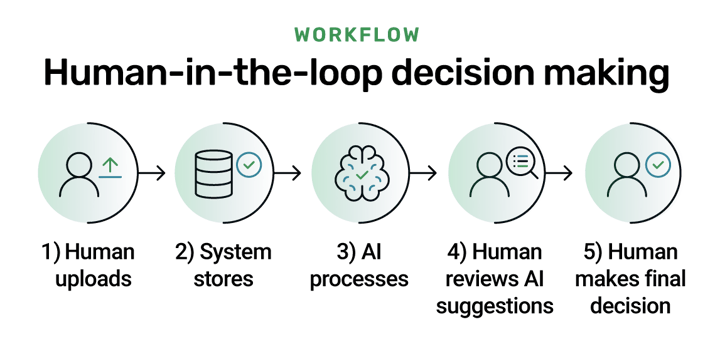
- The workflow remains: human uploads → system stores → AI processes → human reviews AI suggestions → human makes final decision
That all results in these AI performance implications:
Accuracy: AI must interpret documents with no context about their purpose, relationships, or validation requirements. It's working blind.
Active participation: AI processes documents when uploaded or on schedule, not continuously as referenced information changes.
Security: AI requires read access to all documents to function, violating the principle of least privilege. You cannot easily apply different AI processing to different security classifications.
AI-native example: document intelligence platform
Now, let’s transform our example and say a document intelligence platform was designed from day one, assuming AI would:
- Immediately interpret document content upon ingestion
- Extract structured entities, relationships, and metadata automatically
- Store documents as knowledge graphs, not files
- Enable humans to interact with AI's understanding of documents, not raw files
- Continuously monitor referenced documents for changes
Data model for an AI-native document intelligence system
DocumentEntity {
id: string
source_reference: url
entity_type: enum // contract, policy, evidence, etc.
extracted_entities: [
{
type: string
value: string
confidence: float
location: coordinates
}
]
semantic_embedding: vector
relationships: [
{
target_entity_id: string
relationship_type: enum
confidence: float
}
]
validation_rules: rule_set
change_detection: {
last_checked: timestamp
checksum: string
alert_on_change: boolean
}
access_policy: policy_id
} |
This data model assumes AI is the primary interpreter. Storage is optimized for machine reasoning — embeddings for semantic similarity, graph relationships for context, and validation rules for automated checking.
Now, AI has become the foundation, not just a feature:
- Documents are never stored as "just files"; ingestion immediately extracts structure
- There are no folders; organization emerges from AI-understood relationships
- Users query in natural language ("show me all contracts with vendor X mentioning data retention")
- AI continuously monitors source documents for changes without human prompting
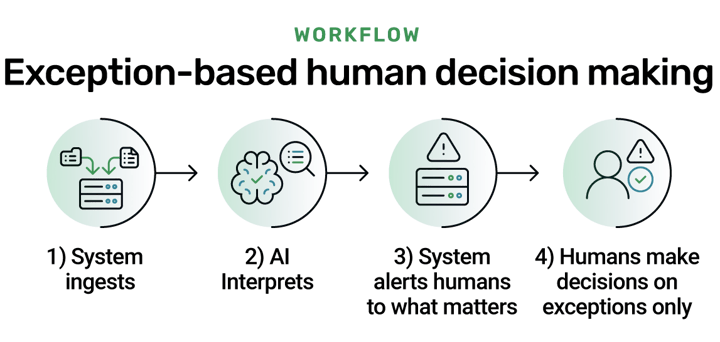
- The workflow is: system ingests → AI interprets → system alerts humans to what matters → humans make decisions on exceptions only
The performance implications are significant:
Accuracy: AI has rich context from day one. AI understands how entities relate, which validation rules apply, and what changed from the last version. It's reasoning with structure, not guessing from text.
Active participation: The system is designed for continuous AI monitoring. Change detection and validation are built into the data model itself.
Security: Access control and AI processing are unified. AI only interprets data that users are authorized to see, and different AI rules can apply to varying classifications without architectural gymnastics.
Key AI architectural differentiators for compliance management platforms
|
Dimension
|
AI-enhanced
|
AI-native
|
|
Data model
|
Designed for human interaction with files/records
|
Designed for machine reasoning with entities and relationships
|
|
Workflow
|
Human-primary with AI assistance
|
AI-primary with human oversight
|
|
Processing
|
Batch/triggered AI analysis
|
Continuous AI monitoring
|
|
Storage
|
Raw documents with AI insights added later
|
Structured knowledge from ingestion
|
|
Query model
|
Keyword search with AI-improved results
|
Semantic understanding and natural language
|
|
Change management
|
Humans detect changes, AI helps analyze
|
AI detects and interprets changes automatically
|
|
Integration
|
AI capabilities added to existing APIs
|
APIs expose AI-interpreted data natively
|

“AI-enhanced systems can bolt on some helpful features, but they are still designed around human workflows and file objects,” says Micah Spieler, Head of Product at Strike Graph. “AI-native systems assume from day one that AI will interpret, store, and continuously re-evaluate the data itself. This becomes decisive in complex, fast-changing domains like compliance.”
Now we can examine how AI-native versus AI-enhanced architectures manifest in actual compliance platform capabilities. The differences between these approaches become most visible and consequential when comparing how platforms handle the seven core dimensions of compliance management.
Compliance dimension 1: risk, control, and evidence design
This is the foundation: how platforms initially structure risk registers, control frameworks, and evidence requirements.
With the approach, AI-enhanced platforms inherit their design workflow from pre-AI GRC systems:
- The compliance team manually creates a risk register based on framework requirements
- Team manually maps controls to risks using framework documentation
- Team manually defines what evidence satisfies each control
- Team manually writes procedures and assigns owners
- AI is then added to suggest similar controls or auto-populate some fields based on templates
But this results in architectural constraints:
Template-based thinking: System assumes risks and controls are selected from predefined libraries because that's how humans work efficiently
Static relationships: Risk-to-control and control-to-evidence mappings are database records created once, not continuously validated
Human readability focus: Control descriptions written for human readers (auditors, implementers) rather than structured for machine validation
Evidence as documentation: Evidence requirements defined as document types ("upload access control policy") rather than validation rules
AI-enhanced compliance example: implementing SOC 2 access control
Control CC6.1: "The entity implements logical access security software, infrastructure, and architectures over protected information assets to protect them from security events."
AI Enhancement Process:
Human selects control from SOC 2 template library
AI suggests description: [pre-written generic text]
Human defines evidence: "IAM policy document, user access review"
AI suggests similar controls from other frameworks
Human manually links related risks |
The AI-enhanced approach for implementing SOC 2 access control still heavily relies on humans – and has little context for validation.
That results in constrained performance:
- Accuracy: AI has minimal context for validation. When evidence is uploaded, AI can check if it's a “policy document,” but cannot determine if that policy actually implements logical access security software correctly. The control definition wasn't written for machine validation.
- Active participation: AI cannot proactively monitor control state because evidence requirements are documentation-based, not validation-based. The system must wait for quarterly evidence uploads.
- Security: Evidence requirements are often overly broad ("access control policy") to accommodate the template approach, meaning systems collect more sensitive data than necessary for validation.
However, GRC behavior changes significantly with the AI-first approach. AI-native platforms design controls and evidence around what AI can continuously validate:
- System ingests framework requirements (SOC 2, ISO 27001) as structured knowledge
- AI analyzes the organization's technical environment to identify applicable controls
- AI designs evidence collection around automatable validation signals
- AI structures control definitions as validation rules, not narrative descriptions
- Humans review and approve AI-designed control mappings and evidence rules
The architectural foundation works like this:
- Validation-centric: Controls defined by what signals prove compliance, not what documents describe it
- Dynamic relationships: Risk-control-evidence relationships are continuously validated as the environment changes
- Machine-structured: Control definitions include semantic requirements that AI can test against evidence
- Evidence as signals: Evidence requirements specify data points, configurations, or logs that demonstrate control operation
AI-native compliance example: implementing SOC 2 access control
Control CC6.1 Validation Rules (AI-Designed):
evidence_requirements: {
iam_configuration: {
source: "AWS IAM API",
validation: [
"MFA enforced for all users",
"Password policy meets minimum standards",
"No wildcard permissions in policies",
"Privileged access requires additional authentication"
],
check_frequency: "continuous"
},
access_review_logs: {
source: "HRIS + IAM system",
validation: [
"Reviews conducted quarterly",
"All users reviewed within 90 days",
"Terminated users removed within 24 hours"
],
check_frequency: "daily"
}
}
related_risks: [
{
risk_id: "R-007",
risk: "Unauthorized access to customer data",
ai_detected_relationship: "Control prevents via authentication requirements",
confidence: 0.94
}
] |
The AI doesn't suggest a generic description. It structures validation rules based on technical evidence, specific configurations, and continuous monitoring.
That results in a performance impact like this:
- Accuracy: AI can accurately determine the control state because the control was designed for machine validation. When MFA is disabled for a user, AI definitively knows the CC6.1 compliance status has changed. No interpretation of narrative descriptions is required
- Active participation: AI monitors IAM configurations. When a developer adds a wildcard permission, the system alerts immediately instead of during the next quarter's evidence collection.
- Security: Evidence collection is scoped precisely to validation requirements. System collects IAM metadata, not entire policy documents, minimizing sensitive data storage.
Compliance dimension 2: risk, control, evidence monitoring, and updates
Compliance is not static. Frameworks evolve, business operations change, technical infrastructure shifts, and threats emerge. How platforms handle ongoing monitoring reveals their architectural DNA.
With an AI-enhanced periodic review model, compliance platforms operate on scheduled review cycles because their architecture assumes human-driven processes:
- Quarterly/annual reviews: Compliance team schedules reviews to update the risk register and control effectiveness
- Manual triggering: Changes to frameworks or operations require humans to identify impacted controls
- Batch evidence updates: Evidence is collected during scheduled audit windows
- AI-assisted analysis: AI helps during reviews by highlighting changes or suggesting updates
AI-enhanced compliance scenario: AWS introduces a new service
Month 1: Organization starts using AWS Lambda
Month 2: Developers deploy 20 Lambda functions
Month 3: Lambda functions access customer data
Month 4: Quarterly compliance review occurs
→ Human discovers Lambda usage
→ Human researches what controls apply to serverless
→ Human updates control scope manually
→ AI suggests similar controls from templates
→ Evidence collection begins for Q4 review
Month 5: First Lambda evidence collected |
Architectural constraints surface in this AI-enhanced example of AWS introducing a new service. Change detection depends on humans, and it’s reactive. Also, it results in periodic snapshots vs. continuous monitoring.
The performance impacts are:
- Accuracy: AI analyzes stale evidence. In the example above, Lambda functions operated without appropriate controls for 4+ months, but the compliance dashboard showed "compliant" because last quarter's evidence (pre-Lambda) passed.
- Active participation: AI is passive. It doesn't detect the Lambda deployment, assess what controls apply, or alert that evidence collection needs expansion. Human direction required.
- Security: The gap window is inherent to the periodic model. New services or configurations create compliance risk until the next scheduled review.
However, with AI-native GRC behavior, platforms monitor continuously because their architecture expects environment changes:
- Real-time change detection: AI monitors integrated systems for configuration changes, new services, and permission modifications
- Automatic impact analysis: AI assesses what controls are affected by detected changes
- Dynamic evidence updating: Evidence requirements automatically adjust to environmental changes
- Proactive alerting: Humans are notified only when AI detects compliance impact
AI-native compliance scenario: AWS introduces a new service
Day 1, 09:00: First Lambda function deployed
Day 1, 09:02: AI detects new service type in AWS environment
Day 1, 09:03: AI analyzes Lambda against control framework
→ Identifies 12 controls that apply to compute services
→ Maps Lambda-specific configurations to validation rules
→ Updates evidence collection to include Lambda
Day 1, 09:05: AI validates current Lambda configurations
→ Detects CloudWatch logging not enabled (CC7.2 gap)
→ Detects VPC not configured (CC6.6 gap)
Day 1, 09:06: Alert sent: "New service detected with control gaps"
Day 1, 14:00: DevOps enables CloudWatch logging and VPC
Day 1, 14:02: AI re-validates, gaps closed
Day 1, 14:03: Compliance status updated: All controls green |
The approach becomes proactive and immediate in this AI-native compliance scenario of AWS introducing a new service. Change detection is AI-native, and it has continuous awareness.
The performance substantially improves:
- Accuracy: AI validates against the current state, not point-in-time snapshots. No hidden gaps between review cycles.
- Active participation: AI autonomously detects changes, assesses implications, and alerts. Humans intervene only when action is needed, not to check if action might be needed.
- Security: Compliance gaps measured in minutes/hours, not months. The issue was detected and remediated the same day rather than lingering until the quarterly review.
Compliance Dimension 3: Measurement
How do you know if you're compliant? This seemingly simple question reveals profound architectural differences.
With an AI-enhanced completion-based model, platforms measure compliance through task completion and documentation status:
- Control status: Based on whether evidence has been uploaded and reviewed
- Framework progress: Percentage of controls marked "complete" by humans
- Risk scores: Calculated from manually-assessed likelihood and impact ratings
- AI contribution: Suggests risk scores, identifies controls that might be incomplete based on missing documentation
AI-enhanced compliance dashboard example for SOC 2
|
SOC 2 Compliance Status: 87% Complete
Trust Service Category Status:
✓ CC1 - Control Environment: 100% (12/12 controls complete)
⚠ CC6 - Logical Access: 75% (9/12 controls complete)
→ Pending: CC6.2 (evidence uploaded, awaiting review)
→ Pending: CC6.4 (evidence due in 14 days)
→ Pending: CC6.7 (no evidence uploaded)
✗ CC7 - System Operations: 50% (6/12 controls complete)
Next Actions:
- Upload evidence for 6 controls
- Review 3 pending evidence items
- Schedule Q4 compliance review
|
This AI-enhanced compliance dashboard measures documentation completeness and task completion, not actual control effectiveness or real compliance state. Consider that CC1 shows as 100%, but the evidence might be 89 days old. Or that CC6.7 is “pending,” but the underlying control might be working perfectly. And the 87% complete says nothing about the risk faced.
The architectural constraints are clear:
- Binary states: Controls are "complete" or "incomplete" based on evidence status, not control effectiveness
- Human-dependent updates: Compliance score only updates when humans upload and review evidence
- Lagging indicators: Measurement reflects past evidence collection, not the current state
- Process metrics: System measures compliance activities rather than compliance outcomes
The performance looks like this:
- Accuracy: Compliance metrics are artifacts of evidence collection timing, not actual compliance. Can show 100% compliant while controls are failing, or 50% compliant while controls are effective but evidence pending.
- Active participation: AI cannot provide real-time compliance measurement because it depends on human-triggered evidence cycles.
- Security: False security from misleadingly positive metrics. Leadership sees "87% compliant" and doesn't understand true risk exposure.
However, with AI-native GRC, the platforms measure compliance through continuous control validation:
- Control status: Based on AI validation of actual control operation against the current state
- Framework adherence: Real-time assessment of control effectiveness, not documentation status
- Risk scores: Calculated from AI-detected vulnerabilities and actual incident patterns
- Confidence metrics: AI reports its own confidence levels for each determination
AI-native compliance dashboard example for SOC 2
|
SOC 2 Compliance Status: Validated 94% | Under Review 6%
Trust Service Category Status:
✓ CC1 - Control Environment: Validated (confidence: 97%)
Last validated: 6 minutes ago
Active signals: 247 evidence points
✓ CC6 - Logical Access: Validated (confidence: 91%)
Last validated: 2 minutes ago
⚠ Minor drift detected: 1 service account without recent review
Active signals: 1,834 evidence points
⚠ CC7 - System Operations: Partial Validation (confidence: 88%)
Last validated: 8 minutes ago
⚠ Gap detected: CloudWatch alerting delayed 45 min (SLA: 15 min)
Active signals: 2,156 evidence points
Remediation in progress
Confidence Adjustments:
- CC6 confidence reduced from 95% → 91% due to service account
review age (82 days, threshold 90 days)
- CC7 gap detected 45 minutes ago, acknowledged by DevOps team
Real Risk Exposure:
High Priority: 1 control gap (CC7 alerting delay)
Medium Priority: 1 control drift (CC6 service account)
Low Priority: 0
|
This AI-native compliance dashboard measures actual control effectiveness through continuous validation. Now, CC1 shows 97% confidence, and CC6 shows 91% with drift. CC7 shows partial validation. And the 94% headline is based on actual validated control effectiveness, with 6% real gaps requiring attention.
The architectural foundation includes:
- Continuous validation states: Controls are validated/non-compliant/under review based on real-time evidence, not document status
- AI-dependent updates: Compliance score updates automatically as AI validates against live systems
- Leading indicators: Measurement reflects the current state and trends toward non-compliance before failures occur
- Outcome metrics: System measures actual control effectiveness, not compliance activities
And the performance now looks like this:
- Accuracy: Compliance metrics reflect reality. Dashboard states correlate with actual control operation. Auditors can verify measurements against the same evidence sources AI uses.
- Active participation: AI provides real-time compliance measurement that updates as the environment changes. No human intervention required for metrics to stay current.
- Security: True risk visibility. Leadership sees actual control gaps and drift patterns, enabling informed risk decisions.
Compliance dimension 4: audit management
Audit season transforms from a chaotic scramble to a routine exercise when AI architecture supports it properly.
With an AI-enhanced document collection model, platforms support traditional audit processes:
- Pre-audit preparation: Team exports evidence documents that auditors requested
- Request tracking: System logs auditor requests and tracks responses
- AI assistance: AI helps locate relevant documents and suggests similar evidence from past audits
- Manual coordination: Humans manage back-and-forth with auditors
AI-enhanced compliance audit workflow example
Week 1: Auditor sends initial document request list (IDR)
- Request: "Provide access control policy effective during audit period"
- Request: "Provide evidence of quarterly access reviews"
- Request: "Provide MFA configuration screenshots"
Week 1-2: Compliance team responds
- Searches system for "access control policy"
- AI suggests 3 policy versions; human picks correct one
- Exports policy PDF to secure file share
- Manually generates access review reports from IAM system
- Takes screenshots of MFA settings
- AI tracks requests marked "complete"
Week 3: Auditor follow-up questions
- Question: "Policy dated Feb, but audit period is Jan-Dec. Was different policy in effect Jan-Feb?"
- Team manually researches policy version history
- Discovers Feb policy identical to Jan policy, just renamed
- Manually documents this explanation
Week 4: Additional evidence requests
- Request: "Provide evidence MFA was enforced on Nov 15 specifically"
- Team realizes screenshots show current state, not Nov 15
- Manually researches IAM logs to prove Nov 15 state
- AI helps search logs, but human must interpret and explain |
Architectural constraints surface in this example of an AI-enhanced compliance audit workflow. The evidence consists of documents and point-in-time proof. There is manual translation. And while document versioning exists, AI struggles with human interpretation.
The performance impact looks like this:
- Accuracy: High risk of providing the wrong evidence version, missing context, or incomplete documentation. AI suggestions based on keyword matching, not semantic understanding of audit requirements.
- Active participation: AI is passive during the audit. It helps humans search faster, but cannot autonomously respond to auditor queries or explain evidence provenance.
- Security: Must export sensitive documents to external file shares. No granular control over what specific evidence auditors access. It's all-or-nothing document sharing.
However, with an AI-native model, platforms treat audits as validation of continuous monitoring, not evidence collection:
- Auditor portal access: Auditors receive a query interface to the same evidence that AI monitors
- Self-service validation: Auditors can query control states at any point in the audit period
- AI-generated explanations: AI produces audit narratives explaining how controls operated and what evidence supports determinations
- Immutable audit trail: Every AI validation decision during the audit period is preserved with a full evidence chain
AI-native compliance audit workflow example
Week 1: Auditor receives portal access
Auditor Query 1: "Show me access control policy effective Nov 15, 2024"
AI Response (immediate):
Policy Version: v2.3 (effective Oct 1 - Dec 31, 2024)
No changes during Nov 15
Full policy content: [embedded]
Approvers: [names, dates]
Related controls: CC6.1, CC6.2, CC6.6
Evidence of enforcement: [3,247 IAM events from Nov 15]
Auditor Query 2: "Was MFA enforced for all users on Nov 15, 2024?"
AI Response (immediate):
Status: Fully Compliant
Evidence: IAM configuration snapshot from Nov 15, 23:47 UTC
- Total users: 47
- MFA enabled: 47 (100%)
- MFA enforcement policy: Active
- Last MFA challenge: Nov 15, 18:23 UTC
Historical context: MFA enforced continuously since Sep 2023
Related validations: 247 daily checks during audit period
Auditor Query 3: "Show exceptions to quarterly access reviews"
AI Response (immediate):
Reviews conducted: Q1 (Jan 15), Q2 (Apr 12), Q3 (Jul 18), Q4 (Oct 22)
Total users reviewed: 47 per quarter
Exceptions identified:
- Service account "ci-deploy" not reviewed Q2 (remediated Q3)
- Reason: Added after Q2 review started, included in Q3
- Gap period: 42 days (Apr 13 - May 25)
Compensating controls during gap:
- Account permissions read-only
- Activity logged and monitored
- No elevated access granted
Week 2-3: Auditor continues querying; AI responds instantly
No compliance team involvement required for evidence provision
Week 4: Auditor requests management representations
- AI generates audit response package from validation history
- Compliance team reviews and signs off
- Complete audit with 94% time savings |
This AI-native workflow example for a compliance audit shows that the evidence is now structured data, not documents. There are temporal queries, self-documentation, and audit-native design.
The performance impact is significant:
- Accuracy: AI responses to auditor queries are derived from the same evidence used for continuous validation. No translation or interpretation layer where errors creep in. Auditor sees exactly what AI validated.
- Active Participation: AI handles the vast majority of auditor questions autonomously. The compliance team intervenes only for management representations or when AI confidence falls below the threshold.
- Security: Granular access control gives auditors query-specific evidence without downloading sensitive documents. All auditor activity logged. Evidence never leaves the platform.
Compliance Audit Management: Efficiency and Risk Reduction from AI
|
Audit Activity
|
AI-Enhanced (Typical Time)
|
AI-Native (Typical Time)
|
|
Pre-audit evidence prep
|
40-80 hours
|
2-4 hours
|
|
Initial document request response
|
2-3 weeks
|
1-2 days
|
|
Follow-up question turnaround
|
3-5 days per question
|
Minutes per query
|
|
Total compliance team audit burden
|
120-200 hours
|
20-30 hours
|
|
Audit duration
|
4-8 weeks
|
2-3 weeks
|
|
Risk of missing evidence
|
Moderate-High
|
Low
|
|
Auditor satisfaction
|
Variable
|
High
|
The efficiency gains aren't about AI helping humans be faster. They're about architectural enablement. AI-native platforms can provide auditors with self-service access because the evidence was structured for machine validation from the start. AI-enhanced platforms cannot offer this because the evidence exists in documents that require human interpretation.
Compliance dimension 5: audit execution
Beyond audit management (coordination), audit execution (the actual validation work) reveals even starker architectural differences.
With an AI-enhanced sample-based approach, audit execution follows traditional methodology because evidence structure requires it:
- Auditor sampling: Auditor selects a representative sample of evidence to examine (e.g., 25 users out of 500)
- Manual validation: Auditor reviews evidence documents, verifies against control requirements
- Exception documentation: Auditor notes any failures or gaps, requests explanations
- AI support: AI might help the auditor search documents or flag potential issues, but validation is human-driven
AI-enhanced example: auditing access control
Control: Quarterly access reviews conducted for all users
Auditor Sampling Process:
1. Requests access review documentation for all four quarters
2. Receives spreadsheets from each quarterly review
3. Selects random sample: 25 users (5% of 500 total)
4. For each sampled user:
- Verifies user appears in all four quarterly reviews
- Checks review dates are within quarterly windows
- Validates reviewer signatures present
- Confirms access changes documented where applicable
5. Finds 2 exceptions in sample:
- User "jdoe" missing from Q2 review
- User "rsmith" review dated 7 days past quarter end
6. Extrapolates: 2/25 = 8% exception rate
7. Requests company explanation for exceptions
8. Company manually investigates:
- jdoe was on leave during Q2, added to Q3 review
- rsmith review delayed due to manager vacation
9. Auditor determines: Acceptable with note
Total validation time: ~8 hours auditor time + 4 hours company time
Risk: Sample might miss systemic issues affecting non-sampled users |
The architectural constraints surface in this AI-enhanced example of auditing access control. It’s sample-based, document-bound, and point-in-time, with manual exception investigation.
This results in a performance impact like this:
- Accuracy: Sample-based validation introduces statistical risk. In the example above, if 20 users (not in the sample) had the same issue as jdoe, the auditor would miss it. Confidence is probabilistic, not definitive.
- Active participation: AI can suggest which samples to test, but cannot perform population-level validation because the evidence structure doesn't support it.
- Security: Must provide auditor access to potentially sensitive user data in documents rather than auditor querying only what's needed.
However, with AI-native GRC, AI enables complete population testing because evidence is structured data:
- Automated population analysis: AI validates control operation against 100% of the population, not a sample
- Exception identification: AI identifies all exceptions automatically with root cause analysis
- Auditor verification: Auditor reviews AI's methodology and validates exception handling
- Real-time demonstration: Auditor can re-run validation queries to verify AI conclusions
AI-native example: auditing access control
Control: Quarterly access reviews conducted for all users
AI Population Analysis:
1. Query all user accounts: 500 users active during audit period
2. Cross-reference with access review logs: 4 quarterly reviews
3. Validate 100% of population (500 users × 4 reviews = 2,000 data points)
Results (generated in 2.3 seconds):
✓ Compliant: 1,987 reviews (99.35%)
✗ Exceptions: 13 reviews (0.65%)
Exception Detail (all 13):
- 8 users: Review delayed 1-7 days (avg 4 days)
* All 8 reviews completed within 10 days of quarter end
* Compensating control: No access changes during delay period
* Root cause analysis: Manager vacation (confirmed via HRIS)
- 4 users: Missed Q2 review entirely
* All 4 on leave during Q2 (confirmed via HRIS)
* All 4 included in Q3 review upon return
* Access status: Suspended during leave per policy
- 1 user: Service account not reviewed in any quarter
* Account type: CI/CD automation
* Permissions: Read-only, no PII access
* Remediation: Added to Q1 2025 review cycle
* Compensating control: Automated permission monitoring active
Auditor Validation Process:
1. Reviews AI methodology: Confirms query logic sound
2. Spot-checks AI findings: Verifies 5 random compliant cases
3. Deep-dives all 13 exceptions: Confirms AI root cause accurate
4. Re-runs queries with different parameters: Results consistent
5. Determines: Population validated, exceptions acceptable
Total validation time: ~2 hours auditor time + 0.5 hours company time
Risk: Zero sampling risk; entire population validated |
This AI-native example of auditing access control shows what a difference its architecture makes. It enables population testing and continuous validation. It’s data-native. And it includes automated root cause.
The impact on performance is substantial:
- Accuracy: 100% population validation eliminates sampling risk. Every exception found and explained. The auditor has a definitive answer, not statistical confidence.
- Active Participation: AI performs validation work that would require days of manual effort. Auditor's role shifts from evidence examination to methodology verification, which is higher-value work.
- Security: Auditors can query structured data without accessing underlying documents. They can validate control without viewing PII and just confirm that reviews occurred per policy.
Compliance dimension 6: multi-framework compliance
Most organizations don't comply with just one framework. They need SOC 2, ISO 27001, perhaps GDPR, and maybe CMMC. How platforms handle overlapping requirements reveals architectural sophistication.
With AI-enhanced GRC, there’s a framework silo. Platforms treat each framework separately because their template-based architecture encourages it:
- Separate implementations: Each framework is deployed as a distinct project with its own control library
- Manual mapping: Humans identify overlapping controls between frameworks
- Duplicated evidence: Same evidence uploaded multiple times to satisfy different framework requirements
- AI-assisted mapping: AI suggests which controls might overlap based on keyword similarity
AI-enhanced example: organization pursuing SOC 2 + ISO 27001
SOC 2 Implementation:
- 64 controls defined from SOC 2 template
- Evidence collected for each control
- Dashboard: SOC 2 Compliance Status
ISO 27001 Implementation:
- 93 controls defined from ISO 27001 template
- Evidence collected for each control
- Dashboard: ISO 27001 Compliance Status
Manual Mapping Exercise:
1. Compliance team reviews both control sets
2. AI suggests possible overlaps:
- SOC 2 CC6.1 (logical access) ↔ ISO 27001 A.9.1.1 (access control policy)
- SOC 2 CC7.2 (monitoring) ↔ ISO 27001 A.12.4.1 (event logging)
[etc.]
3. Team manually confirms each mapping
4. Team uploads IAM policy document to:
- SOC 2 evidence folder for CC6.1
- ISO 27001 evidence folder for A.9.1.1
5. During audits, provide evidence separately to each auditor
Inefficiency Result:
- Same IAM configuration evidence collected twice
- Same policies reviewed by two different auditors
- Changes to access control require updating evidence in two places
- Inconsistency risk: One framework shows compliant, other shows gap
for same underlying control
|
The architectural constraints are clear in this AI-enhanced approach of an organization pursuing SOC 2 + ISO 27001. It’s a framework-centric data model with document-based evidence. It depends on human mapping, and there’s an inconsistency in validation.
This results in a performance impact like this:
- Accuracy: Mapping errors are common. When humans miss overlaps, the organization duplicates work unnecessarily. When humans incorrectly map non-equivalent controls, compliance gaps result.
- Active Participation: AI cannot proactively identify cross-framework implications because frameworks are siloed. If access controls change, AI might alert for SOC 2 but not for ISO 27001 unless humans update both.
- Security: Evidence sprawl—same sensitive data stored multiple times increases attack surface and complicates access control.
However, with AI-native GRC behavior, there’s a unified control intelligence approach. AI-native platforms understand that frameworks are different views of the same underlying security controls:
- Framework-agnostic control model: AI structures controls by security objective, not framework
- Automatic multi-framework mapping: AI understands semantic relationships between framework requirements
- Single evidence source: Evidence collected once, automatically mapped to all applicable framework controls
- Unified validation: AI validates underlying security control once, reports status across all frameworks
AI native example: organization pursuing SOC 2 + ISO 27001
AI Framework Ingestion:
1. AI ingests SOC 2 Trust Service Criteria
2. AI ingests ISO 27001 Annex A controls
3. AI builds semantic control graph:
Underlying Control: "Multi-Factor Authentication Enforcement"
├─ Maps to: SOC 2 CC6.1
├─ Maps to: ISO 27001 A.9.4.2
├─ Evidence Requirements:
│ ├─ IAM configuration (MFA enabled)
│ ├─ Authentication logs
│ └─ Exception handling procedures
├─ Validation Rule: All users require MFA except approved exceptions
└─ Current Status: Validated ✓
Underlying Control: "System Monitoring and Alerting"
├─ Maps to: SOC 2 CC7.2
├─ Maps to: ISO 27001 A.12.4.1
├─ Maps to: ISO 27001 A.16.1.2 (incident response)
├─ Evidence Requirements:
│ ├─ CloudWatch/monitoring configurations
│ ├─ Alert rule definitions
│ └─ Alert response logs
├─ Validation Rule: Security events generate alerts within 15 minutes
└─ Current Status: Validated ✓
AI-Generated Compliance View:
Dashboard: Unified Compliance Status
- Core security controls: 47 implemented
- Framework coverage:
* SOC 2: 64 controls → 47 core controls (100% mapped)
* ISO 27001: 93 controls → 47 core controls (100% mapped)
- Evidence collected: 47 control evidence sets
- Status: Both frameworks compliant
Multi-Framework Insight:
"All 47 core controls satisfy both SOC 2 and ISO 27001 requirements.
No additional implementation needed for dual compliance.
Estimated efficiency gain: 42% fewer total controls vs. separate approach."
|
This AI native example shows the advantages for an organization pursuing SOC 2 + ISO 27001. It includes semantic control understanding, graph-based relationships, evidence-control polymorphism, and each framework as a view layer.
The performance impact is clear:
- Accuracy: Eliminates mapping errors through semantic understanding. AI doesn't guess which controls overlap. It understands what they require and maps based on actual validation rule equivalence.
- Active Participation: AI maintains a single source of truth. Changes validated once, automatically reflected across all frameworks. No human intervention is needed to keep frameworks synchronized.
- Security: Evidence minimization means collect once, reference many times. Reduces the storage of sensitive data and simplifies access control.
“The multi-framework advantage isn't linear. It's exponential,” says Spieler. “Each additional framework in AI-enhanced platforms multiplies effort. In AI-native platforms, additional frameworks primarily require mapping (which AI does automatically), not reimplementation.”
Compliance dimension 7: Use of consultants
The final dimension reveals the most telling difference: how much expert human help do you need?
With AI-enhanced GRC, platforms still require significant consultant engagement. The platform automates tactical tasks (such as storing documents and tracking deadlines), but strategic decisions remain human-dependent.
Initial Implementation:
- Average consultant hours: 80-120 hours
- Activities:
- Framework selection and scoping
- Control library customization
- Evidence requirement definition
- Team training on platform usage
- Initial evidence collection guidance
- Gap assessment and remediation planning
Ongoing Support:
- Quarterly consultant engagement: 20-40 hours/quarter
- Activities:
- Preparing for audits
- Evidence review and gap identification
- Control effectiveness assessment
- Framework updates (when frameworks change)
- New framework implementation
- Complex control interpretation
AI-enhanced approach for an organization adding ISO 27001 after SOC 2
Organization adds ISO 27001 after achieving SOC 2:
Without Consultant:
- Team struggles to understand ISO 27001 Annex A structure
- Unclear which existing SOC 2 controls map to ISO requirements
- Uncertainty about what new evidence needed
- Risk of implementing unnecessary redundant controls
- Likely: audit failures on first attempt
With Consultant (typical engagement):
- Week 1-2: Consultant maps SOC 2 controls to ISO (16 hours)
- Week 3-4: Consultant defines gap controls and evidence (24 hours)
- Week 5-8: Consultant reviews evidence as collected (16 hours)
- Pre-audit: Consultant reviews readiness (8 hours)
Total: 64 consultant hours + internal team time
AI Platform Contribution:
- Stores consultant's control mapping in system
- Tracks evidence collection tasks
- Generates compliance reports
- Suggests similar evidence from SOC 2
Net result: Platform reduces administrative burden but doesn't eliminate
consultant dependency for strategic compliance decisions
|
This AI-enhanced approach illustrates how an organization needs significant consultant help to add ISO 27001 after achieving SOC 2.
The cost model for an AI-enhanced approach looks like this:
- Initial implementation: $15,000-$25,000 (at $200/hr)
- Annual ongoing: $16,000-$32,000 (quarterly support)
- New framework addition: $12,000-$20,000 per framework
- Total 3-year cost (2 frameworks): $80,000-$130,000
The situation fundamentally changes with an AI-first model. AI-native platforms embed consultant expertise into the AI, reducing but not eliminating the need for consultants. The platform automates strategic decisions that previously required human expertise. These include control interpretation, AI-validated evidence, gap remediation, audit preparation, and automatic framework mapping.
Initial Implementation:
- Average consultant hours: 8-16 hours
- Activities:
- Business context review (scope, risk appetite)
- AI-generated control framework review/approval
- Exception policy definition
- Integration verification
- (AI handles framework mapping, evidence design, and integration configuration)
Ongoing Support:
- Quarterly consultant engagement: 0-8 hours/quarter (optional)
- Activities:
- Complex exception review (edge cases AI flags)
- Risk acceptance decisions
- Strategic compliance planning
- (AI handles evidence validation, gap identification, framework updates)
AI-native approach for an organization adding ISO 27001 after SOC 2
Organization adds ISO 27001 after achieving SOC 2:
AI-Native Platform Process:
Day 1, Morning:
- Team enables ISO 27001 framework in platform
- AI ingests ISO 27001 Annex A (5 minutes)
- AI analyzes existing SOC 2 implementation
- AI generates mapping report:
* 47 core controls already implemented
* 39 ISO controls fully satisfied by existing controls
* 8 ISO controls require additional evidence collection
* 46 ISO controls have evidence gaps (inherent to framework difference)
Day 1, Afternoon:
- AI presents 8 controls requiring new evidence:
* A.5.1.1 - Information security policies (need formal doc)
* A.6.1.1 - Information security roles (need RACI matrix)
* [6 others listed with specific evidence needs]
- Team uploads/creates 8 evidence items
- AI validates and maps to controls
Day 2:
- AI completes ISO 27001 validation
- Compliance status: 93 controls validated
- Ready for ISO 27001 audit
Optional Consultant Review (4 hours):
- Reviews AI's control mapping (confirms logical)
- Spot-checks evidence sufficiency (validates AI judgment)
- Approves readiness for audit
Total effort: 8 internal hours + 4 consultant hours (optional)
Net result: AI eliminated 60 consultant hours by handling framework
mapping, evidence design, and validation autonomously |
This AI-native approach illustrates how an organization needs much less consultant help to add ISO 27001 after achieving SOC 2.
Consultant costs for the AI-native approach look like this:
- Initial implementation: $2,000-$4,000 (minimal consultant hours)
- Annual ongoing: $0-$6,400 (optional quarterly check-ins)
- New framework addition: $800-$1,600 per framework (review only)
- Total 3-year cost (2 frameworks): $6,000-$20,000
Compliance consultant costs, AI-enhanced vs. AI-native
|
Scenario
|
AI-Enhanced
|
AI-Native
|
Savings
|
|
Initial implementation (1 framework)
|
$20,000
|
$3,000
|
85%
|
|
Add a second framework
|
$16,000
|
$1,200
|
93%
|
|
Annual ongoing (2 frameworks)
|
$24,000
|
$3,200
|
87%
|
|
3-year total (2 frameworks)
|
$105,000
|
$13,600
|
87%
|
The difference isn't that AI-native platforms have "better AI help features." It's that they embed consultant expertise architecturally. The consultant cost difference (87% reduction) reflects the architectural shift from "AI assists compliance work" to "AI performs compliance work."
Overview of AI-enhanced compliance software vs. AI-native
|
Dimension
|
AI-Enhanced Performance
|
AI-Native Performance
|
Advantage
|
|
Accuracy
|
Interpretive, confidence varies
|
Definitive, rules-based
|
15-20% fewer false positives
|
|
Active Participation
|
Periodic/triggered
|
Continuous/autonomous
|
90%+ reduction in manual monitoring
|
|
Security
|
Document-based, broad access, third-party model dependency
|
Data-based, granular access, self-hosted models
|
Reduced attack surface, simpler vendor risk
|
|
Design
|
Template-based, manual mapping
|
AI-generated, semantic mapping
|
60% faster initial setup
|
|
Monitoring
|
Quarterly/scheduled
|
Real-time/continuous
|
Days vs. minutes to detect gaps
|
|
Measurement
|
Task completion metrics
|
Control effectiveness metrics
|
True risk visibility
|
|
Audit Management
|
Document collection
|
Self-service validation
|
85% time reduction
|
|
Audit Execution
|
Sample-based validation
|
Population-based validation
|
100% coverage vs. 5-10%
|
|
Multi-Framework
|
Siloed, duplicated
|
Unified, mapped
|
70% effort reduction per framework
|
|
Consultant Dependency
|
High ongoing need
|
Low ongoing need
|
87% cost reduction
|
The performance differences between AI-native and AI-enhanced compliance platforms are not incremental. They are categorical. This is not a story of one vendor having better AI models or more AI features. It's a story of architectural choices that either enable or constrain what AI can do.
The ROI reality of AI-native compliance platforms vs. AI-enhanced
Much of the ROI gap comes from the heavy manual effort AI-enhanced platforms still demand for framework mapping, evidence review, and audit preparation. AI-native systems automate those steps through continuous validation, sharply reducing recurring labor and creating a sustained cost advantage over time.
For a typical mid-size organization pursuing two compliance frameworks, the 3-year total cost on an AI-enhanced platform looks like this:
- Platform: $75,000
- Consultants: $105,000
- Internal effort: 800 hours
- Total: $180,000 + 800 hours
Contrast that with the 3-year total cost on an AI-native Platform (3-year total cost):
- Platform: $90,000 (typically higher due to sophisticated technology)
- Consultants: $13,600
- Internal effort: 200 hours
- Total: $103,600 + 200 hours
Net Savings: $76,400 + 600 hours (75% internal effort reduction)
These savings also compound over time. AI-native platforms reuse structured controls, validation history, and evidence across every audit and framework, so each cycle requires less work than the last. AI-enhanced platforms repeat much of the same manual effort annually, making long-term costs structurally higher even when initial platform pricing looks comparable.
The strategic compliance decision for organizations
Organizations evaluating compliance platforms face a critical decision: Are you buying a better way to do compliance the old way, or a fundamentally new way to achieve compliance?
AI-enhanced platforms optimize traditional compliance processes. They make evidence collection faster, make audits more organized, and make reporting easier. They're incrementally better at the same basic workflow humans have used for decades.
AI-native platforms enable a different compliance paradigm. They shift from periodic documentation to continuous validation, from human judgment to machine determination, from audit preparation to audit readiness as a persistent state. They're not incrementally better; they're categorically different.
The most critical insight: An AI-enhanced compliance platform cannot become AI-native through feature additions.
No amount of AI capability bolted onto a document management system will transform it into a continuous validation platform. The underlying data model, the workflow architecture, and the evidence structure are foundational choices that constrain what AI can achieve.
This is why the AI-native vs. AI-enhanced distinction matters. It's not marketing positioning. It's an architectural reality with measurable performance implications across accuracy, active participation, security, efficiency, and cost.
Organizations building compliance programs for the next decade should understand that the platform architecture they choose today determines the level of AI performance they can achieve tomorrow. Choose wisely.
See the Leading AI-native Compliance Software in Action
This article analysis details the architectural framework driving Strike Graph’s AI-native compliance platform, leveraging patent-pending Verify AI to deploy the strategic capability of an automated internal auditor.
The performance divergence between AI-native and AI-enhanced architectures is accelerating. To secure future competitiveness, organizations must prioritize platforms designed to scale with AI’s evolution, rather than relying on systems where intelligence is merely an additive layer.
See how Martus Solutions transformed its compliance workflow using Strike Graph. Martus Solutions’ security questionnaire preparation time dropped by 87% and monthly evidence collection was reduced to less than one day.
Strike Graph enables seamless integration, allowing organizations to leverage AI capabilities while maintaining operational continuity. Our architecture supports continuous monitoring to ensure a consistent compliance posture.
Book a demo today to explore how AI-native compliance management can optimize your compliance strategy.

.jpg?width=1448&height=726&name=Screen%20Shot%202023-02-09%20at%202.57.5-min%20(1).jpg)
%20(5).png?width=500&height=300&name=Untitled%20(350%20x%20200%20px)%20(5).png)
.png)






/Blog%20Graphic%20%5BAI-and-automation-tag-banner-SG%20blog-Oct2024%5D.png)