More than 220,000 organizations in the Defense Industrial Base (DIB) will be required to meet the Cybersecurity Maturity Model Certification (CMMC). Yet many teams still find themselves slowed by manual processes: chasing evidence across departments, interpreting complex controls, and producing extensive documentation from scratch.
These are not problems of intent—they are problems of scale. With rising demands from federal contractors and subcontractors, companies must now demonstrate strong security practices with greater speed and confidence.
And this is where artificial intelligence (AI) is fundamentally changing the equation. AI removes friction, reduces manual lift, and delivers real-time intelligence.
Below are four key ways AI is accelerating compliance readiness with real-world scenarios and deeper insight into how these capabilities work.
1. AI automates evidence collection and analysis
Collecting and validating evidence is one of the most time-consuming components of CMMC readiness. Traditionally, teams spend weeks chasing screenshots, policy files, system configurations, and activity logs.
AI dramatically changes this dynamic.
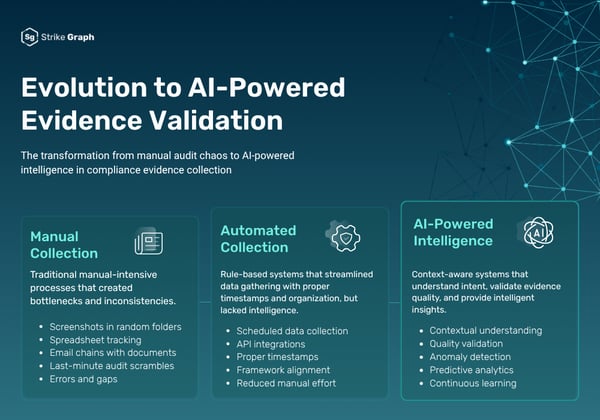
AI-native compliance management software can now reduce this burden by automatically ingesting the correct evidence item, interpreting the information, and mapping to the correct control or CMMC practices.
How AI helps:
- Automatically classifies artifacts
AI recognizes whether a document is a policy, configuration output, screenshot, or access report—eliminating hours of manual sorting.
- Extracts relevant compliance data
Using OCR and semantic understanding, AI pulls key details out of PDFs, images, JSON, CSVs, and cloud configurations.
- Maps evidence to CMMC practices
Models trained on NIST 800-171 requirements can match artifacts directly to the correct practices and objectives.
- Evaluates completeness and relevance
AI identifies outdated records, missing fields, or incomplete evidence that could cause audit findings.
- Detects inconsistencies and duplicates
Conflicting or redundant evidence is flagged early, reducing noise and audit confusion.
Scenario:
A mid-size defense contractor preparing for CMMC Level 2 needs to gather evidence from engineering, HR, IT, and cloud operations. Historically, this meant multiple rounds of back-and-forth emails and spreadsheets. With an AI-driven system, the team uploads artifacts directly (ideally, into an AI-native compliance management software) and receives instant analysis showing which items satisfy requirements and which are incomplete. Instead of taking three weeks, the evidence review takes less than a day—and outdated artifacts are flagged before they become a problem.
2. AI speeds up gap identification with prescriptive guidance
Most organizations don’t struggle because they lack controls; they struggle because they don’t know which controls satisfy which requirements or how to close the gaps. Understanding what’s missing—and what to fix next—is essential for moving quickly toward readiness. Manual gap assessments involve reading hundreds of pages of policies, reviewing system configurations, and interpreting framework requirements.
AI improves this slow, error-prone work by analyzing policies, configurations, and controls and providing clear, prioritized recommendations.
How AI helps:
- Reads policies like a human auditor
AI identifies missing sections (e.g., password rotation, logging retention, access governance) based on CMMC’s expected language.
- Analyzes system configurations
It interprets IAM settings, cloud policy files, group permission models, firewall settings, and log exports.
- Correlates evidence to requirements
AI understands the structure of CMMC and can tell you exactly what requirement each piece of evidence satisfies.
- Prioritizes findings based on audit impact
Critical issues rise to the top, helping teams focus on high-value remediation.
- Provides prescriptive remediation actions
Beyond identifying gaps, AI can recommend what to fix, how to fix it, and which systems are affected.
Scenario:
A fast-growing SaaS company working with DoD suppliers believes they meet most CMMC practices but isn’t sure how their current controls map to the framework. After uploading their existing documentation and configurations into an AI-powered assessment tool, they instantly receive a full compliance map, highlighting which requirements are already met and which need remediation. The AI flags missing MFA coverage on legacy systems and identifies outdated policy language that would cause audit friction—giving the team a precise, actionable plan.
3. AI enables continuous readiness—not just point-in-time preparation
CMMC compliance is not static. Organizations must maintain strong, consistent security practices to remain ready for assessments and ongoing DoD engagement. Not maintaining compliance will result in fines. Traditional compliance workflows—built around annual or semi-annual reviews—often fail to catch drift early enough.
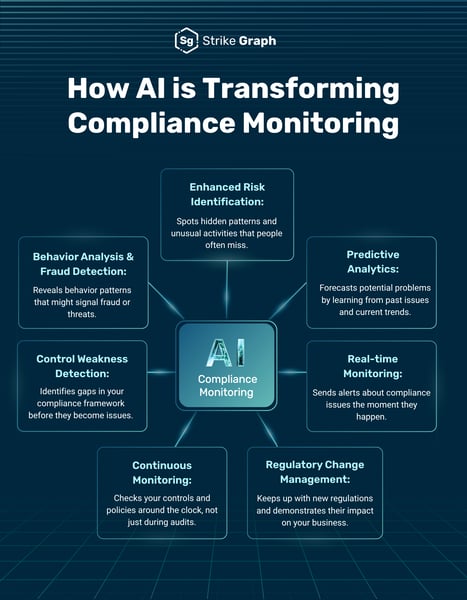
AI-enabled monitoring changes that by detecting deviations in controls, policies, or configurations as they happen.
How AI helps:
- Monitors configurations for drift
AI reviews system outputs or integrations to detect changes that violate compliance baselines (e.g., MFA disabled on admin accounts).
- Evaluates control performance continuously
It checks whether regular tasks—like access reviews or incident response updates—are being maintained.
- Updates evidence freshness automatically
AI monitors versioning and timestamps to flag stale or outdated proof.
- Maintains a live compliance score
Instead of waiting for periodic reviews, AI generates an always-current readiness score.
- Reduces surprise failures
Issues are surfaced at the moment they arise—not at audit time.
Scenario:
An organization passes its internal readiness review but, months later, a new identity provider rollout inadvertently disables MFA on a subset of administrative accounts. With an AI-driven continuous monitoring layer, the issue is surfaced within minutes, not discovered during the next annual review. The security team corrects the misconfiguration immediately, preventing a future non-conformity and ensuring ongoing alignment to CMMC access control practices.
4. AI accelerates documentation and policy creation
CMMC requires substantial documentation: system security plans, policies, procedures, control narratives, and more. Drafting these materials from scratch is labor-intensive and often requires specialized expertise. Adopting pre-built templates can also cause headaches by forcing changes to your organization when existing practices may have met the requirements.
AI speeds this up significantly by helping teams draft, structure, and refine documentation based on best-practice templates and framework-specific expectations.
How AI helps:
- Drafts framework-aligned policies
AI generates complete, structured policies based on CMMC practices, reducing writing time dramatically.
- Identifies missing or outdated documentation
AI analyzes existing documents to spot missing controls, legacy references, or insufficient detail.
- Ensures consistency across all documents
Terminology, definitions, and sections remain uniform—avoiding contradictions during audits.
- Creates detailed control narratives
AI can generate narratives using existing system data, turning technical configurations into audit-ready explanations.
- Updates documentation automatically
When systems change, AI suggests updates to affected policies and SSP sections.
Scenario:
A small engineering consultancy with no dedicated compliance team needs to produce more than a dozen policies to meet CMMC requirements. Instead of starting from a blank page, they use an AI-assisted writing tool that generates tailored drafts, ensures consistency across all documents, and highlights missing sections. What originally would have taken months is reduced to a week—without sacrificing quality or audit readiness.
How to Start Implementing AI in Your CMMC Program
Whether you’re just starting your compliance journey or modernizing an existing program, you don’t need to guess at the next step.
That’s exactly why we created the free CMMC Implementation Guide—a practical, step-by-step resource that walks you through scoping your environment, prioritizing the controls and processes, centralizing evidence and documentation for stronger automation, building repeatable workflows, preparing your team for AI-enabled readiness, and avoiding the common pitfalls that slow organizations down.
👉 Download the free CMMC Implementation Guide to get the full roadmap:
https://www.strikegraph.com/free-cmmc-implementation-guide
This resource will give you everything you need to start implementing AI in your compliance program with clarity, confidence, and momentum.
What’s Next: The Future of AI in CMMC Compliance
The future of CMMC isn’t just about efficiency gains—it’s about a fundamental shift toward intelligent, predictive, and continuously operating compliance. As highlighted in Strike Graph’s broader research on AI in GRC, organizations are moving away from reactive, point-in-time audits and toward always-on visibility. CMMC will follow the same trajectory.
AI will increasingly enable predictive compliance, identifying risks or misconfigurations as soon as they appear. Instead of waiting for periodic readiness reviews, organizations will rely on real-time validation that flags issues before they become audit findings. This shift transforms CMMC from an annual project into a sustained posture of operational maturity.
We’ll also see AI evolve from simple pattern recognition into systems that truly understand compliance context. Most compliance consultants focus on a single framework. But AI tools, when built well, can store much more information than the human mind. These models will interpret frameworks holistically, map controls across CMMC, NIST 800-171, ISO, and SOC 2, and provide nuanced recommendations that account for an organization’s unique environment. For companies managing multiple standards simultaneously, this cross-framework intelligence will simplify operations and reduce duplication of effort.
As AI becomes more capable, it will take on deeper forms of automated control testing. Instead of manually verifying controls, AI will continually analyze logs, configuration changes, and system behavior to confirm that controls are functioning correctly. Documentation will evolve as well, with dynamic SSPs and auditor-ready packages generated automatically as controls and systems change.
CMMC will also benefit from more advanced, data-aware models. AI will help organizations protect Controlled Unclassified Information (CUI) by detecting when sensitive data is stored incorrectly, shared improperly, or drifting into non-compliant systems. This shifts compliance from static rule-checking to intelligent data protection.
Throughout this evolution, AI won’t replace human judgment—it will elevate it. Compliance leaders will spend less time on repetitive administrative work and more time on strategy, prioritization, and risk-aligned decision-making. In the future, the strongest CMMC programs will be those that combine human expertise with AI-powered precision and speed.
How Strike Graph Accelerates CMMC Readiness With AI
Strike Graph brings AI advancements directly into the CMMC workflow through purpose-built, secure, and audit-ready capabilities. Strike Graph’s CMMC solution solves for the three key CMMC deliverables: a System Security Plan, an SPRS score, and a Plan of Action & Milestones. Our platform is designed to remove uncertainty, eliminate manual lift, and help teams achieve—and maintain—readiness with far greater speed and clarity.
Two innovations in particular, Verify AI and the AI Security Assistant, make Strike Graph uniquely effective for organizations preparing for CMMC.
Verify AI, our automated evidence analysis engine, accelerates readiness by collecting evidence, interpreting its contents, and validating them against control requirements. In this case, CMMC practices. Instead of manually reviewing screenshots, logs, policy files, and configuration outputs, Verify AI evaluates completeness, flags gaps, detects inconsistencies, and keeps evidence aligned with the framework in real time. This dramatically reduces the burden on security and compliance teams while strengthening audit confidence.
Complementing this, our AI Security Assistant gives organizations an intelligent guide throughout their compliance journey. It answers questions about CMMC requirements, helps interpret complex controls, recommends next steps, and even assists in drafting policies, procedures, and SSP language tailored to the organization’s environment. For teams that don’t have deep CMMC expertise—or are stretched thin—the AI Security Assistant becomes a force multiplier that improves accuracy and speeds decision-making.
Together, these capabilities help organizations streamline every stage of CMMC readiness: automating evidence operations, simplifying gap remediation, improving documentation quality, and maintaining continuous alignment with the framework. The result is a faster, more predictable path to certification—and a compliance program that scales alongside the organization’s security maturity.
To learn how to transform and accelerate your CMMC certification, book time with one of our compliance experts at www.strikegraph.com/demo.







/Blog%20Graphic%20%5BAI-and-automation-tag-banner-SG%20blog-Oct2024%5D.png)
.png?width=600&height=600&name=Blog%20Featured%20Image%20600x350px%20(29).png)