Executive summary:
To get funding for artificial intelligence in third-party risk management (TPRM), leaders need to make a strong, data-backed case. This guide explains how to calculate return on investment (ROI) by considering cost savings, efficiency improvements, and reduced supply chain risk. We provide a step-by-step plan for building your proposal, tailoring your case to different stakeholders, and establishing robust AI governance with human oversight. With our customizable presentation kit, you can address executive concerns, compare the costs of automation and manual work, and transition your vendor risk management program to a scalable, AI-based solution.
Key business drivers for AI in TPRM
The key business drivers for AI in TPRM are resource optimization, financial risk mitigation, portfolio scalability, standardized audit trails, and operational resilience. AI replaces manual spreadsheet tracking with machine learning that scans thousands of vendor data points, helping teams make faster, more informed decisions about vendor security and reliability.
The technology helps control costs by quantifying liabilities. It identifies fiscal risks, including non-compliance fines under DORA or GDPR and direct costs from service disruptions. Early detection enables companies to avoid significant, unexpected expenses from third-party security failures or operational issues.
Executives consider five key operational and financial factors when evaluating the return on investment for AI in TPRM:
- Resource optimization: AI eliminates repetitive tasks in manual reviews. Automating data extraction from security frameworks such as SOC 2 and ISO reports enables teams to focus on strategic risk mitigation. The staff can then prioritize complex vendor negotiations rather than manually tracking questionnaire responses.
 Andy Cottrell, CEO of Truvantis, frames the underlying problem this way: "We've seen this from the vendor side. A vCISO client was fielding SIG Lite questionnaires and lengthy security forms throughout their sales cycle for a service that posed very little actual risk to their customers." His diagnosis: "The real issue isn't speed versus rigor. It's that TPRM requests are rarely calibrated to actual risk."
- Financial risk mitigation: Major third-party incidents, such as a data breach, regulatory fine, or operational downtime, can lead to immediate financial exposure. AI detects technical and compliance vulnerabilities early. For example, you might detect a vendor's lack of encryption before a breach occurs. Ensuring partners meet strict compliance mandates may help avoid multimillion-dollar penalties. Or identifying a vendor’s financial instability or lack of disaster recovery planning could help you avoid downtime.
- Comprehensive portfolio scalability: Most manual programs can only audit the highest-tier vendors. AI allows organizations to scale oversight to the entire vendor base without a corresponding increase in compliance headcount. This ensures that low-spend vendors do not become high-risk entry points for cyberattacks.
- Standardized audit trails: Manual reviews are prone to human fatigue, leading to inconsistent risk scoring. AI applies consistent logic to every document, creating a defensible, machine-generated audit trail. This is essential for internal audits or regulatory inquiries and ensures compliance does not depend on individual interpretation.
- Operational resilience: Static, point-in-time assessments quickly become outdated. AI enables continuous monitoring by processing real-time data, including negative news and updated security ratings. This shifts the program from reactive annual checks to proactive defense, delivering immediate alerts on market changes or emerging threats.
Use cases for AI in TPRM
The top use cases for AI in TPRM are automated security questionnaires, dynamic risk scoring, continuous monitoring, automated remediation tracking, and enhanced due diligence. Together, these applications streamline vendor onboarding, replace static audits with real-time threat detection, and help teams catch costly supply chain problems early.
Once the initial assessments are complete, AI continues to add value by automatically tracking remediation. Rather than following up with vendors for security updates, automated workflows help ensure compliance and keep SLAs on track. This saves time on admin tasks, lowers labor costs, and helps protect the business from new supply chain risks.
Using AI throughout the third-party risk process leads to several important benefits:
- Automated evidence validation: Artificial intelligence shifts vendor assessments from self-attestation to objective verification. Systems test actual compliance documentation, such as SOC 2 reports and internal security policies, directly against your specific requirements, automatically flagging missing controls without requiring manual PDF review.
- Automated security questionnaires: Generative AI can quickly gather and check data from long submissions, making vendor onboarding easier. This reduces manual review time and accelerates procurement, enabling teams to complete contracts more quickly while still meeting compliance and privacy requirements.
- Dynamic risk scoring: AI considers many factors to provide an accurate risk assessment. This ongoing process automatically sorts vendors, helping teams focus on the highest risks and use resources where they matter most.
- Continuous monitoring: Rather than checking internal vendor compliance documents, this function scans external data sources in real time for emerging cybersecurity threats, negative news, or financial instability. This provides proactive alerts to protect the business from unforeseen market disruptions.
- Automated remediation tracking: Systems send smart alerts and automated workflows to ensure third parties fix problems quickly. This reduces administrative work, so analysts can focus on larger risk issues rather than routine follow-ups.
- Enhanced due diligence: Advanced algorithms review unstructured data like negative news and legal documents to provide thorough due diligence. This detailed analysis finds hidden risks and complex connections, helping prevent reputational harm and costly compliance issues.
How to make a business case for AI in TPRM, step-by-step
To make a business case for AI in TPRM, identify your main operational problems, establish a current-state baseline, choose high-impact use cases, define governance controls, estimate financial value, account for implementation costs, propose a phased rollout, and package the recommendation for leadership with clear ROI projections.
A strong proposal for leaders should clearly show how artificial intelligence can solve specific problems in your vendor risk management program. Measure your current inefficiencies and connect your solutions to key goals, such as resilience and compliance monitoring. This gives decision-makers the financial details they need to approve your investment.
Step 1: Define the TPRM problems you need to solve
Begin by finding the main problems in your current third-party risk management process. Many programs face slow vendor onboarding, poor risk visibility, and uneven compliance checks. These issues can pose serious cybersecurity risks and lead to financial penalties.
Consider these common operational problems to define your baseline:
- Assessment delays: Manual questionnaire reviews cause severe bottlenecks during procurement and onboarding.
- Coverage gaps: Limited headcount forces teams to audit only critical suppliers, leaving fourth-party risk unaddressed.
- SLA violations: Lack of automated remediation tracking results in missed internal deadlines and unmitigated vulnerabilities.
Step 2: Establish your current-state baseline
To estimate your future return on investment, measure your current inefficiencies. Track your vendor coverage rate, how many days it takes to finish due diligence, and how often manual reviews cause missed service-level agreements.
Step 3: Choose the AI use cases with the highest impact
Choose machine learning applications that give quick, clear results. Focus on tasks that require significant effort, such as automating security questionnaires or running dynamic risk assessments. These usually cut costs fastest and show early wins to executives.
Step 4: Define governance, human oversight, and approval controls
Regulators expect transparency when you use generative AI or machine learning. Set up a clear governance plan that explains how your organization checks automated decisions. Ensure your workflows require experts to review critical cases and approve risk decisions for key vendors.
Implement these controls to ensure responsible automation and regulatory compliance:
- Escalation triggers: Route ambiguous or high-risk vendor responses directly to senior analysts.
- Periodic model audits: Schedule regular reviews to detect and correct algorithmic bias.
- Explainability requirements: Use transparent models that provide clear rationale for every assigned risk score.
Step 5: Estimate the value in financial and operational terms
Figure out your return on investment by comparing your current costs to your expected savings. Point out how automation lowers the cost of each assessment. Show executives that you can cover more vendors in your supply chain without needing more compliance staff.
For example, demonstrate how replacing a manual inherent risk assessment with automated dynamic scoring frees up hundreds of analyst hours. Present this reclaimed time as a direct reduction in operational costs and a measurable increase in overall team capacity.
Concrete client outcomes can strengthen the case further. Cottrell describes one example: "We put together a tight evidence package: a summary from their most recent penetration test, the Independent Service Auditor's Report from their SOC 2, and a security whitepaper tying it all together. Responding with that bundle passed review almost every time and shortened their sales cycle considerably."
Step 6: Account for implementation costs and AI-related risks
A strong business case should address possible challenges up front. List the costs for software licenses, data integration, and training. Point out AI risks like data privacy issues or errors, and explain how you will manage these to reassure stakeholders about security.
Step 7: Propose a phased rollout
Suggest rolling out the plan in stages to show quick results and limit disruption. Start with tasks that require the most effort, such as document review or initial risk checks. This careful approach builds trust and gets early wins before you expand the technology to the whole supply chain.
A standard phased rollout might follow this structure:
- Phase 1 (Months 1-2): Automate data extraction for standard security questionnaires to accelerate vendor onboarding.
- Phase 2 (Months 3-4): Activate continuous monitoring for your top-tier, business-critical suppliers.
- Phase 3 (Months 5-6): Deploy dynamic risk scoring and automated remediation tracking across the broader vendor portfolio.
Step 8: Package the recommendation for leadership
Show your findings as a smart investment in your organization’s resilience, not just a tech upgrade. Explain how reducing supply chain risk protects revenue and avoids compliance penalties, offering clear financial benefits that matter to the executive board.
AI in TPRM case studies
Companies that have replaced manual vendor assessments with Strike Graph’s AI-native platform have seen immediate operational improvements. Automating evidence evaluation and risk scoring eliminates severe bottlenecks, allowing risk management teams to process vendor data accurately and maintain compliance.
Here are three case studies of companies using AI for third-party risk management:
- Black Mountain Software, a provider of ERP software for local governments and schools, improved efficiency with Strike Graph’s AI Security Assistant, significantly reducing questionnaire completion time. The compliance team previously dedicated several hours to individual forms. Now, Verify AI maps vendor responses to specific control lists, processing requests in minutes. Additionally, direct integrations automatically pull recent files, halving manual evidence collection.
- Nation Safe Drivers, a provider of white-label products for auto finance and insurance and roadside assistance, compressed vendor assessment cycles from 30 days to under a week using Strike Graph’s Trust Chain. By letting Verify AI automate evidence evaluation and flag gaps, Risk Management Director Donna Vazquez eliminated manual follow-ups. “The process was so efficient with Trust Chain that I ran out of vendor due diligence in the first two months,” she said. Additionally, the company now uses the platform's dashboards to report vendor risk posture during quarterly business reviews.
- An enterprise manufacturing organization used Verify AI for autonomous evidence validation, eliminating its bottleneck of manual reviews. Before that, its procurement team could manually assess only about 80 of its 400 vendors. The team now uses Strike Graph’s Trust Chain to manage vendor communications end-to-end, allowing full supply chain oversight without additional team members.
How to calculate ROI for AI in TPRM
To determine the return on investment (ROI) for adding Artificial Intelligence to your Third-Party Risk Management (TPRM) program, focus on real numbers instead of buzzwords. AI in TPRM is valuable because it automates the most time-consuming tasks, such as reading lengthy SOC 2 reports, answering security questionnaires, and monitoring vendor risk.
Strategic investment patterns validate the shift toward positioning intelligent tools at the center of risk oversight. As KPMG analysts detail in their November 2025 report, “Bridging gaps and building guardrails,” 69 percent of global CEOs plan to allocate up to 20 percent of their budgets to AI this year. Most expect these investments to deliver measurable financial returns within three years.
To see if an AI tool is worth the cost, use the standard ROI formula: ROI = (Total Benefits − Total Costs) / Total Costs) × 100.
Below is a simple, step-by-step guide to help you calculate the exact costs and benefits of using AI in TPRM.
Step 1: Baseline your current state
Start by reviewing your current manual workflows to create a clear, data-based starting point. You need to know exactly what your current TPRM processes cost before you can show how much time or money an AI tool might save.
Gather 12 to 24 months of historical data, focusing on the following core metrics:
-
Vendor volume: How many vendors do you assess annually, categorized by risk tier (Critical, High, Medium, Low)?
-
Time per assessment: How many hours does your team spend manually sending, chasing, reading, and validating security questionnaires or evidence?
-
Labor costs: What is the fully loaded hourly rate (including benefits) of the analysts and compliance officers executing this work?
-
Historical incident costs: Have you faced any financial losses, compliance fines, or downtime due to a third-party breach in the past?
Step 2: Calculate total costs (the investment)
Figure out the real total cost of ownership by looking beyond just the software’s price. Include all costs for implementation, training, and ongoing operations. A good ROI model is only possible if you are open about any hidden costs of adding a new AI platform to your current systems.
Make sure your cost analysis includes these direct and indirect investment areas:
- Software licensing: The annual subscription or usage-based fees for the AI TPRM platform.
- Implementation and integration: Costs for data migration, setting up APIs to connect with your procurement systems, and initial workspace configuration.
- Training and change management: The cost of the hours your team spends learning to use the new system and building trust in the AI’s results.
- Ongoing maintenance: Fees for managed services or the time your IT team spends maintaining and updating the platform.
Step 3: Quantify total benefits (the return)
Break down your expected returns into direct cost savings and preventative cost avoidance to make a strong business case for leadership. Avoiding a major data breach is the long-term goal, but getting executive support usually depends on showing the real money you can save right now.
Find your direct cost savings by looking at the money you will no longer spend on manual work and outside services:
- Labor savings: Figure out how many hours AI will save (usually a 60% to 80% cut in manual review time) and multiply that by your team’s hourly rate, including benefits.
- Faster onboarding: Estimate how much money you gain by speeding up vendor procurement, which helps new projects start earning revenue sooner.
- Consultant reductions: Subtract the fees you now pay to outside auditors, contractors, or service providers that the AI platform will replace.
Estimate your preventative cost avoidance by considering the costly problems and penalties the AI platform can help you avoid:
- Breach avoidance: Estimate how much a third-party data breach could cost (including legal fees and lost business), then multiply that by the risk reduction the AI tool offers through ongoing monitoring.
- Compliance penalties: Include the highest possible regulatory fines and audit failure costs you can avoid by using stronger, automated oversight for frameworks like DORA, GDPR, or HIPAA.
Step 4: Run the numbers (a simple example)
Support your final pitch by putting your confirmed metrics into the standard ROI formula to get a clear percentage that leadership can understand. Make your numbers solid by listing the baseline metrics you used before showing the final calculation. Here’s an example for a mid-sized company that reviews 500 vendors each year:
- The baseline: The company’s TPRM team used to spend 8 hours per assessment (4,000 hours total) at $75 per hour, totaling $300,000 per year.
- The costs: They buy an AI TPRM platform for $50,000 and spend $2,000 on implementation, for a total investment of $52,000.
- The benefits: The AI tool cuts manual assessment time by 70%, saving $210,000 in labor costs, and eliminates $40,000 in consultant fees, for a total benefit of $250,000 in cost savings.
- The calculation: Subtract the $52,000 cost from the $250,000 benefit to get $198,000. Divide that by the $52,000 cost and multiply by 100 to show a 396% ROI in the first year.
What to include in your AI-in-TPRM ROI model
A complete AI-in-TPRM ROI model should include historical baseline costs, total AI investment, projected productivity gains, direct cost savings, and cost avoidance metrics. Together, these elements show leadership the true cost of current manual processes alongside the financial benefits of automation, making the return on investment clear and defensible.
Here’s a more detailed view of these important points:
- Historical baseline costs: Record how many staff hours are spent on manual vendor reviews, the full cost of employee time, and what you currently pay for compliance software.
- Total AI investment: List all costs for the new platform, such as licensing, integration, and change management.
- Projected productivity gains: Point out the time you expect to save throughout the vendor process, especially during onboarding, ongoing risk checks, and audit preparation.
- Direct cost savings: Show the money saved by cutting manual admin work and removing the need for costly outside consultants.
- Cost avoidance metrics: Explain how better vendor oversight can help avoid regulatory fines and expensive breach fixes, and estimate the financial impact.
How to present ROI assumptions credibly
To make your ROI assumptions more credible, use 12 to 24 months of your own historical data for your financial projections. Clearly separate direct labor savings from estimated risk reduction savings. Be cautious when estimating the likelihood of a third-party breach or a future regulatory penalty, and always provide a clear payback period.
How to tailor the business case for different stakeholders
You can tailor the business case for different stakeholders by connecting AI's benefits to what each department values most: financial returns for finance, defensible audit trails for risk and compliance, threat detection for security, faster onboarding for procurement, and long-term resilience for executive leadership.
Focus your message on these key areas to get support from across the organization:
- Procurement: Present AI as a way to speed up vendor onboarding and avoid delays that can block deals. Explain how making things easier for vendors, like using AI to help fill out or review questionnaires, helps build better relationships and gets value faster. As Cottrell puts it, that's "exactly the gap smart automation closes, both in setting the right depth of investigation and in analyzing the responses."
- Finance: Stress the real money saved, lower cost per assessment, and a clear payback period. Show how the investment covers its own costs by eliminating unnecessary manual work and costly consultant fees.
- Risk and compliance: Focus on closing gaps and making sure evaluations are consistent and defensible. Show how AI gives a full audit trail and real-time alerts for regulatory changes, helping the program move from reactive to well-managed.
- Security: Provide examples of how using AI will give better visibility into cybersecurity risks across the entire supply chain, including risks from your vendors’ vendors. Emphasize that machine learning can spot threat patterns that manual reviews might miss.
- Executive Leadership: Present AI as a key part of risk management that helps the company stay strong over time. Link your proposal to big-picture goals, such as avoiding financial losses and protecting the brand from third-party issues.
How to answer objections to the business case for AI-TPRM
To answer objections, focus on concerns like automation reliability, rollout complexity, and whether processes are ready. Highlight strong governance, required human oversight, and realistic, data-supported ROI. Addressing these points early builds executive trust and keeps approvals moving forward.
Be ready to answer these common questions from executives:
- "Why now instead of waiting six months?" The number of vendors is rising faster than our team can keep up. Waiting to adopt AI-TPRM will widen coverage gaps and raise the risk of expensive security issues.
- "Is the implementation burden too high for our team?" We suggest a phased rollout that starts with quick wins. We’ll use managed services or AI tools that fit easily into our current workflows.
- "Is our data quality good enough for AI?" AI can help spot and correct data issues. We’ll begin with a baseline sprint to ensure our main vendor records are accurate before moving forward.
- "Can we trust AI to make risk decisions?" AI will not take over human judgment. It points out unusual patterns so our experts can focus on the most important risks.
- "What if the regulatory landscape changes?" The platform uses a flexible AI governance framework that can add new requirements, like those from the EU AI Act, as they come up.
AI-TPRM business case presentation kit
To accelerate your internal approval process, we have developed a comprehensive AI-TPRM business case presentation kit. This resource includes a slide deck designed for executive presentations, a detailed cost-benefit and ROI worksheet to quantify financial impact, and an AI readiness checklist to evaluate your current organizational infrastructure.
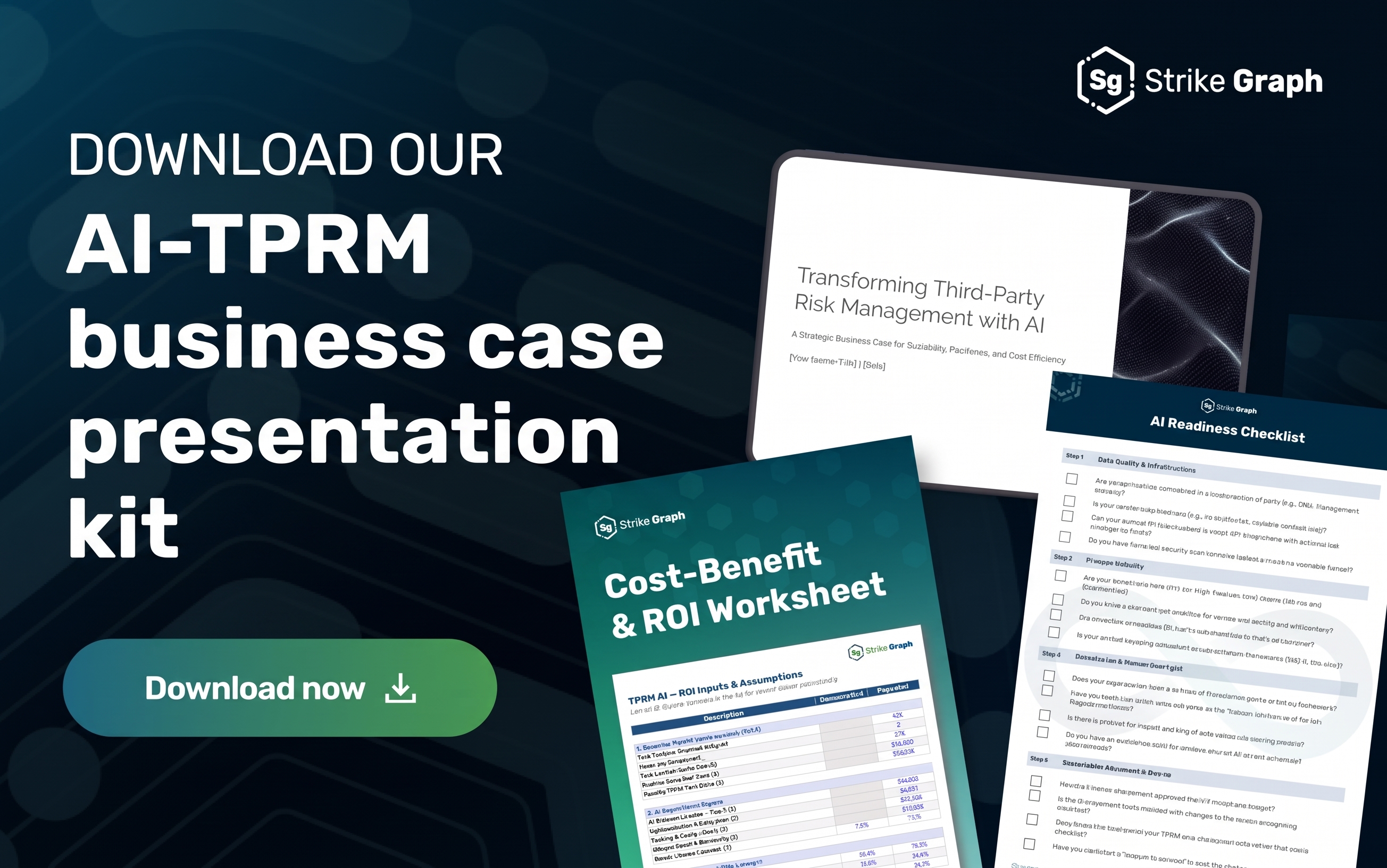
Click here to download our complete AI-TRPM Business Case Presentation Kit, or access each individual file below.
Mistakes to avoid in presenting an AI-TPRM business case
The biggest mistakes to avoid in presenting an AI-TPRM business case are relying on vague use cases, skipping a current-state baseline, ignoring governance and human oversight, and making unrealistic ROI claims that overlook implementation costs or your team's learning curve. Each of these can lead to immediate executive rejection.
Furthermore, failing to address governance and human oversight early creates significant compliance concerns. Unrealistic ROI claims that ignore implementation costs or the learning curve of your team undermine your credibility. A successful proposal must balance ambition with a realistic assessment of operational readiness and risk mitigation strategies.
Cost of AI TPRM vs. non-AI TPRM
Traditional TPRM programs often have hidden costs because they rely on manual work, cover fewer vendors, and slow down procurement. AI-assisted TPRM costs more upfront for technology, but it lowers the cost per assessment, reduces the need for more staff, and supports real-time monitoring.
Using spreadsheets and manual processes usually means only a small part of the vendor list is reviewed, which can leave the company open to supply chain risks. These delays can also slow down important procurement and revenue activities. With AI-assisted TPRM, data extraction and risk scoring are automated, so organizations do not need to keep hiring more staff as their vendor list grows. This approach makes reviews more consistent and allows for real-time monitoring, which helps prevent expensive security problems.
Is your organization ready for AI in TPRM?
Your organization is ready for AI in TPRM when it has high data quality, mature and documented processes, executive buy-in with budget commitment, technical infrastructure that supports AI integration, and the staffing or partners needed to interpret AI-driven insights and maintain responsible oversight.
Assess your organizational readiness by evaluating these critical components:
- Data quality: Verify that your vendor records are standardized, cleansed, and integrated across risk, procurement, and finance functions.
- Process maturity: Determine whether your current TPRM workflows are documented and standardized enough to be converted into automated, real-time risk-scoring models.
- Executive buy-in: Secure a commitment for budget allocation and a strategic mandate that treats third-party risk with the same rigor as other enterprise risks.
- Technical infrastructure: Confirm that your existing IT infrastructure can support AI deployment and integrate multiple data sources through APIs or RPA.
- Staffing and expertise: Identify the internal talent or managed services partners needed to interpret AI-driven insights and maintain responsible AI oversight.
What to evaluate in AI-powered vs. AI-native TPRM solutions
When comparing AI-powered and AI-native TPRM solutions, look at factors like how the system is built, how well it can handle tasks on its own, how it protects data, and how transparent it is about regulations. AI-powered tools usually add machine learning to older systems for simple summaries, while AI-native platforms use AI at their core to handle full processes such as collecting evidence and running internal audits.
AI-powered tools usually add machine learning to existing systems and often depend on outside APIs, which can create security risks. These add-on solutions mainly help with summarizing data instead of handling more complex, complete tasks.
AI-native solutions build artificial intelligence into the main system so they can handle tasks like collecting evidence and running internal audits on their own. It’s important to choose platforms that keep sensitive vendor data safe. Native systems also offer more transparency and a better understanding of regulatory needs.
How Strike Graph’s AI-native platform streamlines your TPRM
Strike Graph provides a scalable, AI-native platform that eliminates the administrative friction of traditional third-party risk management. By utilizing an autonomous core engine to review evidence and handle routine questionnaire responses, teams drastically reduce manual assessment cycles without requiring a standalone, single-purpose software subscription.
To support this, Strike Graph’s Trust Chain solution for TPRM shifts vendor assessment away from self-reported questionnaires to a "verify-then-trust" model. The system uses AI to evaluate actual security documents against your specific compliance requirements. By continuously testing real evidence rather than relying on static answers, organizations can base third-party risk decisions on objective data while significantly reducing assessment times.
Our AI-native architecture enables the platform to perform autonomous actions, such as executing complete internal audits, rather than simply flagging issues for manual review. This approach allows organizations to operationalize vendor oversight directly within existing security workflows, improving consistency while significantly reducing the unit cost of each individual assessment.
Consolidating your program into a comprehensive compliance platform provides the precise tools needed to mitigate supply chain risk. Strike Graph automates control mapping across more than 25 frameworks, ensuring a single vendor security measure satisfies requirements for SOC 2, ISO 27001, and GDPR.
This unified method accelerates evidence collection by automatically verifying third-party audit reports and certifications. By eliminating redundant manual reviews, Strike Graph reduces tedious administrative overhead and builds stronger trust with enterprise customers through rapid turnaround times, keeping your organization continuously audit-ready.
Schedule a demo today to see how Strike Graph can help you use AI to automate your vendor risk management and maintain compliance with confidence.
Frequently asked questions
How do you make the case for AI if your TPRM program is immature?
Starting with artificial intelligence in an immature program prevents the entrenchment of inefficient manual habits. An AI-native framework provides the digital backbone needed to standardize vendor risk management from the beginning. It allows organizations to scale rapidly by automating the most labor-intensive tasks without adding headcount.
What if leadership is worried about AI risk or black-box decisions harming your TPRM program?
Address these concerns by emphasizing explainable AI (XAI) and robust human oversight. Modern AI-native platforms provide clear audit trails and rationales for every risk score. This ensures leadership remains in control, as human intelligence is used to validate flagged anomalies and make final ethical decisions.
Do you need a full AI-TPRM platform, or can you start with a narrower workflow?
While a full platform offers maximum integration, starting with narrow workflows—such as automating security questionnaires or due diligence—is a practical way to prove immediate return on investment. High-impact use cases deliver rapid operational savings, building the internal confidence needed to eventually scale into a comprehensive, proactive risk program.





/ebook-ctas_340x500_in-house-ai-compliance.webp)
.jpg?width=600&height=600&name=Blog%20images%20(1).jpg)
.png?width=600&height=600&name=Blog%20Featured%20Image%20600x350px%20(30).png)