
February 9, 2023
Why an AI-native architecture matters in compliance management
Most compliance tools that claim to be "AI-powered" retrofit existing systems rather than developing new ones. They rely on external AI platforms to add simple features, layering text interfaces or writing tools onto databases never designed for AI. These tools can provide quick answers but struggle with depth, accuracy, and data security.
Strike Graph took a different approach. From day one, our founders built a graph-based data structure capable of modeling the complexity of modern compliance programs. This design enables our AI to reason across interconnected relationships and perform actual compliance tasks—like evidence validation and control testing—without sending data outside the platform.

We secure data: No third-party APIs, no exceptions.
Data never leaves the platform (no third-party APIs). Your sensitive compliance information stays encrypted and segmented within our self-hosted environment. While competitors send your data to OpenAI, Anthropic, or Google for processing, Strike Graph's models run entirely on our infrastructure.
The graph-based model delivers measurable precision
The AI understands relationships, not just keywords. Our graph-based ontology enables the system to trace how evidence validates controls, how controls mitigate risks, and how frameworks depend on both—delivering predictions and validations with measurable precision.
Beyond AI suggestions: AI that actively performs compliance work
It performs tasks—validating evidence, testing control coverage, alerting risk exposure, and predicting audit outcomes. Strike Graph's agentic AI doesn't just highlight problems or provide suggestions. Verify AI executes the work of an internal auditor, while Security Assistant, a compliance consultant, recommends fixes and can even launch remediation workflows at a click.
The foundation: Strike Graph's graph-based data ontology advantage
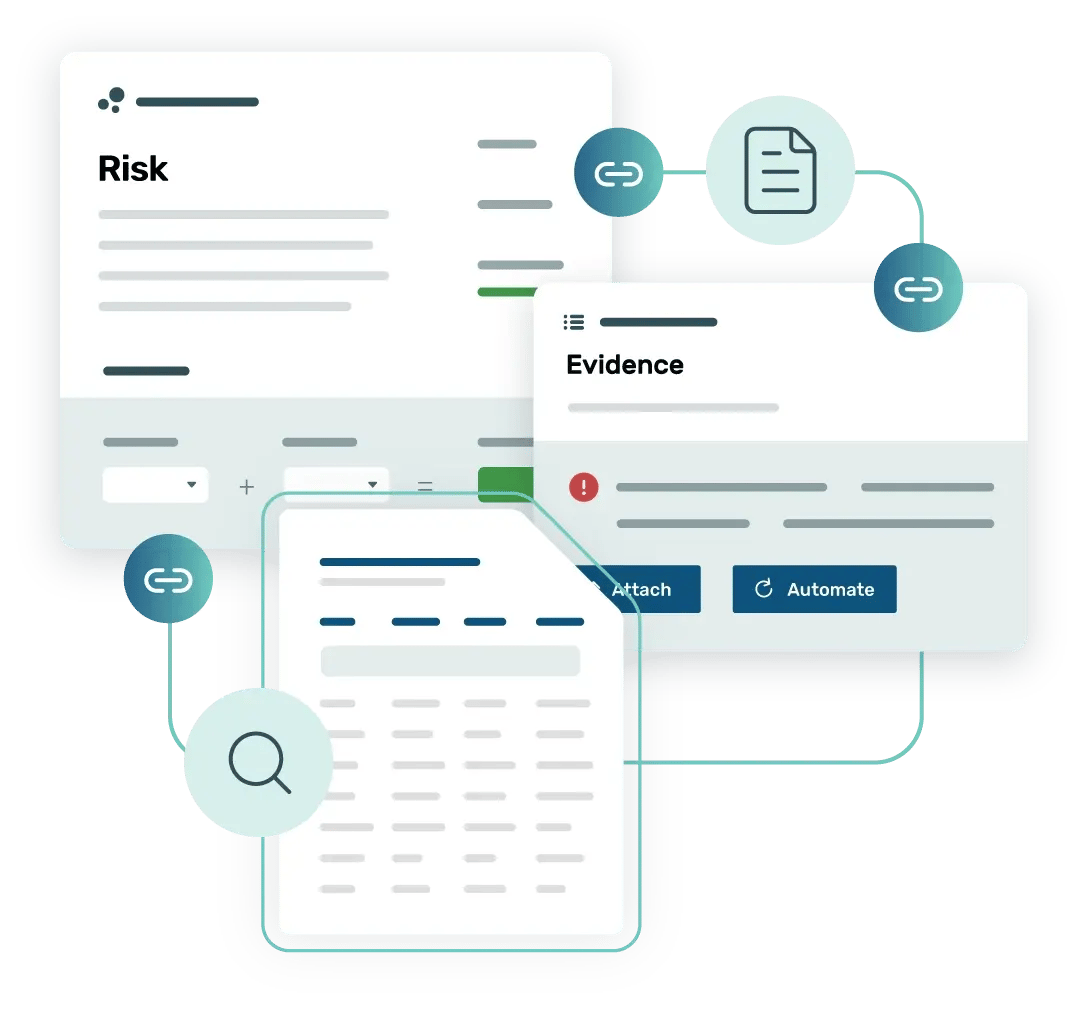
At the core of Strike Graph's platform is a graph-based data ontology that models how your security and operations actually work. Risks, controls, evidence, teammates, and frameworks aren't siloed—they're linked in many-to-many relationships that define how security programs operate in the real world.
This data model provides our AI with an accurate and comprehensive understanding of context. It knows that evidence validates controls, that controls mitigate risks, and that frameworks depend on both. That context enables more accurate predictions, smarter automation, and seamless reuse of controls across multiple frameworks or certifications like NIST, SOC 2, ISO 27001, HIPAA, or CMMC.
Traditional web applications are not designed to express meaning between elements; Strike Graph's ontology encodes it. That difference powers every intelligent feature we deliver.
How Strike Graph’s data ontology creates architectural compliance advantages
In Strike Graph, risks, controls, evidence, and frameworks exist as nodes in a connected graph with explicit, typed relationships between them:
- A Risk is mitigated by a Control
- An Evidence artifact validates a Control's implementation
- A Control is exercised in support of a specific Framework Requirement
- Multiple Controls might collectively address a single Framework Requirement
- Evidence can serve multiple validation purposes across many frameworks
These aren't semantic tags or metadata—they're structured relationships that allow our models to reason about compliance states with precision that would be impossible in an unstructured system. When you adopt a new framework, Strike Graph's AI can instantly assess what's missing and customize findings to your actual tech stack and existing controls because it understands these categorical relationships.
Why rich data beats big data
80% of AI's power comes from understanding data relationships, not just having lots of data. Because our architecture captures meaning and relationships—not just raw information—our AI can test controls, identify coverage gaps, and verify evidence autonomously.
- Justin Beals, CEO and Co-Founder of Strike Graph
The breakthrough in ontological architecture mirrors advances in cancer genomics, where researchers discovered that properly structured data about gene relationships could train models to predict treatment responses with accuracy exceeding individual oncologists. The Human Disease Ontology and Gene Ontology projects demonstrated that relatively modest datasets, when properly structured with formal relationships, could power AI systems that identified novel drug targets and predicted patient outcomes. The key wasn't more data—it was data with explicit relational structure that allowed models to understand causation, not just correlation.
Secure by design: the Zero-Trust AI stack
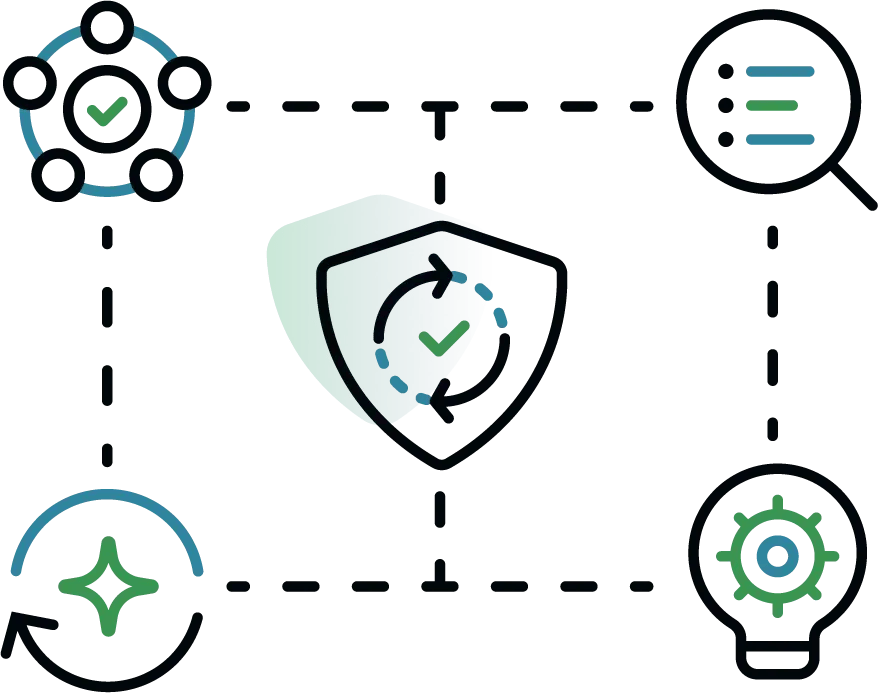
Security isn't an afterthought—it's built into every layer of Strike Graph's architecture. Our AI models run entirely within our self-hosted environment, never relying on third-party APIs or external LLMs. This zero-trust design ensures data sovereignty and eliminates the risks of data leakage or model training on your private information.
Self-hosted AI models:
Instead of shipping customer data to third-party AI models, the Strike Graph platform requires that customer data reside within our data center. All AI models exist within that system and are managed with our standard Software Development Life Cycle. Your data is never used to train external systems, and we maintain complete control over data flow, model behavior, and security boundaries.
Zero trust integration:
Strike Graph evidence collection automation requires appropriate network segmentation and dual-system authentication before retrieving evidence from sensitive systems. Our integration approach uses OAuth and API tokens with limited scopes rather than requiring persistent credentials or agent installations without introspection that expand attack surfaces.
Granular access control:
Permissions are managed across users, systems, evidence, risks, controls, and integrations, ensuring sensitive data is never overexposed. Role-based access controls limit visibility to only those who need it. Every data transaction—whether it's evidence ingestion or model inference—is encrypted, authenticated, and logged.
System-based security posture design:
In Strike Graph, users manage risks, controls, evidence, and frameworks in a flexible data ontology. This allows customers to implement the right security practices, eliminating confusion and redundancy in security operations while maintaining strict separation between different compliance contexts.
Why zero-trust principles matter for regulated industries
For organizations operating under strict regulatory requirements, such as CMMC, HIPAA, or FedRAMP, Strike Graph provides the confidence that intelligence never comes at the expense of security. Defense contractors handling CUI, healthcare organizations managing PHI, and financial institutions protecting customer data can leverage advanced AI capabilities without compromising their compliance posture or introducing new third-party risk.
Strike Graph was built for contextual reasoning, not just response generation
Strike Graph's AI doesn't guess—it reasons. Our models are built to understand your compliance posture, interpret relationships, and evaluate results within context. That means they can test a control, trace the evidence supporting it, and explain the logic behind their findings.
How reasoning AI differs from generative AI
Generative AI tools may produce text that looks convincing, but they can't verify its accuracy or relevance. They're optimized to create content that sounds authoritative by averaging across thousands of examples, but this "wisdom of crowds" approach introduces uncertainty at every layer. When you chain multiple generative models together in an agentic architecture without proper grounding, errors compound rather than cancel out.
Strike Graph's reasoning AI is transparent and measurable. Every conclusion comes with traceable evidence and explainable logic—so auditors, security teams, and executives can see exactly how and why a decision was made. Our AI can:
- Trace impact paths: Identify which evidence gaps will affect which framework requirements
- Detect control redundancies: Find opportunities to consolidate controls across frameworks
- Predict risk reduction: Determine which remediations will have the greatest impact
- Validate with precision: Test control effectiveness using dynamically generated test cases and rubrics
The knowledge base trap vs. ontological intelligence
Even advanced AI systems that ground their models in curated knowledge bases face fundamental limitations. While they can find content with similar words or phrases to your query and synthesize related concepts based on vector similarity, they don't understand the relationships between structured elements of your domain.
Strike Graph's ontological architecture recognizes that risks are categorically distinct from controls, that evidence serves a distinct validation purpose, and that multiple controls may collectively address a single framework requirement. The system doesn't just retrieve relevant text—it understands how concepts actually interconnect.
Agentic AI in action: Verify AI and AI Security Assistant
Strike Graph's AI operates autonomously to execute real compliance work
Strike Graph's agentic AI does more than advise—it acts. Verify AI performs the work of an internal auditor by:
- Validating evidence and attachments as they're loaded
- Testing control effectiveness using dynamically generated document request rubrics
- Identifying gaps before they become audit findings
- Smoke-testing compliance programs between audits for continuous readiness
- Analyzing evidence across multiple frameworks simultaneously for thorough continuous control monitoring
Verify AI ensures independence by stopping short of making prescriptive recommendations, thereby maintaining audit integrity. It tells you what the compliance state is with measurable accuracy, while maintaining the objectivity required for internal audit functions. AI Security Assistant builds on those results by:
- Recommending how to fix identified issues
- Suggesting control edits and improvements
- Automatically filling security questionnaires based on your actual security posture
- Writing custom integrations to your well-designed IT or application architecture
Together, they create a continuous feedback loop—detecting issues, addressing them, and verifying improvements in real time. Where other tools highlight problems, Strike Graph's AI solves them.
Real-world implementation
Using criteria from multiple frameworks at once, Verify AI audits your control coverage for thorough continuous control monitoring. Strike Graph generates test cases and rubrics dynamically from system design and evidence requirements and tests third-party data for constant compliance. Security Assistant guides your organization to strategic compliance outcomes, ensuring you meet new regulatory and third-party risk requirements. You'll instantly stay up to speed on your security posture, the latest compliance changes, and effective technology automations to improve your compliance program.
Architecture that scales across regulatory frameworks, distributed teams, and multiple integrations
Strike Graph's AI-native architecture was designed to scale as your compliance needs grow. Whether you manage multiple frameworks, business units, or distributed teams, our platform keeps every control, evidence item, and risk synchronized across environments.
Integration AI: Your step-by-step compliance consultant
Strike Graph's integration AI is your step-by-step consultant—automating evidence collection, identifying the right controls, writing secure connection code, and scheduling future pulls—saving your team hundreds of hours. Security Assistant integration setup gets you up and running in minutes, collecting only what you need, from existing systems, with no unnecessary data, unnecessary changes, or extra risk.
Our integration AI:
- Connects securely with over 5,000 data sources, including Azure, Google Cloud, AWS, GitHub, Service Now, Atlassian, Office 365, Google Workspace, and more
- Writes connection code automatically, implementing OAuth flows and API integrations without manual coding
- Validates scopes to ensure you collect only what you need—no unnecessary data or extra risk
- Schedules future pulls for continuous, automated evidence collection
- Eliminates manual uploads by pulling real-time evidence automatically
Enterprise workspaces for federated compliance
Using criteria from multiple frameworks at once, Verify AI audits your control coverage for thorough continuous control monitoring. Strike Graph generates test cases and rubrics dynamically from system design and evidence requirements and tests third-party data for constant compliance. Security Assistant guides your organization to strategic compliance outcomes, ensuring you meet new regulatory and third-party risk requirements. You'll instantly stay up to speed on your security posture, the latest compliance changes, and effective technology automations to improve your compliance program.
Modular, interconnected compliance:
Let's say your organization needs to comply with SOC 2, HIPAA, and CMMC—each with overlapping yet distinct requirements. Most compliance tools require setting up separate frameworks, controls, and evidence sets—leading to complexity, duplication, and potential gaps. With Strike Graph, everything stays modular and interconnected. You can reuse controls and evidence across frameworks without duplication.
Flexible data ontology:
Users manage risks, controls, evidence, and frameworks in a flexible data ontology. This allows customers to implement the right security practices, eliminating confusion and redundancy in security operations.
Granular access control:
Permissions are managed across users, systems, evidence, risks, controls, and integrations, ensuring sensitive data is never overexposed. Role-based access controls limit visibility to only those who need it. Every data transaction—whether it's evidence ingestion or model inference—is encrypted, authenticated, and logged.
As your business expands, Strike Graph adapts without forcing you to re-architect and ensures your continuous compliance readiness. Build a security program that fits your business—not the other way around—with complete control over frameworks, controls, and evidence.
Why AI-native architecture future-proofs compliance
Compliance evolves constantly—new frameworks, new threats, new expectations. Systems built on legacy architecture can't keep up.
Strike Graph's AI-native foundation is designed to evolve continuously with your security design. Its modular ontology, secure AI stack, and feedback-driven learning loops enable rapid innovation without disruption.
The innovation acceleration flywheel
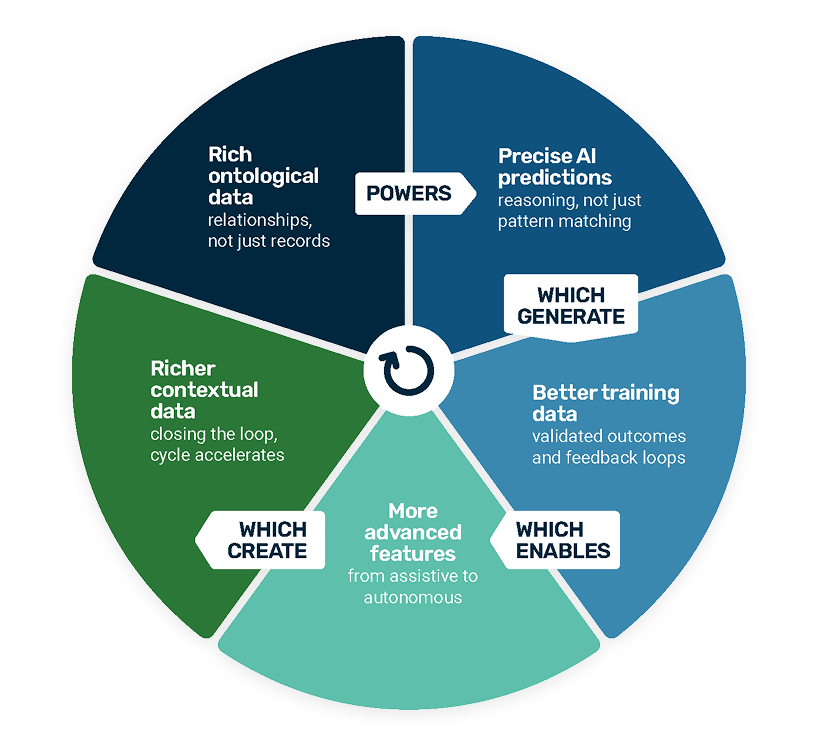
This architecture creates an innovation acceleration flywheel: a compounding advantage where each advancement enables the next. It begins with rich ontological data that captures relationships rather than just records, which powers precise AI predictions capable of genuine reasoning instead of simple pattern matching. Those predictions generate better training data through validated outcomes and feedback loops, which in turn enables more advanced features that evolve from assistive to autonomous. As these features operate, they create even richer contextual data, closing the loop and accelerating the cycle with each revolution.
As AI capabilities advance—from assistive to agentic to fully organizational intelligence—Strike Graph's platform is already positioned to support autonomous, continuous compliance. Being AI-native means your compliance program improves automatically over time, instead of falling behind with every new wave of technology.
Why traditional GRC platforms can't catch up
This architectural requirement explains why traditional GRC platforms and "compliance-in-a-box" solutions will never successfully bolt on comparable AI capabilities. These systems face an insurmountable data problem:
Either:
A:
They never created structured training datasets from their customer content—meaning they have no foundation to build models upon, or
B:
They treat every customer identically, using the same generic templates and workflows regardless of organizational context
Without differentiation in the underlying data, you cannot build effective models. A pharmaceutical company's control implementation looks nothing like a defense contractor's, yet legacy platforms force both into the same rigid structures. When these vendors inevitably add "AI features," they're applying generic language models to undifferentiated data, which produces consistently mediocre outcomes.
They're trying to add intelligence to systems that were architecturally designed to be dumb containers for documents. You cannot achieve AI-native capabilities through retrofitting—the foundational data structures simply don't exist to support it.
Architecture deep dive for technical buyers
Graph-Based Data Model:
Strike Graph uses a property graph database architecture where entities (risks, controls, evidence, frameworks) are represented as nodes with typed edges defining their relationships. This enables efficient graph traversal queries for impact analysis, coverage mapping, and multi-framework intelligence.
Custom AI Stack:
Our AI runs on a custom-built stack that leverages the best available models—while keeping your data fully encrypted, segmented, and never used to train external systems. We train specialized models on our structured ontological data, achieving higher accuracy with smaller model sizes than generic LLMs attempting compliance tasks.
Zero-Trust Integration Architecture:
Evidence collection uses OAuth 2.0 with principle of least privilege, time-limited tokens, and network segmentation. No persistent credentials or agent installations required. All integrations authenticate through dual-system verification before accessing sensitive systems.
Federated Multi-Tenant Architecture:
Enterprise customers can deploy federated compliance management where corporate security leaders set frameworks and policies while business units maintain operational independence. Data remains isolated with granular access controls while enabling centralized visibility and reporting.
Patent-Pending Verify AI Technology:
Our agentic evidence validation system dynamically generates test cases and rubrics from control definitions and framework requirements, then executes validation logic autonomously. The system maintains audit independence by separating observation (what is) from recommendation (what should be).
Continuous Learning Loops:
As Verify AI validates evidence and Security Assistant implements fixes, the system captures outcome data that feeds back into model training—creating a flywheel where the platform becomes more accurate and contextually aware with each audit cycle.
API-First Design:
Strike Graph's Evidence API enables programmatic access to compliance data, allowing organizations to build custom workflows, integrate with existing tools, and extract insights for executive dashboards—all while maintaining security boundaries.
Performance at Scale:
The graph architecture enables sub-second query performance even with millions of evidence items and complex multi-framework scenarios. Parallel processing of evidence validation tasks ensures audit readiness doesn't slow as programs grow.
Security and compliance specifications
- Encryption: AES-256 at rest, TLS 1.3 in transit
- Data residency: US-based data centers with FedRAMP Moderate ATO and European data centers for GDPR data residency.
- Access control: Role-based with access with MFA and support for SSO/SAML
- Audit logging: Comprehensive audit trails for all system actions
- Compliance frameworks: Strike Graph maintains its own compliance certifications (SOC 2 Type II, HIPAA as a Business Associate, CMMC Level 2, Annual Certified Penetration Testing), demonstrating our security architecture in production
Comparison Table: AI-native vs AI-powered compliance management
Experience the architecture behind AI-driven compliance
Strike Graph's AI-native architecture is more than a technical achievement. It’s the foundation for a smarter, more secure, and more adaptive compliance future.
See how our graph-based design, zero-trust AI stack, and autonomous features help teams stay ready for every audit, every day.
Ready to revolutionize how you manage security compliance?
-1.svg)
Why wait?
Get started for free.
The best way to understand how powerful the Strike Graph platform is is to jump right in and give it a spin.

Still have questions?
Let us show you around.
Schedule a demo, and one of our security experts will show you how Strike Graph can empower you to reach your security goals.