- Frameworks
- CMMC
Put the NIST AI RMF into practice
Strike Graph's AI-native compliance management platform turns the NIST AI Risk Management Framework into clear controls, owners, and evidence. You can prove responsible AI governance to customers, regulators, and procurement teams.
Start your free CMMC journey today
Sign up today and get 60 days free on Strike Graph's complete CMMC platform.
- Unlock access to our CMMC compliance platform, complete with NIST 800-171 mappings
- Complete requirements for self-assessment, SSP, and POA&Ms
- Cut weeks of manual compliance work with AI-native tools for integration setup, automated evidence collection, and validation.
- Customized onboarding call to answer all your questions.
- No commitment whatsoever
We look forward to helping you with your compliance needs
Sign up today and get 60 days free on Strike Graph's complete CMMC platform.
- Unlock access to our CMMC compliance platform, complete with NIST 800-171 mappings
- Complete requirements for self-assessment, SSP, and POA&Ms
- Cut weeks of manual compliance work with AI-native tools for integration setup, automated evidence collection, and validation.
- Customized onboarding call to answer all your questions.
- No commitment whatsoever
We look forward to helping you with your compliance needs
CMMC doesn't have to be difficult.
See how Strike Graph helps you streamline and organize your CMMC efforts.
Prove responsible AI governance without the spreadsheet chaos
The NIST AI Risk Management Framework (RMF) tells you what good AI governance looks like, but not how to get there. Strike Graph helps you get there.
Turn outcomes into action
From abstract outcomes to concrete controls
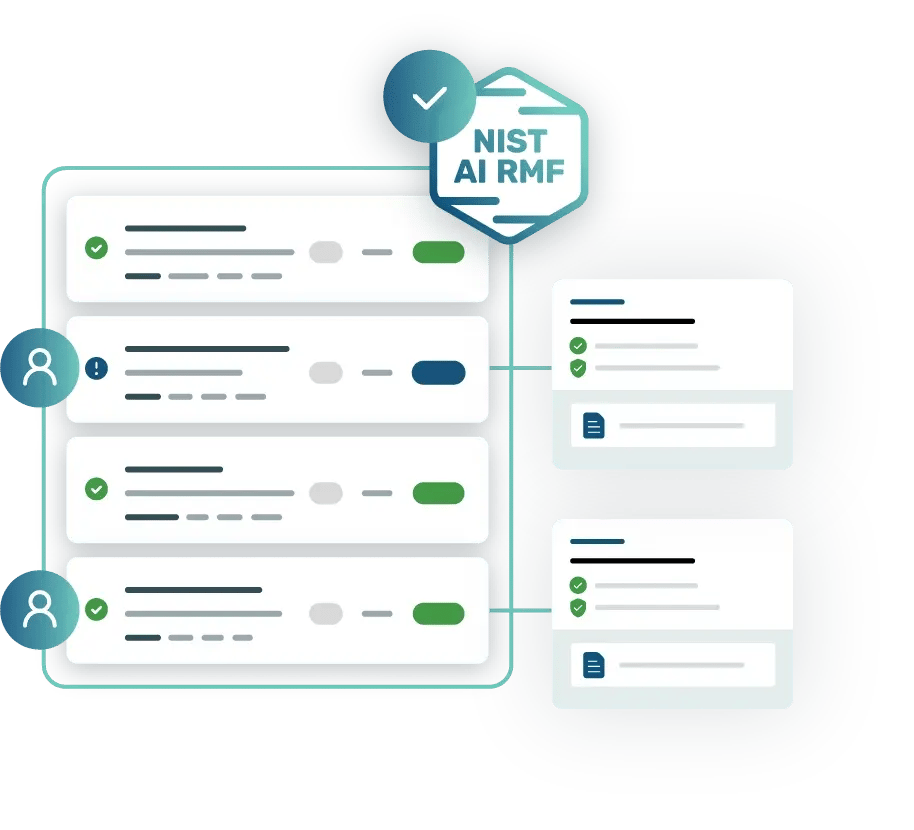
The AI RMF is outcome-based, so its 72 subcategories describe what should be true without telling you how to get there. Strike Graph translates the framework into 80 controls and 106 suggested evidence items. Your team knows exactly what to implement, what to collect, and who owns it.
[IMAGE: Control library view showing AI RMF controls mapped to evidence items and owners.]
Answer buyers faser
Win AI due diligence reviews
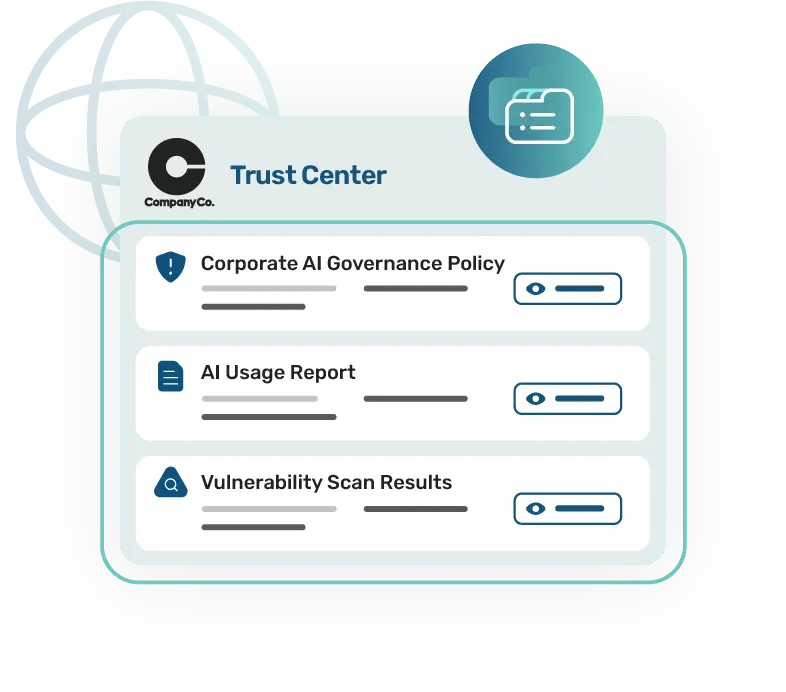
Enterprise buyers and vendor security reviews now ask how you govern AI risk, and they use AI RMF language to ask. Keep your AI system inventory, bias evaluations, and governance policies organized in one place. You can answer questionnaires with confidence instead of scrambling for documentation.
[IMAGE: Security questionnaire or Trust Center view with AI governance documentation.]
Do the work once
One program for AI RMF and ISO 42001
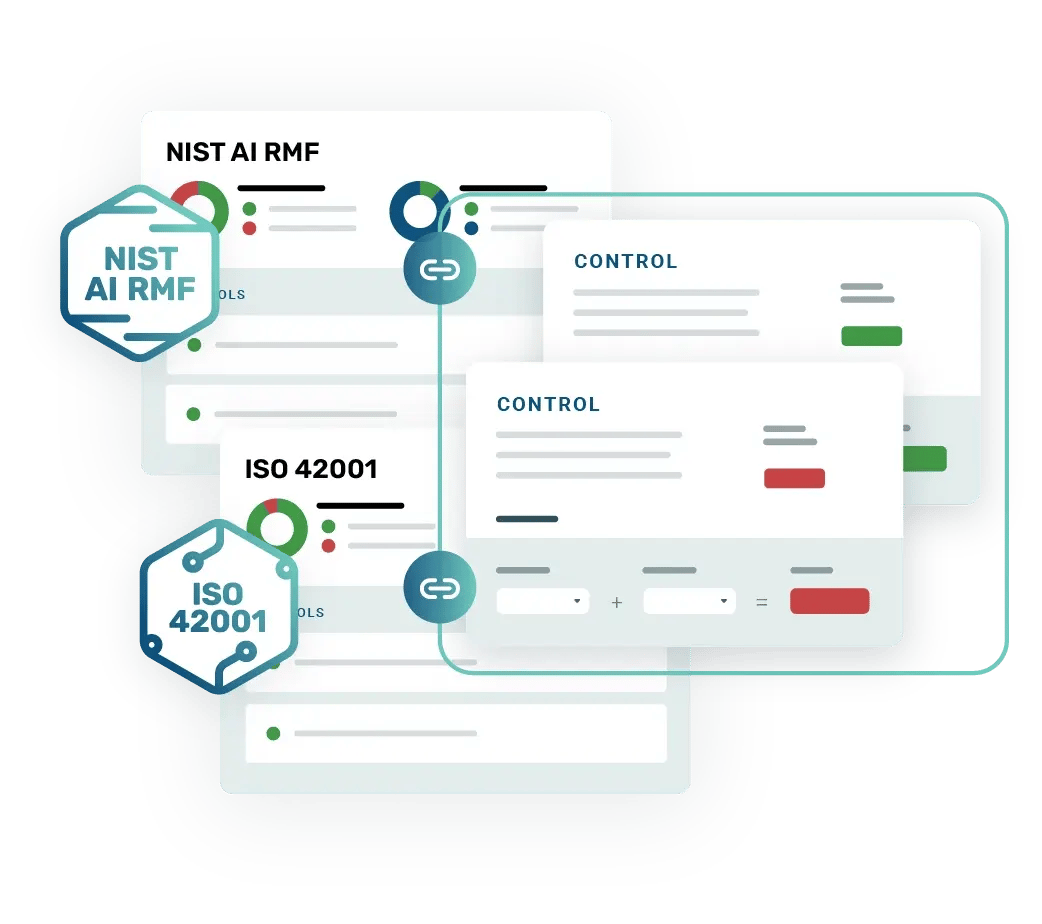
The AI RMF has no certification, so many organizations pair it with ISO/IEC 42001, the certifiable AI management system standard. Strike Graph's cross-framework mappings show where the two overlap, so evidence you collect once can support both. This builds a strong foundation for EU AI Act readiness.
[IMAGE: Multi-framework mapping view showing shared controls between NIST AI RMF and ISO 42001.]
The AI Governance Gap
"We knew we needed to get ahead of AI risk, but the NIST AI RMF felt abstract until we brought it into Strike Graph. Seeing it mapped against the controls we already had for SOC 2 and ISO 27001 showed us we were further along than we thought, and exactly where the gaps were."
What the NIST AI RMF is, and what it isn't
The NIST AI Risk Management Framework is a voluntary, non-certifiable framework for managing the risks AI systems create for people, organizations, and society. Knowing where it fits alongside ISO 42001 and the EU AI Act helps you build the right AI governance program the first time.
NIST AI RMF
What it is:
Published by NIST on January 26, 2023. The main reference for AI governance in the United States. Voluntary and self-attested.
Certifiable? No
ISO/IEC 42001
What it is:
The certifiable AI management system standard. Often pursued alongside the AI RMF to earn third-party certification customers can verify
Certifiable? Yes
The controls you build for the AI RMF in Strike Graph carry straight into ISO 42001. No duplicate evidence, no siloed spreadsheets, no starting over when certification becomes a sales requirement.
EU AI ACT
What it is:
A binding regulation with penalties. AI RMF alignment supports readiness but does not satisfy every requirement on its own.
Certifiable? Regulation, not a certification
Strike Graph's Atlas shows where your AI RMF program already supports EU AI Act readiness and where the regulation asks for more, so you close gaps on your timeline instead of under penalty.
Key features for NIST AI RMF requirements
Whether you build AI, embed it in your products, or buy it from vendors, Strike Graph adapts to how your organization governs AI.
Customizations
Tailor AI RMF controls and evidence to match your AI use cases, risk tolerance, and existing processes. The framework is outcome-based, so your controls should reflect how your team actually works.
Cross-framework mappings
See where NIST AI RMF overlaps with ISO 42001 and other frameworks, then reuse evidence across programs instead of duplicating work.
Verify AI
Patent-pending Verify AI validates submitted evidence against control requirements. This reduces manual review and catches gaps before a customer or regulator does.
AI Security Assistant
Query your AI governance policies, inventories, and evaluations to quickly answer internal questions and customer due diligence requests.
Third-party risk management
Evaluate the AI vendors and foundation models your organization depends on, and validate the documentation they provide against your controls.
Dashboard & Reporting
Track progress across GOVERN, MAP, MEASURE, and MANAGE in real time, and share a clear view of your AI governance posture with leadership.
Ready to certify your AI governance?
The NIST AI RMF has no certification, but ISO 42001 does. See how Strike Graph helps you turn AI RMF alignment into a certifiable AI management system that customers can verify.
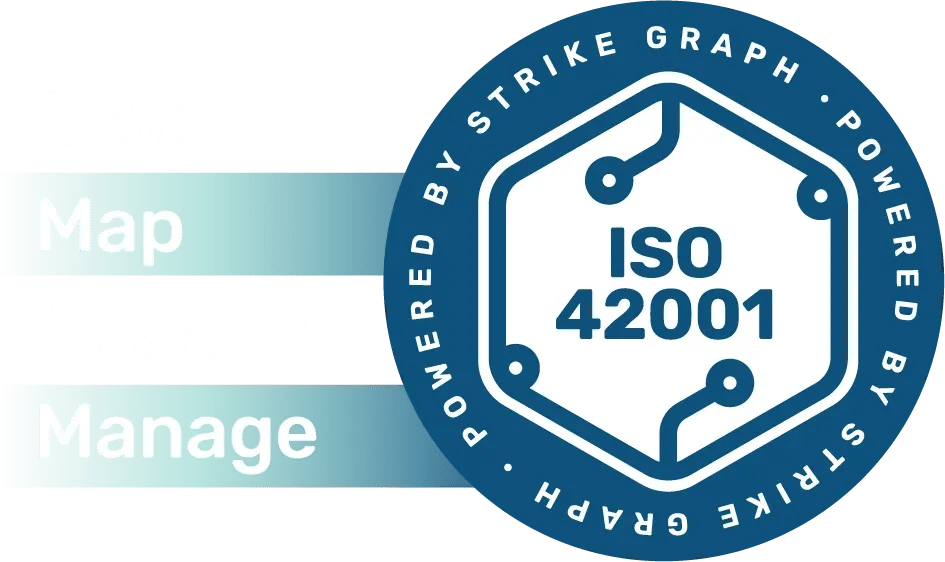
[IMAGE: Visual pairing the AI RMF's four functions with an ISO 42001 certification badge.]
Here’s how it works:

Step 1
Inventory and scope your AI
Build a complete inventory of the AI systems you develop, deploy, or buy, including pre-trained and foundation model dependencies. Then set the scope of your AI RMF program based on risk. This addresses GOVERN 1.6 and removes the blind spots created by shadow AI.
Step 2
Assign ownership and accountability
Assign AI RMF controls to the right owners across engineering, legal, product, and security. GOVERN runs across the whole framework, so clear accountability keeps every function moving.
Step 3
Collect and validate evidence
Gather the evidence that shows your AI governance works in practice, such as fairness and bias evaluations, risk assessments, and monitoring records. Verify AI checks each item against its control requirements.
Step 4
Monitor, report, and prove alignment
Track your AI governance posture on real-time dashboards and keep evidence current as models change. You can share proof of AI RMF alignment with buyers, regulators, and auditors whenever they ask.
Our customers love that Strike Graph sets them up for success today and in the future

"I’ve seen quite a few GRC platforms, and none of them hold a candle to Strike Graph."
“Strike Graph makes the compliance process smooth and stress-free. The platform is incredibly intuitive, making it easy to navigate SOC 2, ISO 27001, and other security frameworks without unnecessary complexity.”
“The team at Strike Graph is a guiding light through security land”
FAQ
Looking to build your AI governance program? We have the answers you're looking for.
What is the NIST AI Risk Management Framework (AI RMF)?
The NIST AI RMF is a voluntary framework from the National Institute of Standards and Technology for identifying and managing AI risks to individuals, organizations, and society. It was released on January 26, 2023. It is organized into four functions, 19 categories, and 72 subcategories, and it applies to any technology, sector, or organization size.
Organizations that handle CUI must be certified at the appropriate CMMC level before they can win or renew DoD contracts. Preparation takes time—building evidence, completing self-assessments, and closing gaps—so contractors should begin now to avoid delays or disqualification when CMMC appears in solicitations.
Is the NIST AI RMF mandatory?
No. The NIST AI RMF is voluntary, and no regulator enforces it directly. In practice, many organizations adopt it because enterprise buyers, federal agencies, and regulators increasingly expect it. Regulators including the FTC, CFPB, SEC, FDA, and EEOC have echoed AI RMF concepts in their guidance, so alignment can serve as evidence of reasonable care.
CMMC Level 3 builds on NIST 800-171 by incorporating the enhanced security requirements of NIST 800-172, designed to protect the most sensitive controlled unclassified information (CUI) from advanced persistent threats (APTs).
Is there a NIST AI RMF certification?
No. NIST does not audit or certify against the AI RMF, and organizations self-attest their alignment. Organizations that want a third-party certification typically pursue ISO/IEC 42001, the certifiable AI management system standard, alongside the AI RMF.
What are the four functions of the NIST AI RMF?
The four functions are GOVERN, MAP, MEASURE, and MANAGE. GOVERN runs across the others and covers policies, roles, and accountability. MAP establishes context and identifies risks. MEASURE analyzes and tracks those risks. MANAGE prioritizes them and acts on them.
What are the seven characteristics of trustworthy AI?
The NIST AI RMF defines trustworthy AI as having seven characteristics:
- Valid and reliable
- Safe
- Secure and resilient
- Accountable and transparent
- Explainable and interpretable
- Privacy-enhanced
- Fair, with harmful bias managed
Does the NIST AI RMF apply if we only use third-party AI tools?
Yes. The AI RMF applies to organizations that deploy third-party AI, not only those that train their own models. If you use a vendor's LLM or foundation model, you are still responsible for mapping, measuring, and managing its risks in your environment. MANAGE 3.2, for example, calls for ongoing monitoring of pre-trained models.
How does Strike Graph help with NIST AI RMF compliance?
Strike Graph is an AI-native compliance management platform. It provides 80 NIST AI RMF controls and 106 suggested evidence items, with cross-mappings to ISO 42001. Teams use Strike Graph to assign ownership, collect and validate evidence with Verify AI, and track AI governance posture in real time.
Can’t find the answer you’re looking for? Contact our team!
See how Strike Graph simplifies NIST AI RMF compliance.
Request a demo to see how Strike Graph helps you inventory AI systems, manage AI risk, and prove responsible AI governance, all in one place.

Ready to see Strike Graph in action?
Find out why Strike Graph is the right choice for your organization. What can you expect?
- Brief conversation to discuss your compliance goals and how your team currently tracks security operations
- Live demo of our platform, tailored to the way you work
- All your questions answered to make sure you have all the information you need
- No commitment whatsoever
We look forward to helping you with your compliance needs!
Find out why Strike Graph is the right choice for your organization. What can you expect?
- Brief conversation to discuss your compliance goals and how your team currently tracks security operations
- Live demo of our platform, tailored to the way you work
- All your questions answered to make sure you have all the information you need
- No commitment whatsoever
We look forward to helping you with your compliance needs!
Additional resources
Read more about NIST 800-171 and CMMC from the Strike Graph experts.