February 9, 2023

Quick summary:
An AI-native CMMC compliance solution embeds machine learning in its core architecture, processing evidence within the platform's own controlled infrastructure instead of sending evidence to third-party AI models. That difference drives compliance outcomes, not just convenience. AI-native tools hold evidence-to-control lineage, detect configuration drift continuously, and keep human sign-off on binding attestations. Conversely, AI-enhanced platforms bolt AI onto legacy databases and often can't trace outputs to their source. Although the DoD has suspended new C3PAO assessment requirements, NIST SP 800-171, SPRS, and DFARS 252.204-7012 obligations remain in force, so architecture still decides whether your program stays defensible.
AI-native solutions handle CMMC compliance more effectively than platforms with bolted-on AI. Machine learning built into the core architecture reads evidence, maps it to controls, and validates it continuously—work that add-on AI can't reproduce. The difference shows up in your compliance outcomes, not just your convenience.
That advantage comes from architecture, not from a label. "AI-native" describes how a system is built; it is not a compliance designation, and no product earns CMMC credit for being AI-native. What earns credit is the result the architecture produces: traceable outputs, accurate evidence-to-control mapping, and a compliance status that keeps pace with your environment.
Traceability is where the architecture matters most. Before you sign your self-assessment affirmation, you need a clear record of where each AI-generated output came from, which control it maps to and which technical artifact supports it. A system that embeds this lineage in its data model can produce accurate evidence-to-control mapping and flag configuration drift as your IT systems change, so your reported posture reflects your actual one. A system that generates summaries after the fact usually can't.
Consider what has direct access to your secure enclave. A compliance platform shouldn't read the actual files inside your CUI environment; it should only analyze configurations and policies to prove the enclave is secure. Any tool that reads raw data in your enclave must be strictly controlled as part of your CUI data-handling process.
If an AI component inappropriately accesses your files and sends that data to external servers or generic foundation models lacking FedRAMP Moderate equivalency, it moves CUI outside your authorized boundary, a direct control failure under DFARS 252.204-7012. Architecture and strict data handling processes determine whether your sensitive data stays safely inside the boundary.
These obligations hold regardless of where the CMMC rollout stands. While the DoD has suspended mandatory C3PAO certification assessments as a condition for new contract awards, the requirement remains on many existing contracts until formally amended, and prime contractors may still demand C3PAO certification from their supply chain. Even without a looming DoD deadline, your underlying requirements remain fully in force across the defense industrial base. Contractors must still comply with NIST SP 800-171, submit an accurate self-assessment affirmation to the Supplier Performance Risk System, and meet the data protection requirements in DFARS 252.204-7012 and 32 CFR Part 170.
Adopting a secure AI-native solution protects your day-to-day operations now and positions your program for C3PAO assessment readiness, whether a prime contractor requires it today or the DoD does in the future. It's part of the broader shift in how AI is transforming CMMC delivery.
AI tools used for CMMC compliance divide into three types. Generic AI sends data to public models like ChatGPT through an API. AI-enhanced tools add LLMs onto legacy GRC platforms built for static documents. AI-native platforms build machine learning into their core architecture, enabling continuous validation and data capture.
Generic AI tools pose a massive risk to government data. When a team member copies Federal Contract Information (FCI) or Controlled Unclassified Information (CUI) into a public chatbot to draft a policy or summarize a contract, that data leaves your secure environment. Doing this with FCI violates the basic access controls of FAR 52.204-21. Worse, because commercial tools usually lack FedRAMP Moderate equivalency, pasting CUI into them directly breaches DFARS 252.204-7012. In effect, you've extended your assessment scope to an unauthorized external service provider and created a potential data spill.
 Dan Clarke, president of Truyo, an AI governance and privacy compliance platform, argues on a recent SecureTalk podcast that using AI properly hinges on transparency.
"If you can explain how that application works, what data it's leveraging, you're like most of the way there in making sure that it's safe and responsible,” Clarke says. “The reason I talk about transparency so much is you can't be transparent about it if you don't understand it."
Once CUI moves to an external commercial model, that transparency disappears with it. You can no longer explain what data the model touched or how it reached its output, which is exactly the kind of accountability gap a CMMC self-assessment can't absorb.
In the second category, AI-enhanced systems, the main risk is inadequate evidence lineage. Because the AI was added to a platform originally built to store static documents, it can't reliably identify where its outputs came from. When it produces a compliance report, you can't show which control or configuration it assessed. That black box blocks human oversight and makes it hard to confidently sign your SPRS affirmation or defend your System Security Plan in an audit. Micah Spieler, Chief Product Officer for Strike Graph, emphasizes that without a clear, verifiable chain of reasoning, AI becomes a liability rather than an asset during an official review.
"An auditor won't accept 'the AI said so' as evidence, and they shouldn't," he says. "If a tool can't show which control maps to which piece of evidence and why, or why an evidence artifact actually satisfies the requirements laid out for it, that black box becomes the exception finding instead of the continuous monitoring control."
AI-native compliance solutions work much differently than AI-enhanced or generic AI. Machine learning sits in the core architecture, so evidence is captured and validated within the platform's controlled infrastructure rather than sent to a public model, and every output stays tied to the specific control and artifact behind it rather than emerging from a black box. That structural traceability is where the practical advantages start.
An AI-native CMMC tool delivers four main advantages: greater accuracy, faster readiness, more defensible outputs, and lower total cost. Because expert reasoning is built into the architecture instead of bolted on, the platform automates evidence work while keeping every determination traceable to the data behind it.
 Dorian Cougias, founder of MoxyWolf LLC and former CEO of Unified Compliance Framework, frames this on another SecureTalk episode as a division of labor between machine and human work.
"Tying in all the stuff with AI, let the computers, let the cogs do what the cogs need to do,” he says. “Let the people think. It frees them up."
An AI-native platform is built around that same division: automating the mechanical, repetitive work of evidence collection and control mapping so your team can focus its judgment on the parts of compliance that actually require it, like closing gaps, making risk calls, and standing behind the affirmation they sign.
Choosing an AI-native compliance solution delivers several foundational advantages for defense organizations:
An AI-native compliance solution handles the operational core of a CMMC program: evidence collection, continuous evidence validation, continuous compliance monitoring, gap analysis, and SSP and POA&M generation. Integrated machine logic runs these day to day, replacing the manual workflows contractors otherwise maintain by hand.
Specifically, an AI-native solution transforms the following functional CMMC compliance areas:
To determine if a solution is truly AI-native, apply the removal test: If you removed the AI tomorrow, would the core product still function as designed? If yes, it is merely AI-enhanced, where users could manually complete tasks. If no, it is AI-native, because the AI is the workflow itself.
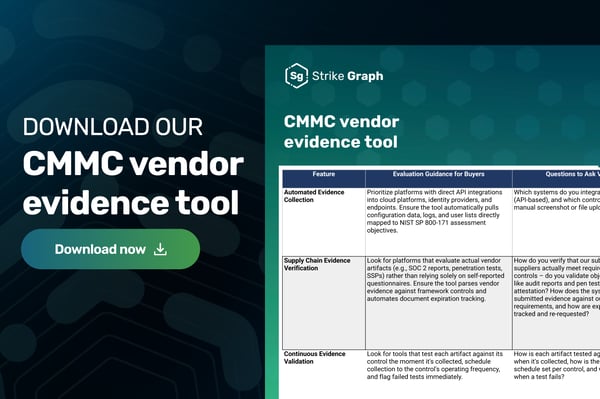
Beyond the fundamental removal test, you must ask vendors specific technical questions to reveal their underlying system architecture and protect your Controlled Unclassified Information. Marketing materials often blur the lines between bolted-on chat tools and structurally embedded machine learning. Direct questions quickly cut through sales messaging, helping executives determine whether a platform will streamline security operations or inadvertently trigger a reporting incident.
Here are the essential questions to ask, along with what acceptable and problematic answers entail:
|
Ask the vendor… |
AI-native behavior |
AI-enhanced behavior |
|
Where does the AI process evidence? |
Processes data entirely within the vendor's controlled cloud infrastructure (e.g., their secure AWS environment); never transmits data to external AI APIs. |
Transmits data to external third-party LLMs or clouds, putting sensitive security data outside your control. |
|
Can we trace an output back to its source? |
Maintains complete evidence lineage, linking determinations directly to specific technical artifacts. |
Produces text summaries without traceable links to underlying system configurations or logs. |
|
Does the platform align with our environment's operational cadence? |
Automatically ingests evidence at configured operational frequencies (up to daily) and instantly verifies compliance status upon ingestion. |
Relies on manual evidence gathering, isolated screenshots, or sporadic prompts, leaving unmonitored gaps between reviews. |
|
Does the platform require human sign-off? |
Mandates human-in-the-loop validation before finalizing control statuses or attestation documents. |
Not necessarily. It may automate approvals without human review. |
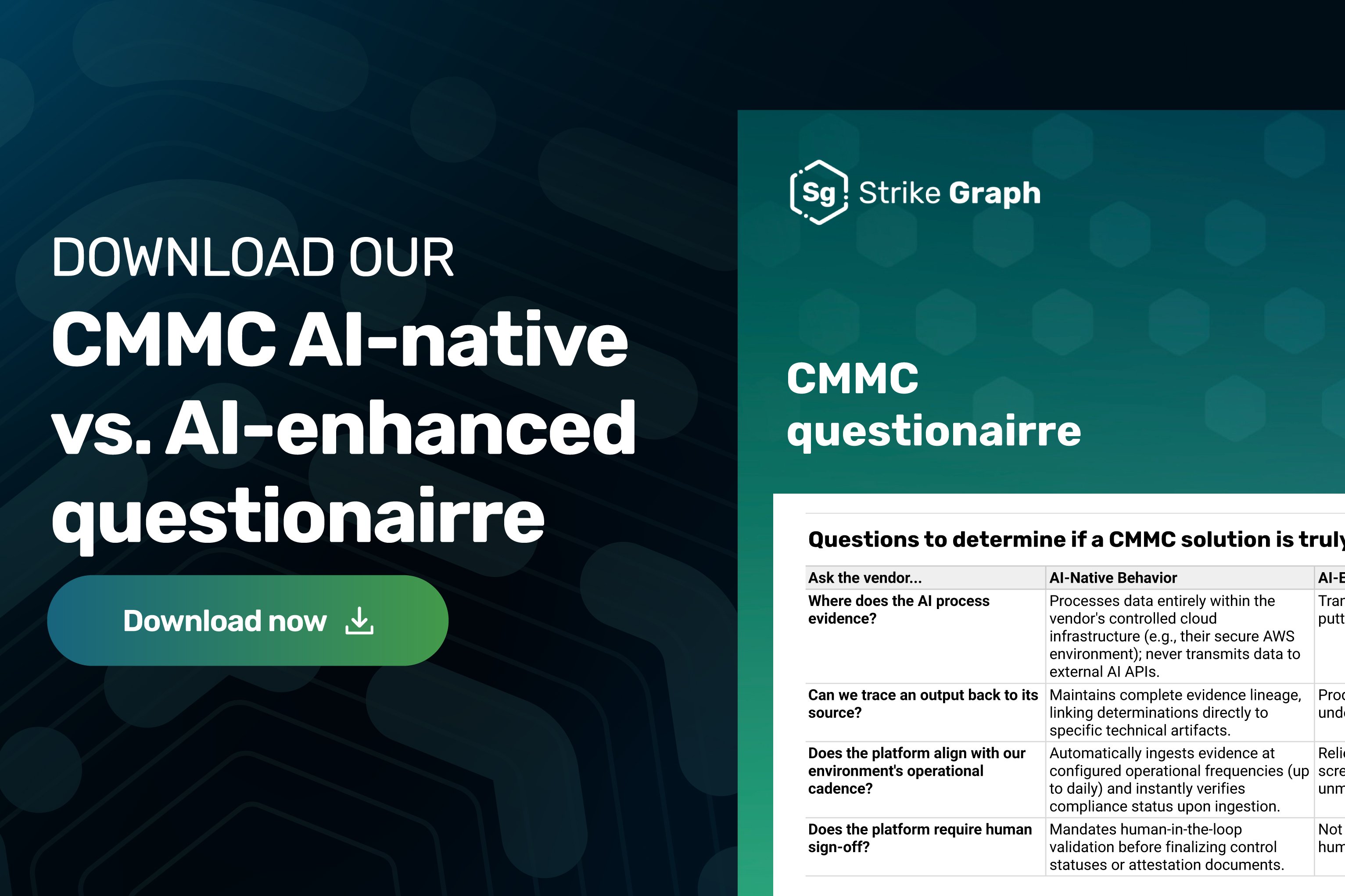
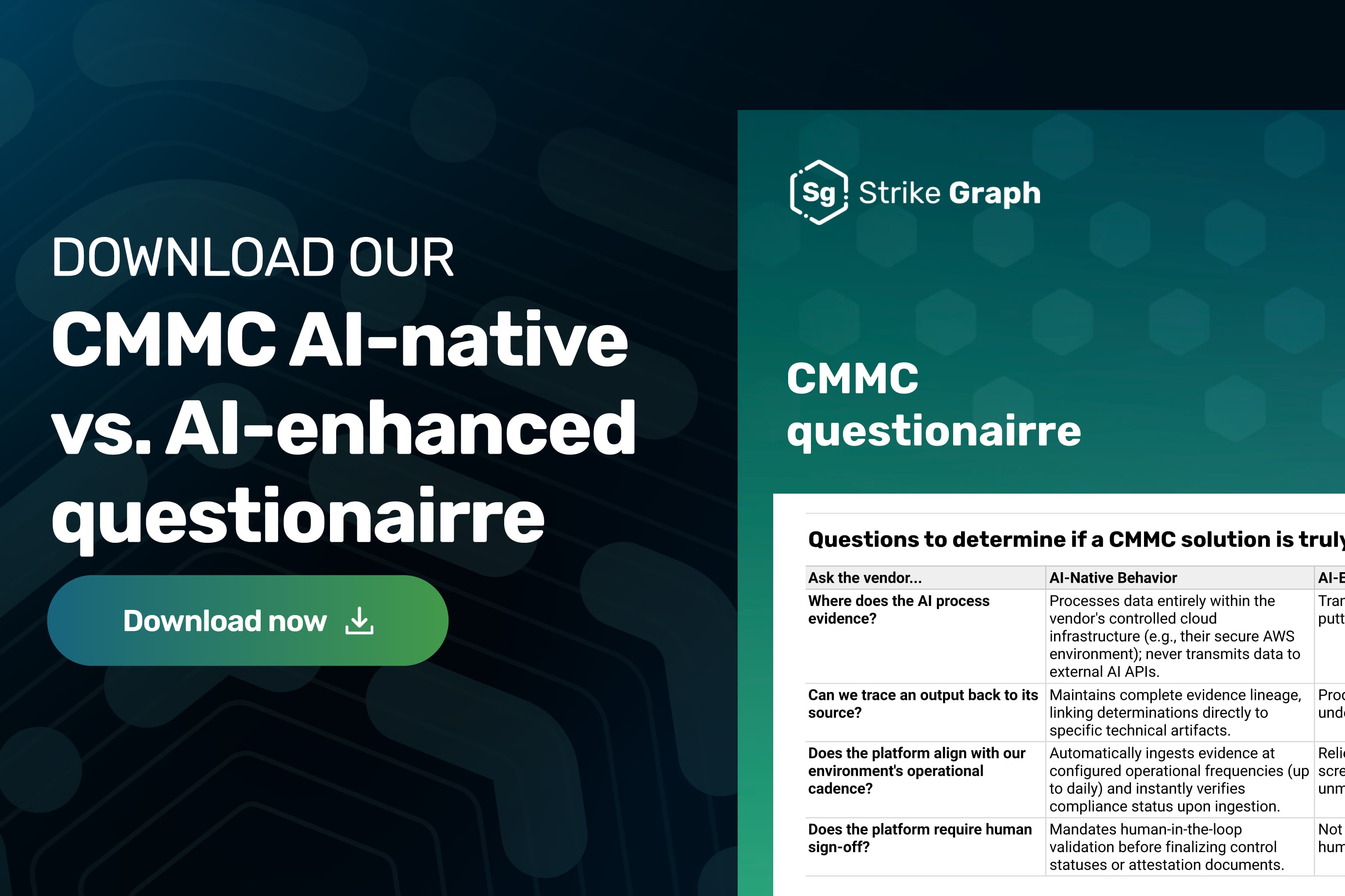
Download a Google Sheet “Questions to determine if a CMMC solution is truly AI-native”
Common red flags in AI-native CMMC vendor claims include manual evidence collection sold as continuous compliance, chatbots layered on legacy databases, GovCloud hosting used to justify uploading CUI, SSPs without evidence links, vague answers on model training, and promises of zero hallucinations.
Watch for these critical red flags that disguise legacy products as modern AI solutions:
Choosing a CMMC solution shouldn't require taking a vendor's word for it. Ask where the AI processes your evidence, whether every output traces back to its source, and whether validation runs continuously — then see how Strike Graph answers.
Strike Graph’s AI-native GRC platform processes evidence entirely within its controlled infrastructure — never sent to third-party model providers, never used for model training — maps artifacts to NIST 800-171 controls with lineage you can stand behind at affirmation time, and validates continuously so you're defensible today and audit-ready whenever a prime contractor or the DoD requires your certification.
Book a Strike Graph demo and bring your hardest compliance questions.



Copy URL