Executive summary:
To perform evidence-based validation in third-party risk management (TPRM), organizations must move beyond basic questionnaires and self-attestations. This guide provides actionable steps to integrate or build a new validation framework. We map specific artifacts, such as penetration tests and audited financials, directly to the cybersecurity, operational, and financial risk domains. Using our playbook, checklists, and AI automation best practices, risk leaders can identify control gaps, streamline assessments, and maintain audit-ready supply chain security.
How evidence-based validation works in TPRM
In TPRM, evidence-based validation means practitioners review concrete technical evidence, such as penetration tests and audit reports, to ensure that a supplier’s security policies are actually being used in their day-to-day work.
When suppliers provide insufficient proof or submit overly broad certification scopes, risk teams analyze these deficiencies to determine the residual risk accurately. If critical evidence remains missing, professionals leverage this data to negotiate stricter contract terms, mandate specific remediation timelines, or document formal risk acceptance cases for executive approval before engagement.
 Iliana Peters, a shareholder at the Polsinelli law firm and a former advisor and director at the U.S. Department of Health and Human Services, has seen firsthand the shortcomings in HIPAA compliance.
"A lot of times what I see is a controls audit, which is very helpful and important. But it's not an enterprise risk analysis, because it's not looking at where the assets are, where the data is, where the risks are," Peters said on a recent SecureTalk podcast episode about HIPAA. "It's telling you, 'Have you implemented the controls that are required?' Again, very important. But not the same thing."
Moving to an evidence-based approach means choosing a method that fits your operational maturity. You can add validation steps to your current questionnaire process, or you can create a new third-party risk management system that relies on continuous assessment and clear evidence.
Steps to integrate evidence-based validation into an existing TPRM program
To integrate evidence validation into an existing TPRM program, begin by identifying your most important suppliers. Focus first on third parties that pose the highest risk. Add requests for proof, such as SOC 2 Type II reports, into your next contract renewals and planned reassessments.
Here are the details to integrate validation into an existing TPRM program:
- Sort your current vendors into risk levels:
Tier them by how much data they access and how critical they are to your operations. This approach helps you see which suppliers need evidence validation right away, so you can focus your efforts on the highest-risk third parties first.
- Set minimum evidence requirements for each vendor risk level:
Rather than relying solely on a standard SIG Questionnaire, request independent proof such as SOC 2 Type II reports or penetration test results for your high-risk suppliers.
 Elliot Harnagel, Strike Graph's Product & Compliance Experience Strategist, emphasizes the importance of right-sizing these demands to avoid overburdening your team and suppliers. "The main way to address this is to adjust your vendor evidence requests based on vendor risk," Harnagel says. "A higher level of assurance requires more in-depth evidence requests, but deeper assurance is only needed for higher risk vendors."
Harnagel also notes that streamlining the process for these critical vendors can improve relationships. "Having some ability to leverage their existing public security documentation or trust center in your evidence ingestion workflow goes a long way towards building goodwill," he adds. "Vendors are more willing to gather evidence... if they feel like they aren't duplicating work they've already done."
- Set up a schedule for collecting documentation:
This is essential for your most important existing vendors. Use upcoming contract renewals or planned reassessments as opportunities to ask for this information, so you can close any past gaps in due diligence without putting too much pressure on your procurement team.
- When renewing supplier contracts, include evidence requirements:
Ensure suppliers agree to continue sharing audit rights, vulnerability reports, and incident notifications.
- Move from yearly reviews to ongoing monitoring for your most important suppliers:
Watch for outside alerts, security updates, and threat intelligence, and be ready to review a vendor’s risk if their situation changes.
Checklist for integrating evidence-based validation into TPRM
|
Step
|
Action
|
Evidence to collect
|
Common gaps to watch for
|
|
01
|
Map vendors to risk tiers
Categorize your existing inventory by data access, system privilege, and operational criticality — not by spend.
|
Data flow maps, system access logs, business impact assessments, vendor classification records
|
- Tiering based on contract value instead of actual data exposure
- Shadow vendors omitted from inventory entirely
- No criteria for upgrading a vendor's tier after scope expansion
|
|
02
|
Define minimum evidence requirements per tier
Replace self-attestation questionnaires with mandatory, independent artifact baselines for each risk tier.
|
SOC 2 Type II reports, ISO 27001 certificates, penetration test summaries, HITRUST validated assessments
|
- Accepting SOC 2 Type I when Type II is required
- No staleness threshold defined per artifact type — e.g., treating an ISO 27001 cert as current without confirming annual surveillance audits were completed
- Baselines defined for the critical tier only; mid-tier left unspecified
|
|
03
|
Update contract language at renewal
Embed evidence-submission obligations, right-to-audit clauses, and incident-notification SLAs into agreements during upcoming renewal cycles.
|
Updated MSAs, security schedules, DPAs, incident notification SLA terms and audit rights clauses
|
- Auto-renewals that bypass the opportunity to insert new terms
- Right-to-audit clause added, but no defined process for exercising it
- SLA timelines for breach notification left vague or absent
- No remediation deadline language if a vendor fails validation
|
|
04
|
Run a structured backfill schedule
Request verifiable documentation from existing critical vendors using contract renewals and scheduled reassessments as forcing functions.
|
Historical audit reports, prior risk assessment records, evidence submission tracker, gap remediation log
|
- Backfill requests sent without deadlines — no follow-up mechanism
- All vendors are targeted simultaneously, overwhelming procurement bandwidth
- Historical questionnaire responses accepted as a substitute for artifacts
- No formal risk acceptance for vendors that cannot provide documentation
|
|
05
|
Transition to continuous monitoring
Replace annual point-in-time reviews with persistent monitoring that triggers reassessment when vendor risk signals change.
|
Threat intelligence feeds, security advisory subscriptions, financial risk indicators and evidence expiration schedules
|
- Monitoring is limited to external signals — no process for vendor-reported incidents
- Reassessment is triggered manually rather than automatically on risk signals
- Evidence expiration not tracked — stale artifacts accumulate unnoticed
- No escalation path when a mid-cycle reassessment flags a critical finding
|
Steps to implement evidence-based validation in TPRM from scratch
Starting a program from scratch lets you include clear proof at every stage of the vendor process. When you set up evidence requirements in your tiering, onboarding, reassessment, and offboarding steps, you create a consistent system that helps reduce supply chain cyber risks.
Here are the details to create an evidence-based third-party risk management framework:
- Set up risk tiers:
Scope by considering factors such as data sensitivity, privileged access, and business impact, rather than just financial spend. This approach helps you determine how much due diligence is needed before entering into any agreements.
- Set minimum evidence standards:
Do this by linking specific documents to each risk tier. For important suppliers, ask for independent evidence such as a SOC 2 Type II report, summaries of penetration tests, and evidence of disaster recovery testing to confirm their controls.
- Ensure vendors provide evidence before engagement begins:
Include clear security schedules, notification SLAs, and right-to-audit clauses to support ongoing oversight.
- Set up automated systems to track vendor performance:
This will monitor performance in real time, rather than just conducting yearly reviews. Monitor threat intelligence feeds, security alerts, and financial indicators so you can quickly reassess whether a vendor’s risk level has changed.
- Create supplier offboarding and exit steps:
This will protect your data when a vendor relationship ends. These steps include obtaining proof of data deletion, revoking access immediately, and ensuring all exit support is completed promptly.
Checklist for implementing TPRM evidence-based validation
|
Step
|
Action
|
Evidence to collect
|
Common gaps to watch for
|
|
01
|
Establish risk tiering and scoping
Define vendor tiers using inherent risk signals — data sensitivity, privilege access, regulatory scope, and business impact — before any contracts are signed.
|
Risk tiering framework, inherent risk scoring model, data classification policy, regulatory applicability register
|
- Tiers defined by service category (SaaS, managed, etc.) instead of actual exposure
- No mechanism to re-tier a vendor after their access scope expands post-onboarding
- Regulatory applicability (GDPR, HIPAA, DORA) not factored into tier assignment
|
|
02
|
Set minimum evidence baselines per tier
Map specific artifacts to each tier to standardize evaluations before any supplier engagement begins. Critical tiers must require independent assurance, not self-attested questionnaires.
|
SOC 2 Type II reports, ISO 27001 certificates, pen test summaries, DR test results, AI Bills of Materials for AI-embedded vendors
|
- Baseline defines what to request, but no pass/fail criteria
- Certification scope not validated against the actual services procured
- AI BoMs not requested for vendors embedding third-party foundation models — an emerging but increasingly important artifact as AI supply chain risk grows
- No alternative verification path for small vendors who lack formal certifications
|
|
03
|
Embed requirements into onboarding and contracts
Make evidence submission a hard prerequisite for vendor activation. Integrate security schedules, SLA terms, and right-to-audit clauses from contract inception — not as amendments later.
|
Security schedules, DPAs, incident notification SLA terms, right-to-audit clauses, and onboarding completion gate criteria
|
- Evidence collected post-onboarding rather than as a gate condition
- Security schedules treated as boilerplate, not tailored to vendor tier
- No defined process when a vendor fails the onboarding evidence gate
- Audit rights included in the contract but never operationalized
|
|
04
|
Automate continuous monitoring
Implement systems that track vendor risk signals continuously — financial indicators, threat intelligence, security advisories — and trigger reassessment automatically rather than on a fixed calendar.
|
Threat intelligence feeds, financial risk indicators, security advisory subscriptions, evidence expiration tracker, reassessment trigger log
|
- Monitoring is deployed only for Tier 1; mid-tier vendors are unobserved between reviews
- Automated signals flag issues but no human escalation workflow exists
- Financial indicators are monitored, but cyber posture signals (new CVEs, breach news) are not
- Evidence expiration dates not tracked — refreshes happen reactively, not proactively
|
|
05
|
Define offboarding and exit protocols
Enforce strict data deletion requirements, access revocation, and exit support timelines at the end of every vendor relationship. Require verifiable proof that obligations have been met.
|
Data deletion certificates, access revocation confirmation logs, exit checklist sign-off, and post-termination audit evidence
|
- Data deletion obligations are stated in the contract but no certificate ever requested
- Access revocation handled by IT but not verified by the risk function
- No exit timeline defined — vendors remain in environment months after contract end
- Subprocessors and fourth-party data flows not included in offboarding scope
|
Playbook for evidence-based validation in TPRM
![[SEO GRAPHIC] validation in TPRM- Playbook-Promo](https://www.strikegraph.com/hs-fs/hubfs/%5BSEO%20GRAPHIC%5D%20validation%20in%20TPRM-%20Playbook-Promo.png?width=3066&height=2043&name=%5BSEO%20GRAPHIC%5D%20validation%20in%20TPRM-%20Playbook-Promo.png)
This free workbook turns the principles above into a working tool you can use right away. It helps you move from questionnaire-and-attestation toward evidence-based validation, giving your team a practical starting point to map what each artifact proves, set expectations by vendor tier, and document gaps consistently across your supply chain.
It contains four tabs. The Artifact Matrix shows what each evidence type proves and where its common gaps lie. Tier-Based Requirements set your evidence baseline per tier. Gap Documentation records artifacts as absent or insufficient, with a disposition and approver. Reassessment Triggers list the events that should prompt re-validation, so reviews fire on change, not just the calendar.)
Types of evidence artifacts for TPRM validation
The main types of evidence artifacts used by risk teams are security certifications, technical validation reports, and corporate documents. Risk teams rely on these because they provide concrete verification of a vendor's security, resilience, financial health, and compliance.
Peters puts it plainly from a regulator's perspective: "Have you implemented the legal requirement? Great. But can you prove to me that you've implemented the legal requirement? That's really almost as important as implementing it — because I have to be able to prove it."
Here is a breakdown of the primary evidence artifacts used to validate third-party risk:
- Framework certifications and audit reports: Certifications such as SOC 2 Type II or ISO 27001 demonstrate that a vendor’s security controls meet industry standards. These reports give important assurance about how controls are designed and how well they work over time.
- Technical security evidence: This type of evidence goes beyond policy and shows the real security status. Items like penetration test summaries, secure code scans, and AI Bills of Materials help confirm that vulnerabilities are managed and software dependencies are secure.
- Operational resilience documentation: These documents show that a vendor can keep services running during disruptions. Reviewing business continuity plans and disaster recovery test results helps confirm the supplier meets your recovery time and recovery point needs during critical incidents.
- Legal and compliance documentation: These documents define the rules for data handling and regulatory compliance. Some documentation, such as Data processing agreements, PCI DSS attestations, and incident notification SLAs, clarifies privacy obligations and proves your organization is meeting strict mandates like NYDFS 23 NYCRR 500 and the SEC cybersecurity disclosure rules.
- Financial and corporate records: Documents such as audited financial statements and cyber liability insurance certificates demonstrate a vendor’s financial stability. These records help ensure the third party can continue operating and cover costs if a data breach occurs.
How TPRM evidence artifacts map to risk domains
TPRM evidence artifacts map directly to distinct risk categories, providing concrete proof of a vendor's capabilities across cybersecurity, operational resilience, financial stability, and regulatory compliance. The exact artifacts required depend entirely on which internal team is evaluating the exposure.
Giving each stakeholder the right evidence helps cover all possible vulnerabilities. Security teams look at technical reports to check data protection, but other departments need different documents to make good decisions. For example, procurement departments review audited financial records to confirm a vendor's financial health. At the same time, risk teams might use the FAIR framework to translate identified technical gaps into measurable financial exposure, and legal teams check processing agreements to ensure regulations are followed.
Security and compliance framework controls
To ensure security frameworks are effective, you need evidence that technical safeguards are doing their job. This evidence helps security teams confirm that a vendor is protecting sensitive data. Audit reports and system settings can show how controls meet the standards of frameworks such as SOC 2 Type II, ISO 27001, NIST 800-53, and HITRUST CSF.
Here’s how different types of evidence match up with these well-known compliance frameworks:
- SOC 2 Type II: These reports show, through independent review, that a vendor’s security, availability, and confidentiality controls work well over time, not just at a single moment.
- ISO 27001: An active certification means the supplier has a strong information security management system in place, with clear rules for protecting data and handling cyber risks.
- NIST 800-53: Evidence such as system security plans and monitoring logs shows that the vendor uses strict federal security controls to guard against advanced threats and supply chain risks.
- HITRUST CSF: A validated assessment report connects controls to over 50 authoritative standards, like healthcare and regulatory rules like HIPAA, offering a reliable and standardized way to show compliance without needing multiple security questionnaires.
Operational, financial, and legal risk domains
Areas of risk that fall outside formal security frameworks need clear operational, financial, and legal proof. Checking these non-technical areas helps prevent serious problems later on. For example, regularly reviewing a supplier’s operational continuity records supports DORA and NIS2 requirements.
For example, experts review disaster recovery test results to ensure systems are resilient, examine audited financials to confirm economic stability, and review data processing agreements and sanctions checks to ensure compliance and reduce liability. Reviewing cyber insurance certificates also shows that the vendor can handle a breach financially. This kind of evidence helps your executive team manage third-party relationships as a whole.
Review these documents to check for operational, financial, and legal risks:
- Penetration test reports: By reviewing these reports and adversarial exposure validation (AEV), you can assess whether a vendor is identifying and fixing vulnerabilities mapped to known threat frameworks like MITRE ATT&CK. This technical proof helps address supply chain cyber risks before attackers can reach your network.
- Data Processing Agreements (DPAs): These legal contracts set out how data is handled and when incidents must be reported. For example, checking DPAs ensures the vendor complies with privacy laws such as GDPR and CCPA and provides your organization with clear legal options if there is a compliance issue.
- BC and DR test records: Business continuity and disaster recovery records show the vendor can quickly switch over during disruptions. This evidence confirms your recovery time goals are met and meets strict requirements like those in DORA.
- Audited financials and cyber insurance: Financial statements and insurance certificates show the vendor is financially stable and has enough resources. This means the supplier can keep running and cover the costs of responding to a major data breach.
Best practices for TPRM evidence-based validation
To carry out evidence-based validation well, organizations should keep evidence up to date, check certification details, handle vendor resistance, document risk acceptance, and set clear escalation steps. These practices help ensure assessments use current, reliable evidence instead of outdated promises.
When following this standard, risk professionals need to carefully review submitted documents to make sure they cover the exact services being purchased. If key suppliers cannot provide enough proof, security teams should use set escalation steps or ask executive leaders to officially accept and document any remaining risk before moving forward.
Peters extends the same logic to vendor and partner relationships. "From a supply chain perspective, from a B2B perspective, it's also a really important piece of the conversation — being able to say to your business partners, 'Yes, we do that. And yes, we have the documentation to prove that we do,'" she says. "That is a really important part of that conversation."
Use these best practices to address common validation challenges and keep strong oversight:
- Check certification scopes: Make sure a SOC 2 Type II or ISO 27001 report covers the exact product or service you are buying. Broad or unclear scopes can hide important security gaps.
- Reduce evidence staleness: Set up ongoing review cycles so vendors must provide recent documents. This helps make sure the evidence matches their current operations and security controls.
- Make risk acceptance official: If you still do not have the needed evidence, ask executive leaders to formally accept the remaining risk. You should write down the missing controls, the reason for moving forward, and any steps taken to reduce the risk.
- Handle vendor pushback: If suppliers will not allow technical checks, explain that transparency is required for procurement.
- Set escalation steps: Decide in advance when to bring high-risk issues to senior management or the board. Note that you should act quickly if important vendors do not fix serious problems, miss notification deadlines, or keep refusing to provide evidence.
Using AI for evidence-based validation in TPRM
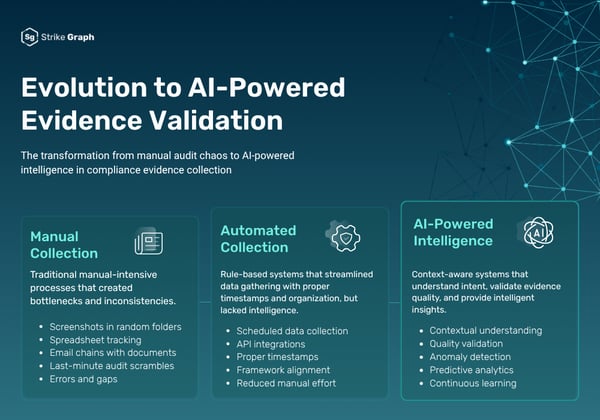
Artificial intelligence accelerates evidence-based validation by automating document analysis, simplifying evidence collection, regulatory control mapping, and ongoing monitoring. Risk teams now use machine learning to scan vendor documents and extract key compliance information efficiently.
A 2025 paper published in the Journal of International Crisis and Risk Communication Research discusses how efficient machine learning can be. The paper, titled “AI-Enabled Third-Party Risk Management: Advancing Governance In Digital Ecosystems,” notes that “machine learning algorithms can review vendor documentation, contracts, control assessments, and external risk signals concurrently to identify patterns and anomalies that could be slow and cumbersome via any manual review process.”
While these technologies reduce administrative tasks, artificial intelligence is intended to support, not replace, expert human assessment. "AI works great for analyzing large, formulaic data like SOC 2 reports or security questionnaires," says Harnagel. "Saving a security analyst from having to manually review dozens of questionnaires... is valuable, and AI tools are well suited for identifying if exceptions were noted."
However, he cautions that human oversight remains necessary to catch the critical subtleties that automated systems might misinterpret. "The main area where AI risk validation falls short is nuance, and in compliance much of that nuance comes into play with how audits are scoped," Harnagel explains. "If an AI tool is used to validate SOC 2 reports year over year... it could miss subtle changes in scope that could have big impacts."
You can add artificial intelligence to your validation process in these key ways:
- Automate document analysis: Natural language processing models can quickly review vendor documents like disaster recovery plans and audit reports. They pull out important risk details and spot missing security controls, so you do not have to read everything by hand.
- Streamline control mapping: AI algorithms can match vendor evidence to specific regulatory requirements, such as PCI DSS or GDPR. This makes it easier to track compliance and see exactly where a vendor does not meet legal requirements.
- Deploy continuous monitoring: Machine learning tools keep an eye on threat intelligence, financial risk signals, and security alerts. They can trigger real-time reviews as soon as a vendor’s risk changes, so teams do not have to rely on scheduled check-ins.
- Generate AI Bills of Materials (BoMs): Automated scanning tools create detailed AI BoMs, giving you a clear view of software dependencies and foundation models, and hidden fourth-party risk. This removes the need to rely on unclear self-attestations from advanced technology suppliers.
Traditional, labor-intensive questionnaires haven’t sufficed for several years now. According to a 2021 study titled "Automated Third-Party Risk Management Platform with AI-Driven Vendor Scoring and PCI DSS Compliance Mapping," traditional questionnaires are "poorly suited to dynamic threat environments where vendor risk profiles can change rapidly due to new vulnerabilities, incidents, or changes in service scope."
How Strike Graph streamlines evidence-based validation in TPRM
Manual spreadsheets and fragmented document tracking slow down procurement and introduce human error. Strike Graph unifies internal compliance and third-party risk workflows onto a single data model, automating evidence validation through its Trust Chain TPRM solution.
This consolidation helps verified supplier artifacts map directly to your regulatory frameworks, reducing tool sprawl and blind spots.
This setup provides your team with several practical benefits:
- Agentic document review: Strike Graph’s Verify AI reads submitted partner artifacts — such as SOC 2 Type II reports or penetration tests — and tests each submission against the specific compliance requirements it is meant to satisfy, going beyond simply confirming a document was received. Gaps surface automatically, while human review remains part of the workflow for accountability during security audits.
- Purpose-built compliance models: Rather than relying on general-purpose AI, Strike Graph trains and hosts its own models on proprietary synthetic data. This specialized approach is designed to improve validation accuracy and reduce the mapping errors that general-purpose AI engines can introduce, though performance will vary by use case.
- Evidence-linked audit trails: Every third-party risk finding connects back to its source documentation, supporting defensible audit trails. Strike Graph's graph-based architecture is designed to maintain traceable rationale between risk assessments and the underlying vendor evidence.
- Continuous monitoring: Trust Chain replaces point-in-time assessments with persistent vendor risk visibility, serving as a foundational element of your continuous threat exposure management (CTEM) strategy. The platform also integrates with a wide range of data sources to support ongoing compliance verification.
- Privacy-first data handling: Sensitive vendor documentation remains encrypted and isolated. Strike Graph hosts its own AI models rather than routing data through third-party AI services, and customer data is never used to train external models.
Book a Strike Graph demo today.







/ebook-ctas_340x500_in-house-ai-compliance.webp)