February 9, 2023

.png)
Quick summary:
Third-party compliance risk management helps organizations verify that vendors, suppliers, and other parties comply with applicable laws, regulations, contractual obligations, and internal policies. An effective program starts with a complete vendor inventory and prioritizes reviews based on risk. Teams then perform due diligence, strengthen contract terms, document controls, and monitor vendors for changes that could create compliance gaps. Practical tools such as maturity benchmarks, implementation steps, and reusable checklists, included in this article, can help standardize this work, reduce audit friction, and identify issues before they become larger operational, legal, or reputational problems.
Third-party risk management (TPRM) covers the full range of risks vendors and other outside partners can introduce, including operational, financial, legal, cyber, and compliance risks. Third-party compliance risk management focuses on whether those third parties comply with the laws, regulations, contractual obligations, and internal policies that apply to your business.
In this article, TPCRM means third-party compliance risk management. Some sources, particularly in cybersecurity contexts, use the acronym to mean third-party cyber risk management, but here we use it to describe the compliance-focused portion of a broader TPRM program.
In practice, organizations may build compliance checks into vendor due diligence, but compliance risk can be underweighted if those checks do not carry through contracting and ongoing monitoring.
A vendor may appear financially or operationally sound while still creating serious compliance exposure, such as privacy violations, weak regulatory controls, or contractual noncompliance. In heavily regulated industries such as finance and healthcare, compliance is a core part of vendor oversight throughout the vendor lifecycle.
|
Feature |
Third-Party Risk Management (TPRM) |
Third-Party Compliance Risk Management |
|
Primary focus |
All potential third-party risks, including financial, operational, legal, strategic, cyber, and compliance risks |
Compliance with laws, regulations, contractual requirements, and internal policies |
|
Scope of oversight |
Broad across the third-party ecosystem, including vendors, suppliers, partners, contractors, and service providers |
Focused on compliance-related obligations across the vendor lifecycle, including regulatory, contractual, and internal policy requirements |
|
Primary goal |
Reduce the likelihood and impact of third-party-related disruptions, losses, and control failures |
Reduce the risk of compliance violations, audit findings, contractual breaches, and regulatory penalties |
|
Key stakeholders |
Enterprise risk, procurement, IT, security, legal, and operations teams |
Compliance, legal, procurement, privacy, security, and internal audit teams, depending on the vendor and regulatory context |
|
Success metric |
Third-party risks are identified and managed early enough to reduce operational, financial, and security disruption. |
Vendors meet required compliance obligations, supporting cleaner audits, fewer exceptions, and faster remediation when issues arise. |
|
Typical example |
Evaluating a key supplier’s financial health and operational resilience to reduce the risk of business disruption during the contract term. |
Verifying that a cloud hosting provider can meet your contractual, privacy, and control requirements before handling regulated or sensitive data. |
An effective third-party compliance risk management program depends on several key elements working together. These elements help teams manage vendors and assess whether they meet applicable policies, contractual obligations, and legal requirements. Without them, compliance oversight can become fragmented and difficult to maintain.
A strong third-party compliance risk management program is built on these main pillars:
To get started, assess the maturity of your current program. Review your vendor oversight, governance, and technology to identify any gaps. Knowing your baseline helps you avoid duplicating work and use your resources wisely as you grow.
Next, articulate goals for your third-party compliance program. Your priorities might include improving audit readiness, reducing manual evidence collection, strengthening vendor contract controls, or supporting specific privacy or regulatory requirements.
Finally, consider what is driving your need for compliance risk management. Common triggers include audit findings, customer or contract requirements, expansion into regulated markets, or changes in the regulatory environment. Knowing what is driving the effort helps you focus first on the most important vendors, controls, and obligations.

To achieve this focus, Michael Rasmussen, GRC Analyst and “Pundit” at GRC 20/20 Research, suggests that success depends on an organization's ability to distinguish relevant threats from background noise.
“The issue with older tools is that they often generate alerts without sufficient understanding of business context, which leads to large volumes of false positives and wasted effort,” Rasmussen says. “Modern AI platforms are more effective when they evaluate the relevance of a signal against the relationship itself. They look at the type of third party, the nature of the service, the geography, the regulatory environment, the data involved, and the role the third party plays in critical business processes.”
As Rasmussen explains, this level of detail is what allows a program to scale effectively. “That context enables the system to separate incidental noise from material risk. A headline, breach report, legal development, or financial indicator might be important for one vendor and irrelevant for another. AI helps determine that difference faster and more consistently than manual review alone. The result is a more focused compliance risk program that pays attention to the issues that actually affect integrity, obligations, and operational exposure.”
|
Assessment question |
Yes / No / Partial |
Next steps if “No” or “Partial” |
|
Do we have a centralized inventory of all third-party vendors? |
Identify and log all active vendors across all departments. |
|
|
Do we issue standard security questionnaires during onboarding? |
Create a standardized intake form for new vendors. |
|
|
Do our vendor contracts include right-to-audit clauses? |
Work with legal to update standard contract templates. |
|
|
Do we have a system for continuous compliance monitoring? |
Establish a process or tool for ongoing monitoring and evidence collection. |
|
|
Can we easily produce an audit trail of our vendor oversight? |
Digitize and centralize all evidence collection and vendor records. |
The right starting approach depends on your organization’s current level of maturity. Some teams need to build a program from the ground up, while others can add compliance controls to an existing TPRM process.
When starting a new program, first establish a strong foundation before reviewing potential outside partners. Define your internal governance, compile a comprehensive vendor list, and establish evaluation criteria to protect your organization from legal and regulatory risks.
Rasmussen suggests that for a program just finding its footing, the approach should center on immediate operational relief and proving the return on investment:
“For a program just getting started, the early wins should center on making limited resources go further. AI can help by automating routine due diligence for lower-risk third parties, reducing repetitive document review, summarizing evidence, and highlighting where human attention is actually needed. This speeds up onboarding and reduces the manual backlog that often frustrates both compliance and the business.”
Beyond efficiency, he notes that automation provides a necessary layer of objectivity. “Many organizations struggle because different reviewers assess similar vendors in different ways. AI can help standardize first-pass reviews and ensure a more consistent application of policy and criteria. That consistency, combined with faster throughput and better prioritization, helps leadership see that AI is not simply a technology investment. It is a force multiplier for a compliance team that needs to do more with constrained capacity.”
Follow these steps to start a third-party compliance risk program from scratch:
If you already manage general vendor risks, add compliance checks to your current workflows. This lets you use your existing technology and processes to enforce regulatory standards throughout your supply chain.
Here are the steps to start third-party compliance risk management within an existing TPRM program:
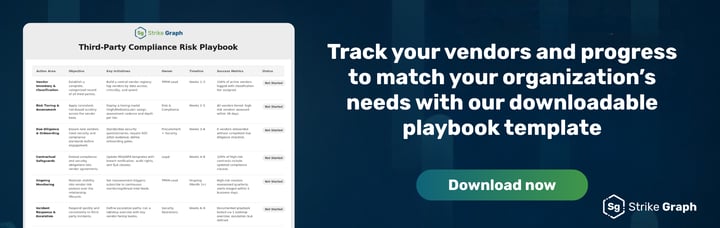
You can use our downloadable playbook template for a step-by-step guide to put your TPCRM program into action. It helps you list your vendors, track your progress, and adjust the steps to match your organization’s needs.
A strong third-party compliance risk management program should rely on recognized standards, certifications, and regulatory requirements to evaluate vendors consistently. Using these benchmarks helps teams assess third-party controls, compare vendors against relevant obligations, and support internal reviews, audits, and ongoing monitoring.
In practice, organizations often map vendor controls to the requirements that matter most for the services being provided. That may include security assurance frameworks, government or sector-specific compliance programs, and privacy or healthcare regulations. This approach helps teams identify gaps, review supporting evidence, and confirm that third parties can meet the legal, contractual, and policy requirements tied to the relationship.
![Headshots [Micah Spieler-headshot]-2](https://www.strikegraph.com/hs-fs/hubfs/Headshots/Headshots%20%5BMicah%20Spieler-headshot%5D-2.png?width=180&height=180&name=Headshots%20%5BMicah%20Spieler-headshot%5D-2.png) Micah Spieler, Chief Product Officer for Strike Graph, says it's essential to start with your particular business risks before diving too deeply into any one framework or regulation.
Micah Spieler, Chief Product Officer for Strike Graph, says it's essential to start with your particular business risks before diving too deeply into any one framework or regulation.
"Focusing on frameworks alone will likely introduce redundancies, since there are so many shared controls and evidence requirements," Spieler says. "To avoid that, structure your initial third-party compliance requirements to mitigate your business risks, then layer on specific framework or regulatory requirements if needed."
These common frameworks and regulatory requirements typically surface in third-party compliance risk management:
Organizations use third-party compliance risk management to meet strict regulations and avoid expensive penalties. Having structured vendor oversight protects your brand’s reputation and ensures partners comply with legal requirements before they access sensitive company data.
Key applications for this oversight include:
Third-party compliance risk covers several distinct categories, each tied to a different set of obligations. The main types include regulatory, contractual, internal policy, data privacy, and cybersecurity compliance risk. Understanding which types apply to your vendor relationships helps you prioritize oversight and apply the right controls.
Organizations work with many external partners across industries and geographies, which means compliance obligations vary significantly by relationship. Dividing your program by risk type helps teams allocate resources effectively and apply the appropriate level of scrutiny to each vendor:
Effective third-party compliance risk management requires cross-functional alignment, continuous vendor monitoring, and thorough documentation. Teams that replace manual processes with automated tools reduce audit friction, catch compliance gaps earlier, and scale oversight without adding headcount.
Follow these best practices of effective third-party compliance management:
“It usually comes down to a priority conflict,” says Spieler. “Each of these roles focus on different outcomes: procurement optimizes for process, the CISO focuses on risk reduction, and the CCO wants to maintain audit defensibility. At the highest level, they’re all aligned on protecting the company from a bad vendor relationship, but they tend to collide when their tolerances conflict. Without shared expectations, there’s a possibility of these three roles getting sidetracked while arguing not about approving a vendor, but instead how to categorize them.”
“If a vendor is being continuously monitored, then there’s no annual 3- to 4-week back-and-forth process trying to re-evaluate them,” Spieler notes.
He adds: “Outside of speed and efficiency, I think that questionnaires leave a lot of room for ambiguity. Switching to a workflow that uses continuous compliance monitoring, it’s harder for a vendor to pass an assessment with an ambiguous response. Gone are the 12 months of plausible deniability baked into the annual reviews process. Continuous monitoring will surface gaps much earlier and immediately force what might be an uncomfortable question: now that we know, what do we do about it?”
As companies add more vendors, keeping up with third-party compliance gets harder. If teams rely on scattered data, spreadsheets, and basic questionnaires, procurement can easily become overloaded. This outdated approach can exhaust vendors and allow key regulatory issues to go unnoticed until an audit uncovers them, resulting in serious penalties.
Below are some common challenges and practical solutions:
To build a strong compliance program, you need a clear framework, thorough due diligence, and automated monitoring. With clear policies, vendor controls mapped to recognized standards, and smart technology replacing manual work, you can grow your supply chain, meet auditor expectations, and avoid expensive regulatory problems.
Strike Graph helps you move to automated vendor oversight by using artificial intelligence in your compliance operations. Rather than juggling many separate tools, Strike Graph brings your risk management together in one place. Your team can easily map vendor evidence to regulatory frameworks and stay ready for audits.
Strike Graph simplifies third-party compliance risk management through several practical capabilities:
To see how Strike Graph might help your risk management, schedule a demo today.
Who is responsible for third-party compliance risk management?
Third-party compliance risk management is often led by the Chief Compliance Officer (CCO) or another governance leader, but responsibility is typically shared across compliance, procurement, legal, security, privacy, and risk teams. The exact owner depends on the organization’s structure, industry, and regulatory obligations.
How long does it take to start a third-party compliance risk management program?
Many organizations can launch a basic third-party compliance risk management process within a few months by setting governance, building a centralized vendor inventory, and tiering vendors by risk. A more mature program, with stronger monitoring and standardized evidence collection, usually takes longer.
Why is continuous monitoring critical for TPCRM?
A vendor’s compliance status can change quickly because of system updates, new subcontractors, or changing rules. Continuous monitoring lets your team spot problems early and fix them before a minor issue becomes a serious penalty.
How do you conduct a vendor compliance gap analysis?
During due diligence, organizations send standard security questionnaires to high-risk partners. By comparing their answers to industry standards such as NIST or GDPR, you can spot specific gaps. This helps procurement teams request the necessary security improvements before signing vendor contracts.



Copy URL


/ebook-ctas_340x500_in-house-ai-compliance.webp)


.jpg?width=600&height=600&name=Blog%20images%20(1).jpg)