Executive summary:
TPRM automation helps organizations streamline and improve third-party oversight by standardizing repeatable work across onboarding, assessments, monitoring, remediation, and offboarding. The most effective programs pair automation with human accountability for risk decisions, use tiered due diligence based on exposure, and connect TPRM to procurement to prevent unchecked approvals. This guide explains the core elements of TPRM automation and walks through a step-by-step implementation approach. It also provides best practices, common pitfalls to avoid, and a practical playbook to operationalize the process.
What TPRM automation means
TPRM automation is the use of technology to streamline repetitive tasks throughout the third-party risk lifecycle. This can include evidence collection, assessments, routing, and documentation. It improves efficiency and reduces errors, but it doesn't replace human judgment in key decisions. “Third parties” can include vendors, service providers, contractors, and partners.
 “There are really two different flavors of automation: automation for time savings, and automation for information gain,” says Elliott Harnagel, Product & Compliance Experience Strategist at Strike Graph. “Automating standard tasks like questionnaire reminders or using AI for SOC 2 reviews frees up resources, but it’s automating for continuous monitoring that actually mitigates risk above and beyond standard practice.”
Elements of third-party risk management automation
Modernizing third-party risk management requires shifting from manual processes to a unified technical stack. You need to deploy tools that centralize data, standardize response protocols, and enable smart analysis. This reduces time spent on administrative tasks and provides more accurate data, enabling your security team to focus on high-priority items.
Here’s a closer look at the elements you’ll use to automate third-party risk management:
- Centralized platform: A central platform will serve as your single source of truth for all third-party data. Consolidating documentation, communication logs, and risk scores into one interface eliminates the risks associated with siloed information. This means every department gets the same verified data, and you get consistent reporting and a clear audit trail for internal and external stakeholders.
- Automated workflows: Use logic-based triggers to move vendors through the risk lifecycle without constant manual intervention. The automations will distribute questionnaires, send deadline reminders and escalate delays to the right people. Codifying the steps for intake and assessment ensures that every third party undergoes the same rigorous evaluation process, removing the variability and errors inherent in manual tracking.
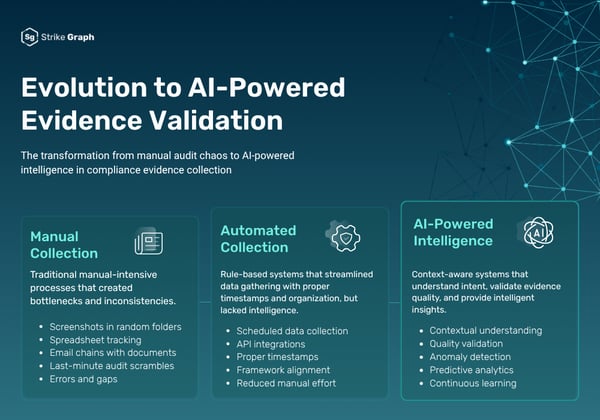
- Artificial Intelligence and Machine Learning: AI and ML can significantly accelerate the analysis of complex security documentation. They can parse SOC 2 or ISO/IEC 27001 reports and privacy policies to spot control gaps or non-standard clauses, but these insights should be treated as decision support, not final determinations. They’re most effective for triage, evidence indexing, and highlighting scope exceptions or outliers that reviewers should validate. Automating the initial review of thousands of data points allows risk analysts to spend less time on first-pass review and move directly to investigating flagged issues. See our related articles on how to create an AI TPRM program and how to choose an AI TPRM tool.
- Software integrations: These connect the TPRM system to the wider corporate ecosystem, including procurement and financial systems, and can help enforce mandatory artifacts, such as a signed Data Processing Agreement (DPA). By syncing data between platforms, you can create automated "blocks" that trigger holds, approvals, or escalation paths to vendors who haven't completed their security assessments. This makes third-party risk management an integral part of business operations, rather than just a compliance exercise.
Key areas of TPRM to automate
The most effective areas to automate in TPRM recur across the vendor lifecycle and slow teams down when handled manually. Organizations should focus automation on vendor onboarding, risk assessments, continuous monitoring, remediation tracking, and offboarding. These areas benefit most from standardized workflows, consistent controls, and ongoing updates that reduce friction.
Each of the areas below represents a point in the vendor lifecycle where automation can replace manual coordination without removing human oversight:
- Vendor onboarding: Automating intake processes can replace unnecessarily long email chains with a standardized "front door" for all new vendor requests and set special data-handling disclosures for vendors, including GDPR and UK GDPR when EU/UK personal data is involved, HIPAA when a vendor acts as a “business associate” handling personal health information (PHI), and PCI DSS when cardholder data is in scope. You can automatically enrich vendor profiles with public data, such as business registration details and financial stability signals (e.g., credit risk ratings or adverse media coverage), before a human analyst even begins reviewing. This early automation initiates basic due diligence immediately, reducing the time from procurement to contract signature.
- Vendor assessments: Questionnaire automation can streamline the most labor-intensive part of third-party risk management. You can distribute tiered assessments based on the vendor's potential impact and use AI to pre-fill responses from previous documentation or security certifications, while still requiring vendor validation and reviewer checks for scope, carve-outs, and exceptions. Automated analysis flags non-compliant answers as they come in, so your security team can focus on resolving identified gaps rather than wading through every line of a submission.
- Continuous monitoring: This shifts risk management from a one-off exercise to a continuous security function. By integrating with external threat intelligence and security rating services, you receive real-time alerts about vendor data breaches, new vulnerabilities, or financial instability. Automated feeds update risk scores in real time as conditions change, triggering rapid reassessments when a vendor's security posture falls below an acceptable threshold.
- Remediation and issue management: Remediation workflows can automate the tracking of security findings until they're successfully resolved. When an assessment identifies a gap, the system can automatically generate a ticket, assign it to the vendor and track the progress of the fix. This systematic approach ensures high-priority risks don't get lost in spreadsheets and provides a clear history of mitigation efforts for auditors.
- Vendor offboarding: Automating offboarding protocols can significantly reduce third-party risks that persist after a partnership ends. The system can automatically cut off access, send alerts to get contracts cancelled, and request proof that all data has been destroyed, saving you from dealing with orphaned accounts and sensitive information getting into the wrong hands any longer than necessary.
Step-by-step: How to automate a TPRM program
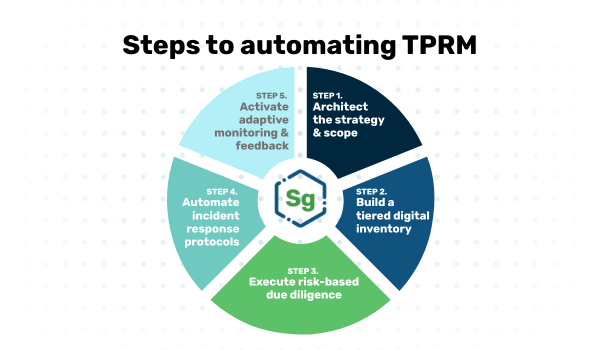
To automate TPRM effectively, start by defining the scope and risk appetite, then build a tiered vendor inventory that automatically drives the right controls. Next, run risk-based due diligence and incident workflows through a structured routing process. Finally, add continuous monitoring and refine tiers, triggers, and requirements over time.
Follow these detailed steps below from security experts to modernize your third-party risk management approach.
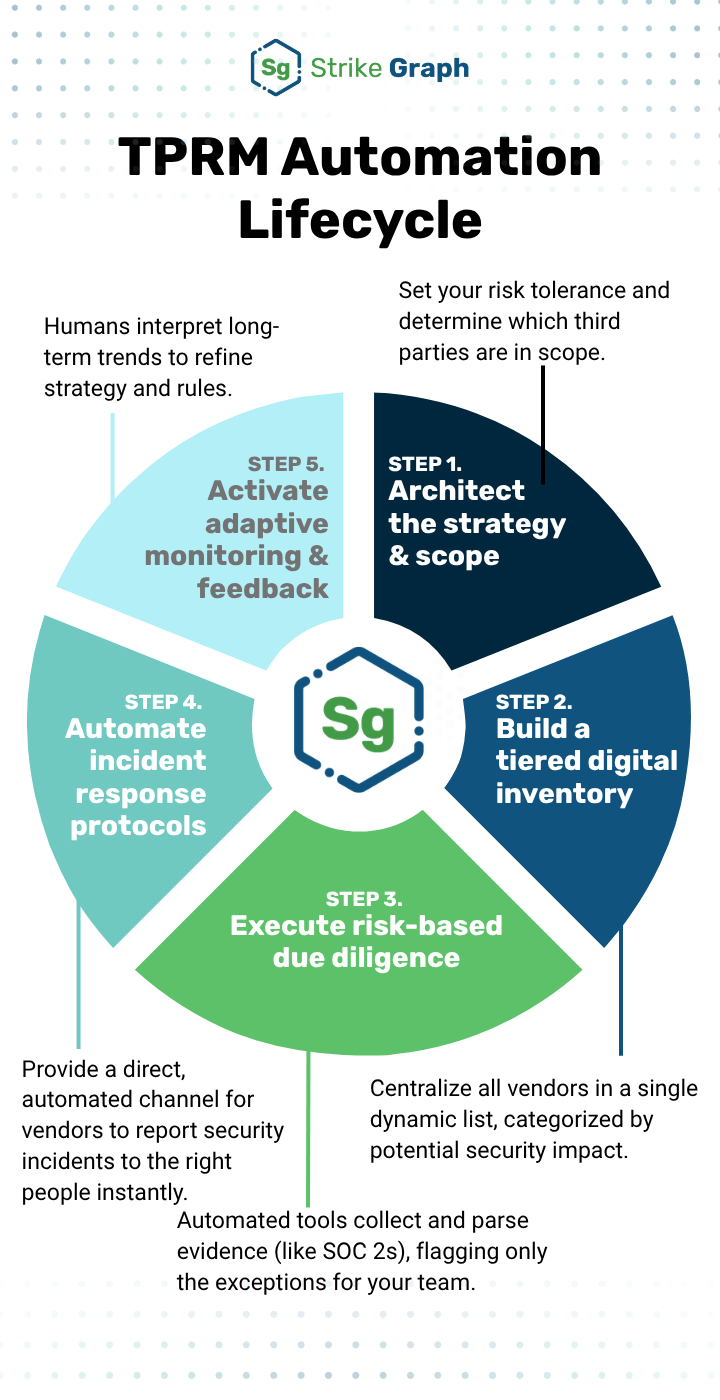
Step 1: Architect the TRPM strategy and scope
Before you even select tools or design workflows, you need to figure out the "why" and "how much" of what you're trying to do. This phase focuses on establishing guardrails for your program, including determining which vendor types are in scope and your organization’s specific risk appetite. Aligning these decisions with a recognized framework, such as the NIST Cybersecurity Framework (CSF), helps ensure your risk categories, controls, and priorities are consistent with broader enterprise security objectives. By setting these objectives early, you can ensure your automation matches your business goals.
Step 2: Build a tiered digital inventory
A flat list of vendors won't be very useful for automation. In this step, you centralize all third parties in a single system and assign risk tiers based on the level of access they have to your sensitive data and internal systems. By tiering them during intake, the system knows which security checks to trigger, so you don't have to manually sort through them.
 Andy Cottrell, CEO of Truvantis, emphasizes that this tiering work needs to happen before anything else. "The solution is accurate risk assessment up front, before any detailed review begins," he says. "You have to identify risk factors such as what data the partner will access, how deeply they integrate with client systems, and the potential blast radius if something goes wrong."
That risk score drives the depth of downstream review.
Step 3: Execute risk-based due diligence
This is where you integrate deep-dive assessments into the due diligence process. Instead of doing these separately, use your automation to send a risk-based questionnaire (e.g., SIG, CAIQ, or a tailored internal assessment) and simultaneously collect evidence (e.g., SOC 2 reports).
The depth of the investigation should match the tier scoring you set in the previous step, so you're not over-analyzing a low-risk office supply vendor or under-vetting a critical cloud provider. As Cottrell puts it: "A low-access SaaS tool with no sensitive data exposure gets a streamlined checklist. A vendor touching production infrastructure or regulated data gets full scrutiny."
Strike Graph’s Harnagel adds: “Moving beyond yes-or-no questionnaires to require actual evidence of a vendor's security stance is huge. Automation for information gain not only saves you time, but it provides meaningful, real-time insight into a vendor's environment that a simple attestation just can't match.”
Step 4: Automate incident response protocols
A defensible TPRM program requires a dedicated approach for handling various incidents where things don’t go as planned, such as service or security issues. This step involves setting up automated reporting mechanisms that allow vendors to flag incidents directly to your team. By codifying how these reports are routed and escalated, you can make sure that no security breach or service outage falls through the cracks or gets stuck in a generic inbox.
Step 5: Activate adaptive monitoring and feedback
This final phase focuses on integrating continuous monitoring with a cycle of continuous improvement. Use real-time data feeds to monitor vendor changes between assessments, and use those insights to refine your tiering rules and assessment questions. It creates an "always-on" feedback loop in which your program becomes smarter and more efficient the longer it runs.
For more, see our companion articles on how to start a TPRM program, how to streamline TPRM, and how to scale TPRM.
TPRM automation playbook
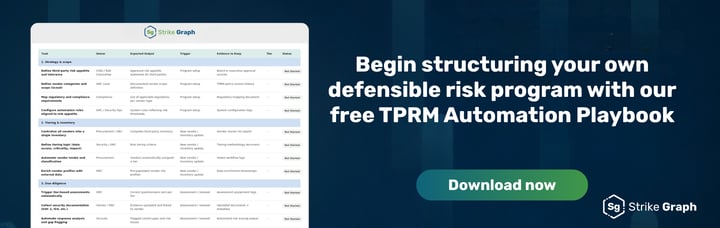
Standardizing vendor oversight requires a methodical approach to ensure consistent security across all third-party engagements. Our free playbook provides a structured framework, defining specific stages, technical tasks, and the exact evidence required for audit readiness. Using this sheet, organizations can assign clear ownership and define expected outputs for every step of the risk management process.
You can download our TPRM Automation Playbook in Google Sheets for free to begin structuring your own defensible risk program.
Best practices for TPRM automation
Best practices for TPRM automation focus on pairing efficiency with accountability. The strongest programs automate repeatable tasks while keeping humans responsible for risk decisions, prioritize vendors based on real exposure, embed reviews into procurement, and maintain continuous visibility into third-party security.
Here’s a detailed rundown of TPRM automation best practices:
- Make sure humans are accountable for risk decisions: Automation can do a lot, but ultimately it's still a human who must make the final decision and take responsibility. This way, you can avoid going through the motions and ensure risk acceptance is always aligned with the specific situation.
- Use a dynamic risk-based model: Categorize your third-party vendors based on factors such as the level of access they have to your data, their criticality to your business, and your regulatory requirements. This way, you can ensure you're allocating the right resources to the right areas.
- Set up automated contract gates: Integrate your risk management system with your procurement system so that no contract is signed or payment is made without a security review. This way, risk management becomes a part of everyday operations rather than just something you do when things go wrong.
- Use real-time continuous monitoring: By integrating threat intelligence feeds, you can receive alerts if any of your vendors are breached or if their security posture changes. This means you can get on top of things fast and reduce the window of exposure.
- Standardize vendor communication through a centralized portal: Move all vendor interactions to a single interface to maintain a complete, well-documented record. This is a big help when it comes to audit time.
- Automate evidence versioning and renewal triggers: This is where you make sure you've always got the latest security documentation for all your vendors, and that you've got reminders to go and get more when it's time.
Common mistakes when automating TPRM
Common TPRM automation mistakes often arise from automating for speed rather than control. Teams may over-trust tools, apply the same assessment to every vendor, or treat reviews as one-time events. The result is noisy data, missed risk signals, and lingering exposure, especially during offboarding and across subcontractor chains.
Here’s a fuller look at TPRM automation mistakes:
- Substituting automation for human judgment: While it’s easy to think that if you've got a good system, you can just let it make all the risk decisions for you, it's still got to be a human who makes the call and takes the responsibility for it. So, you need to make sure you're setting things up so that humans are still in the loop.
- Applying a "one-size-fits-all" assessment model: Automating a single, exhaustive questionnaire for every vendor creates unnecessary administrative drag and frustrates low-risk service providers. This can lead to security questionnaire fatigue and poor data quality, and that's a waste of time for everyone. Instead, you need to be using a dynamic assessment model that tailors the level of due diligence to the specific risk profile of each vendor.
Cottrell frames the payoff directly: "When review depth is anchored to actual risk rather than applied uniformly, low-risk onboarding moves fast and your team's attention stays on the cases where it genuinely matters."
- Neglecting the "exit" in the vendor lifecycle: Many programs focus heavily on the intake process but fail to automate offboarding. This leaves "orphaned" accounts active and sensitive data in the hands of former partners long after a contract has ended. Integrating offboarding triggers into the automated workflow fixes this. When a contract is marked for termination in the procurement system, the TPRM platform should automatically initiate access revocation tickets and send data destruction certifications to the vendor.
- Relying on point-in-time snapshots rather than continuous signals: Don't just rely on annual reviews to keep an eye on things, as it leaves you in the dark when incidents happen in between. A vendor's security can change overnight if they get breached. Get real-time monitoring feeds in your central dashboard so that when there's an alert for a data breach or a drop in security ratings, you can do an emergency review without waiting for the next scheduled check.
- Overlooking fourth-party dependencies: Automation that only checks direct vendors can leave you blind to the risks their subcontractors or subprocessors may be taking. Many high-profile breaches originate far down the supply chain. Use automation to map and monitor the entire vendor's network, and require them to list their primary subcontractors as part of the onboarding process. Then set up alerts if anything goes wrong with those fourth parties.
The business case for TPRM
TPRM automation pays off when the vendor ecosystem grows faster than the security team. Manual intake, questionnaires, evidence chasing, and spreadsheet tracking do not scale, so cycle times lengthen, procurement gets blocked, and the organization either blindly accepts risk or slows the business down.
Automation also improves consistency. Standardized workflows reduce variability that arises when different teams conduct vendor reviews differently, and centralizing evidence creates a clearer audit trail. That makes it easier to defend decisions, explain exceptions, and show regulators or customers how controls were applied.
Most importantly, automation shortens the window between a vendor risk signal and a response. Continuous monitoring, ticketed remediation, and structured escalation paths increase the likelihood that the team detects issues early and can verify mitigation, rather than discovering problems at renewal time or after an incident.
Finally, integrating TPRM with procurement and contract workflows reduces the hidden costs of rework. When security checks, required artifacts, and approvals are built into the purchasing path, the business spends less time rerouting exceptions and more time moving forward with vendors that meet clear requirements.
How Strike Graph streamlines TPRM automation
When you automate third-party risk management, the real value comes from making it a routine, repeatable process, not just a one-off vendor assessment. Strike Graph's risk management system helps you identify and cut down on risks, and then keeps you on top of your security so you can keep third-party decisions consistent, reliable, and scalable – and do the same for internal controls.
To make scalable oversight a reality, Strike Graph offers Trust Chain, a TPRM solution built directly into our AI-native compliance management platform. Unlike legacy tools that rely on self-reported security questionnaires or passive public data crawling, Trust Chain actively tests real vendor evidence. It gives compliance teams a single, centralized hub to collect, validate, and act on vendor risk data, ensuring that outdated assessment timelines don't leave your organization exposed.
Here is how Trust Chain specifically helps organizations operationalize TPRM automation:
- Automated evidence evaluation: Instead of analysts manually reading through hundreds of pages of vendor documentation, Strike Graph's Verify AI analyzes actual vendor evidence against your specific requirements and automatically flags gaps, discrepancies, and risks.
- Streamlined collection and communication: Quickly convert existing questionnaires into evidence requests or use standard sets. Vendors provide documentation via a guided portal with automated onboarding, allowing the system to handle account setup and data organization.
- Hands-off renewal tracking: Trust Chain automatically monitors evidence expiration dates. When documents like a SOC 2 or ISO certification are due for renewal, the system initiates automated reminders and notifications to collect the updated files, keeping your assessments current without manual follow-up.
- Customizable vendor tiering: You can assign evidence requests universally across your entire vendor inventory, or tailor requirements to individual vendor relationships based on their specific risk tier, data access, or business criticality.
- A single source of truth: Because Trust Chain is built natively into the Strike Graph platform, your vendor risk data lives alongside your internal frameworks, controls, and executive dashboards. This unified approach eliminates data silos and clearly defines team ownership and delegation.
You also can download our risk-based security compliance ebook to see why it's such a good idea to do things this way, how ditching checklists can save you time and money, and how software like Strike Graph can help you make it all work efficiently.
For a closer look, schedule a personalized Strike Graph demo today.
FAQ on how to automate TPRM
What are some practical examples of TPRM automation in action?
TPRM automation is most effective when it replaces high-volume, repetitive tasks. Common examples include risk-based questionnaires that use skip logic to show only relevant questions, automated evidence intake with reminders, and document parsing that extracts key fields (like SOC 2 scope or expiration dates) and flags gaps for reviewer follow-up.
What are common challenges in automating TPRM?
The most common challenges are poor data quality and disconnected systems. Automation breaks down when procurement, legal, and security track vendors in separate tools without a shared vendor master list. Without a single source of truth, workflows trigger on outdated records, creating noise, missed offboarding, and inconsistent audit trails.
How can automation manage fourth-party risk without overwhelming the team?
Fourth-party risk comes from your vendor’s subcontractors and subprocessors. Automation can help by requiring vendors to disclose key dependencies during onboarding, tracking changes over time, and linking those dependencies to monitoring signals. When a major provider has an incident, the system can flag affected vendors and trigger targeted reassessments.
How does agentic AI differ from standard workflow automation in TPRM?
Standard workflow automation follows predefined rules, like routing tasks, sending reminders, and enforcing gates. Agentic AI can go further by synthesizing evidence, summarizing issues, and proposing next steps based on patterns in past reviews. It can draft remediation requests or exception memos, but humans still approve decisions and risk acceptance.






/Blog%20Graphic%20%5BAI-and-automation-tag-banner-SG%20blog-Oct2024%5D.png)
.png?width=600&height=600&name=Blog%20Featured%20Image%20600x350px%20(12).png)
.jpg?width=600&height=600&name=Blog%20images%20(1).jpg)