.jpg?width=1448&height=726&name=Screen%20Shot%202023-02-09%20at%202.57.5-min%20(1).jpg)
February 9, 2023

.png)
Executive summary:
Scaling a third-party risk management (TPRM) program requires more than adding tools or headcount. It involves strengthening core elements such as governance, repeatable workflows, and reassessment models, then redesigning intake, tiering, assessment paths, and decision authority to support higher volumes. As third-party counts grow, assessment capacity must increase without sacrificing oversight. Organizations use proportional scoping, federated ownership, standardized frameworks, and automation-supported execution to maintain alignment between effort and risk. This guide outlines the structural changes, practical tips, and an action plan template to help you scale TPRM with discipline and consistency.
A scalable TPRM program relies on consistent elements as third-party volume grows, including vendors, service providers, partners, and contractors. Those elements include a clear governance and decision model, repeatable workflows, a reassessment and monitoring model, and workflow tooling support for administrative tasks.
Here are the core TPRM elements to scale:
Governance and decision model: A scalable TPRM program has clear ownership for each third-party relationship and defined decision rights by risk tier, including escalation and risk acceptance rules that keep reviews from stalling.
Standard workflows: A scalable program uses consistent workflows for intake, tiering, assessments, and reassessments so reviews are repeatable across teams and don’t depend on individual reviewer preferences.
Reassessment and monitoring model: A scalable program has defined reassessment cadence and event-based triggers (such as renewals, scope changes, or incidents) so effort stays focused on material changes as volume grows.
Workflow tooling support: A scalable program has tooling support for repetitive administrative work such as routing, reminders, and evidence tracking, while leaving risk decisions and exceptions to human review.
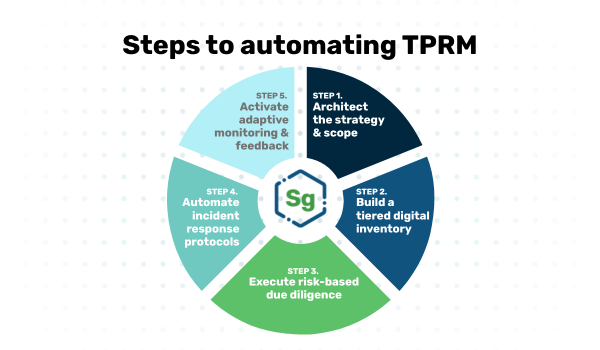
Scaling a TPRM program means moving from ad hoc reviews to repeatable workflows that don’t depend on individual reviewers. The steps below focus on redesigning intake, tiering, assessments, and decision-making to enable the program to handle more third parties without slowing onboarding or weakening oversight.
Having inconsistent intake channels creates blind spots and lets unvetted vendors slip through your security net. To scale, you need to set up a single entry point, a dedicated portal or service desk ticket, for all new vendor requests. This process needs to mandate that a clear internal business owner takes ownership of each relationship, so they can own risk remediation and ongoing performance management.
Risk tiering is about categorizing third parties based on their potential impact to your organization, so you can allocate your due diligence resources accordingly. Instead of applying a uniform assessment to every third party, tiering lets risk teams apply deeper review to high-risk vendors while using lighter checks for low-risk providers. This segmentation prevents assessment bottlenecks and focuses expertise on high-exposure relationships.
Tiering works best when it uses a small set of inherent risk factors, such as data sensitivity, access level, and business criticality. The goal is not a perfect score; it is a consistent way to route each third party to the correct assessment path, so effort remains proportional as volume grows. Once tiers are defined, each tier should have a default review path so reviewers aren’t reinventing the process for every new request.
Scalability means walking away from bespoke questionnaires and replacing them with standardized assessment paths. By matching vendors to pre-defined risk profiles, you can use consistent control sets, such as the SIG Lite or a full security audit, and reduce back-and-forth and make sure data is comparable across the portfolio.
Ambiguous approval chains are a major bottleneck where assessments just get stuck in pending status forever. To scale, define explicit decision rights by tier and issue severity, including when a reviewer can approve, when an issue must escalate, and how risk acceptance is documented. This helps risk decisions keep pace with the business without sacrificing oversight.
Automation is most effective once your intake, tiering, assessment paths, and decision rules are stable and repeatable. At that point, automation can handle administrative work such as routing, reminders, questionnaire distribution, and evidence tracking, while humans retain judgment-based decisions and exception handling.
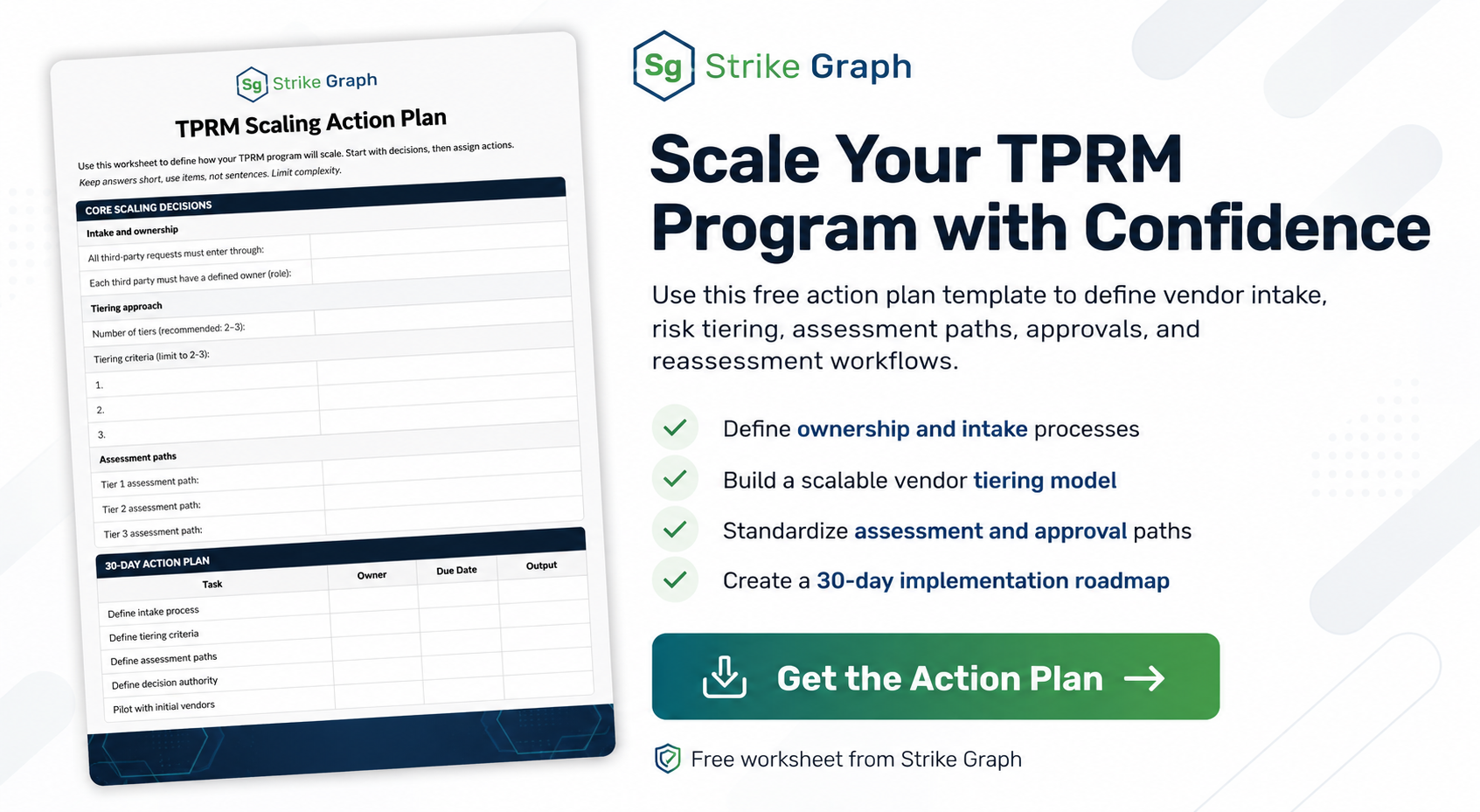
Use this template to turn the scaling guidance in this article into a concrete action plan. It helps teams define their intake, tiering, assessment paths, decision authority, and reassessment model, then assign owners, due dates, and outputs for the work ahead. The example tab shows what a completed version can look like in practice.
Once intake, tiering, and standardized assessment paths are in place, the next challenge is managing assessment volume as third-party counts and renewal cycles increase. At scale, you need to preserve consistency while preventing backlogs, duplicated effort, and reviewer fatigue.
Efficient scaling of third-party risk assessments depends on:
Centralized inventory: A unified third-party inventory is your single source of truth. Without it, you'll end up with a patchwork of departmental silos, and you won't be able to get a clear view of your risk exposure. Growth requires visibility. Without a complete third-party inventory of all your relationships, you can’t accurately assess aggregate risk or streamline intake workflows.
Organizations scale third-party risk assessments by adopting operating approaches that keep effort aligned to risk as volume grows. Common methods include proportional scoping, federated ownership, standardized assessment frameworks, and automation-supported execution. Most scalable programs combine these approaches to increase assessment capacity without weakening oversight.
The methods below are complementary. You can layer them together based on your organization’s structure, maturity, and risk tolerance:
Proportional scoping: This approach aligns assessment depth to inherent risk, so high-risk third parties receive comprehensive review while low-risk relationships follow lighter, streamlined paths. It prevents linear growth in workload and keeps specialized effort focused where exposure is highest.
Sustaining TPRM scale requires reinforcing the operating model with disciplined guardrails. Programs scale more effectively when tiering stays simple, evidence requests remain capped, risk acceptances expire, workflows are piloted before rollout, and exception patterns are monitored over time rather than addressed in isolation.
The following practices help preserve capacity and consistency as third-party volume grows:
Monitor exception trends, not just individual issues: At scale, patterns matter more than single findings. Reviewing trends in escalations and remediation timelines helps identify structural weaknesses before they become systemic failures.
 Andy Cottrell, CEO of Truvantis, points to one pattern in particular: "When risk acceptance becomes standard practice rather than a documented exception, it's usually a sign the assessment process wasn't credible to begin with. Teams accept rather than remediate because they don't actually believe in the risk tier they assigned."
  “Piloting any kind of TPRM automation with your more willing, easier to work with existing vendors is imperative,” notes Elliott Harnagel, Product & Compliance Experience Strategist at Strike Graph. “You don't want to hold up acquisition of new vendors with kinks or bugs in new TPRM automation. And no one likes fulfilling TPRM requests, they do it because it is a requirement, no one is happy to receive new vendor requests, so it's best to pilot new initiatives with customers you already have a good relationship or [are] notably easy to work with.”
Scaling efforts often fail when structural discipline weakens under growth pressure. Common pitfalls include exception creep, bespoke workflows reemerging, automation applied to unstable processes, unclear remediation ownership, and calendar-driven reassessments that overwhelm teams. Identifying these risks early protects both efficiency and oversight.
The following failure modes frequently undermine scaling initiatives:
Exception creep: When reviewers escalate vendors “just to be safe” and create many exceptions, the risk tiers aren’t functioning as they should. As Cottrell puts it, strong tiers mean that overused exceptions “stop being the place uncomfortable decisions go to hide."
Strike Graph helps teams operationalize a scalable TPRM operating model by centralizing work, standardizing review workflows, and reducing manual overhead in evidence and questionnaire handling. It supports consistent decision-making as third-party volume grows, while keeping judgment-based risk decisions with human reviewers.
At the core of this capability is Trust Chain, Strike Graph’s dedicated TPRM solution built directly into our AI-native compliance platform. When vendor volume spikes, relying on manual security questionnaires and passive data crawling quickly becomes a bottleneck. Trust Chain replaces this slow back-and-forth by using AI to actively test real vendor evidence against your specific requirements. This gives your team a single place to collect, validate, and act on vendor risk, allowing your program to handle higher volumes without requiring a proportional increase in headcount:
Here is how Trust Chain specifically uses automation to help organizations scale third-party risk management:
Frictionless, centralized collection: You can effortlessly convert your existing security questionnaires into standardized evidence requests. Vendors submit their documentation through a simple, guided portal, without needing to create a Strike Graph account, which eliminates administrative onboarding bottlenecks.
Proportional, tiered requirements: To support a scalable tiering model, you can assign evidence requests universally across your entire vendor inventory, or customize assignments to match individual vendor relationships based on their specific risk tier and business criticality.
AI-accelerated reviews: Strike Graph’s Verify AI automatically analyzes vendor-submitted documentation against your requirements to surface risks. This drastically reduces the time spent on first-pass reviews, so your team doesn't have to manually read every document as assessment volume rises.
Automated reassessment triggers: Tracking renewals manually across hundreds of vendors is unscalable. Trust Chain monitors evidence expiration automatically and initiates recollection when documents are due for renewal, ensuring your assessments stay current without relying on spreadsheets or calendar reminders.
Unified compliance ecosystem: Because Trust Chain lives natively alongside your internal frameworks and controls, it eliminates the need for siloed tools. This single source of truth limits duplication of effort and keeps your entire compliance posture visible in one centralized dashboard.
Sign up for a Strike Graph demo today.
How long does it usually take to scale a TPRM program?
Scaling a TPRM program can take roughly 12-24 months, depending on vendor volume, regulatory pressure and organizational maturity. Early gains often come within the first 3-6 months through risk tiering, standardization and automation, while full operational maturity requires iterative refinement.
Can smaller or less mature organizations scale TPRM effectively?
Yes. Smaller or less mature organizations can scale TPRM by focusing on proportionality rather than complexity. Clear scoping, lightweight governance and selective automation allow effective risk coverage without enterprise-grade tooling, enabling scale that aligns with organizational size and risk exposure.
How do organizations balance speed and risk tolerance as TPRM programs scale?
Organizations balance speed and risk tolerance by using inherent risk to determine assessment depth and approval pathways. Low-risk vendors move through streamlined workflows while higher-risk relationships trigger deeper reviews and escalations, ensuring speed where acceptable and rigor where required.
What parts of TPRM should remain manual even in a scaled program?
Even in scaled programs, activities requiring judgment remain manual, including vendor criticality risk acceptance decisions, exception approvals and remediation prioritization. Human oversight ensures contextual understanding and prevents automation from masking material risks or misaligned business dependencies.
How does scaling TPRM affect audits, regulators or external reviews?
Well-scaled TPRM programs generally improve audit and regulatory outcomes by increasing consistency, traceability and defensibility. Standardized processes, documented decision logic and centralized reporting make it easier to demonstrate risk-based oversight and respond efficiently to examiner or auditor inquiries.



Copy URL


/Blog%20Graphic%20%5BAI-and-automation-tag-banner-SG%20blog-Oct2024%5D.png)

%20(5).png?width=500&height=300&name=Untitled%20(350%20x%20200%20px)%20(5).png)
.png?width=600&height=600&name=Blog%20Featured%20Image%20600x350px%20(32).png)