Executive summary:
For effective third-party compliance risk assessments, you need a repeatable process built into your onboarding of vendors, service providers and other third parties. This guide provides step-by-step instructions for addressing key standards (such as SOC 2 and PCI DSS) and regulatory requirements (like HIPAA and GDPR), conducting focused due diligence, and assessing risks across your supply chain. You’ll also get an assessment question library, a playbook template, and tips for ongoing monitoring. By following these steps, you can optimize your reviews, manage vendor compliance with confidence, and stay ready for audits with modern tools.
How third-party compliance risk assessments fit in TPRM
Third-party compliance risk assessments lay the groundwork for a solid risk management program. Organizations often start with compliance since it ties directly to audits, contracts, and regulations. Over time, risk management often grows beyond compliance to encompass financial health, operations, strategy, and cybersecurity.
You should complete a compliance assessment whenever an outside company can access sensitive data or impact your regulatory or framework status. This applies to all vendors, suppliers, partners, and service providers. Including this in onboarding helps you meet requirements before adding new services.
Step-by-step process for third-party compliance risk assessments
A repeatable compliance process requires defining the vendor's scope, tiering their inherent risk, and identifying applicable regulatory requirements and standards. From there, you customize questionnaires, collect evidence, and review control gaps to calculate residual risk. Finally, management decides on vendor approval and establishes continuous monitoring.
Execute a thorough third-party compliance risk assessment by following this process:
- Define the business relationship and scope: List the outside company’s services and how much access they have to your systems. Setting the scope early helps you focus on the right compliance issues and avoid wasting time on questions that don’t matter for this vendor, supplier, service provider, or other third party.
- Tier third parties by risk: Implement formal risk tiering to sort third parties based on service criticality and inherent risk. For example, a vendor with access to health data needs more careful review than one who supplies office materials.
- Identify compliance requirements: Determine which laws and contract terms apply to the vendor. If they handle personal or financial data, make sure they comply with regulations such as HIPAA and GDPR, or industry standards such as SOC 2 and PCI DSS. This helps you focus your review on the right requirements.
- Create or adjust your questionnaire and evidence requests: Don’t use generic checklists. Instead, match your questions to the vendor’s risk level. Use standard formats like SIG or CAIQ, and ask for specific documents as proof. This way, you get the right information for your compliance needs.
- Collect vendor answers, documents, and background information: Get completed vendor risk assessment questionnaires and key evidence such as SOC 2 Type II reports, ISO 27001 certificates, or contract clauses. Check their list of subprocessors to spot any hidden risks from other parties that could affect your data security.
- Review control gaps and evidence: Check the documents to ensure the vendor actually uses the security controls they claim to use. Compare their answers to your compliance standards to find any gaps. This helps you see where the vendor falls short and what risks remain.
- Score findings and record the leftover risk: Give each risk a score based on its likelihood and potential impact on your business. Write these results in your risk register to show what risks remain after controls are in place. This helps leaders make informed decisions.
- Decide what to do next: Use the final score to choose whether to approve the vendor, reject them, or ask for fixes. If you proceed with a deficient vendor, formalize a corrective action plan and document your decision to keep a defensible audit record.
- Set a schedule for reviews and keep monitoring: Risks can change, so one-time checks aren’t enough. Review vendors regularly based on their risk level and monitor for new threats. Ongoing checks help your supply chain stay compliant over time.
![Headshots [Micah Spieler-headshot]-2](https://www.strikegraph.com/hs-fs/hubfs/Headshots/Headshots%20%5BMicah%20Spieler-headshot%5D-2.png?width=180&height=180&name=Headshots%20%5BMicah%20Spieler-headshot%5D-2.png) “A lot can happen in a year, especially in tech,” says Micah Spieler, Chief Product Officer at Strike Graph. “A vendor might migrate database hosting to a different jurisdiction weeks after completing a questionnaire, potentially putting you out of compliance with your own customer agreements. You may not find out for another eight months. Third-party risk programs that utilize continuous monitoring catch these shifts immediately, whereas a static, point-in-time yearly review has no chance.”
“A lot can happen in a year, especially in tech,” says Micah Spieler, Chief Product Officer at Strike Graph. “A vendor might migrate database hosting to a different jurisdiction weeks after completing a questionnaire, potentially putting you out of compliance with your own customer agreements. You may not find out for another eight months. Third-party risk programs that utilize continuous monitoring catch these shifts immediately, whereas a static, point-in-time yearly review has no chance.”
How to create an effective third-party compliance risk questionnaire
To build a good third-party compliance questionnaire, focus on clear and useful questions. Don’t overwhelm partners with long lists. Instead, ask for information you can check and use. A focused questionnaire matches your regulatory needs and helps you find real risks in your supply chain.
“Standard questionnaires tend to measure intent, but typically don't reveal actual security or compliance practices,” says Spieler. “A vendor can honestly answer ‘yes, we have a patch management policy’ while running unpatched systems in production. Because savvy vendors are asked to fill out hundreds of questions, they often provide cursory responses just to get through the process. This behavior is unfortunately incentivized by a lack of real validation through actual evidence collection.”
Consider these key approaches for your third-party compliance risk questionnaires:
-
Use core question categories: Ask about key risk areas that affect your business and compliance. Include sections on information security, data privacy, business continuity, and legal compliance. This way, you get a full picture of the vendor’s controls and processes.
- Tailor your questions by vendor tier and service type: Adjust question depth based on the vendor's inherent risk and access to sensitive information. A critical software provider requires an extensive technical evaluation, while a low-risk contractor needs only a basic compliance check, ensuring you allocate assessment resources efficiently.
- Know when to use standard vs. custom questionnaires: Use standard tools, such as a SIG questionnaire, to gather basic data and compare risks. But always adjust these templates to cover special industry rules or your own company policies that standard forms might miss.
- Match questions with evidence: Don’t just take the vendor's word for it. For every important question, ask for proof, such as SOC 2 Type II reports, test results, or written security policies. This way, you can check their claims and keep a solid audit record.
- Avoid long, unfocused questionnaires: Only ask questions that fit the vendor’s services. For example, if a supplier doesn’t handle payments, skip PCI DSS questions. Keeping it focused saves time for everyone and avoids extra paperwork.
Question library to build third-party compliance risk questionnaires
.png?width=3066&height=2043&name=%5BSEO%20GRAPHIC%5D%20TPRA%20Question%20Library-01%20(1).png)
This downloadable question library is a bank of vendor compliance questions, each mapped to the frameworks it satisfies and paired with the evidence to request. Filter by the frameworks that apply to a vendor to build a focused questionnaire from only the relevant questions.
Because the same question often satisfies several frameworks at once — one multi-factor authentication item can cover SOC 2, HIPAA, and PCI DSS together — you ask fewer questions and collect more proof than you would by repeating the same control under each standard.
You can also extend the library with your own questions, framework tags, and evidence requests to cover internal policies or niche industry rules.
Mapping compliance frameworks and standards to your third-party risk assessments
Make sure your risk assessments fit the right compliance requirements and industry standards. Instead of using generic questions, link your assessments to key frameworks. This helps you cover the right controls, protect your data, and meet audit requirements.
“Combining cross-mapped questions into a unified set of evidence requests, compliance teams can reduce administrative effort by 30–50%,” Spieler says. “Rather than 8-10 questions about a data management policy, why not just verify the policy directly? We've seen TPRM programs reduce their 200+ questions into just 25 evidence requests, significantly reducing not only the burden on the vendor, but also on the internal team reviewing their vendors for risk.”
 Bob Kolasky, Senior Vice President for Critical Infrastructure at Exiger and founding director of CISA's National Risk Management Center, made a similar argument on the Secure Talk podcast about supply chain security and the future of TPRM.
"From a risk perspective, it has not been good enough for a long time," Kolasky said. "So let's trust but verify. Let's look for different processes to verify... There's a lot of times you want to verify and then trust. And I think that's where we're getting to."
Use these strategies to make sure your third-party assessments meet your compliance needs:
-
Map requirements to laws: Link every assessment question directly to specific legal mandates governing your data processing agreements. If a vendor handles personal information, their evaluation must strictly verify alignment with relevant statutory regulations, such as GDPR, HIPAA, or CCPA.
-
Map requirements to frameworks and policies: Beyond legislation, your evaluations must address established security standards, such as the NIST Cybersecurity Framework or ISO 27001. Ensure you also map questions to internal policies and contractual representations, including mandatory flow-down requirements, to maintain consistent corporate governance.
-
Adjust framework mapping by vendor type: Customize the frameworks applied based on the vendor's operational function and data access. A payroll processor requires mapping to financial controls and SOC 2 Type II standards, while a cloud storage provider in healthcare must strictly align with HIPAA compliance requirements.
-
Reduce duplicate evidence requests across overlapping requirements: Many compliance frameworks share identical security controls, such as access management or encryption standards. Map these overlapping requirements to a single evidence request, like a Statement of Applicability or standard contractual clauses, to eliminate redundant tasks and accelerate vendor response times.
Playbook for implementing third-party compliance risk assessments
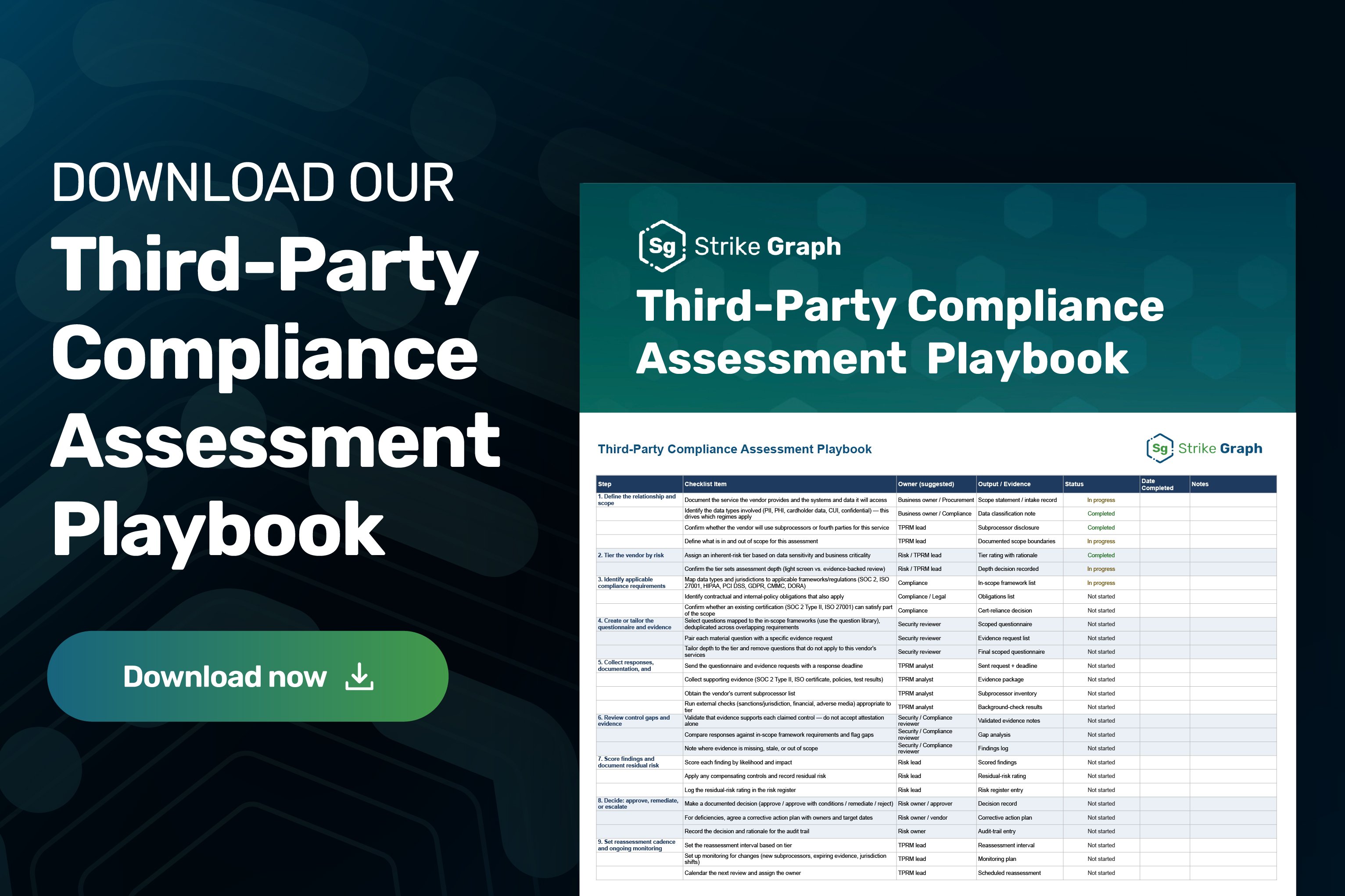
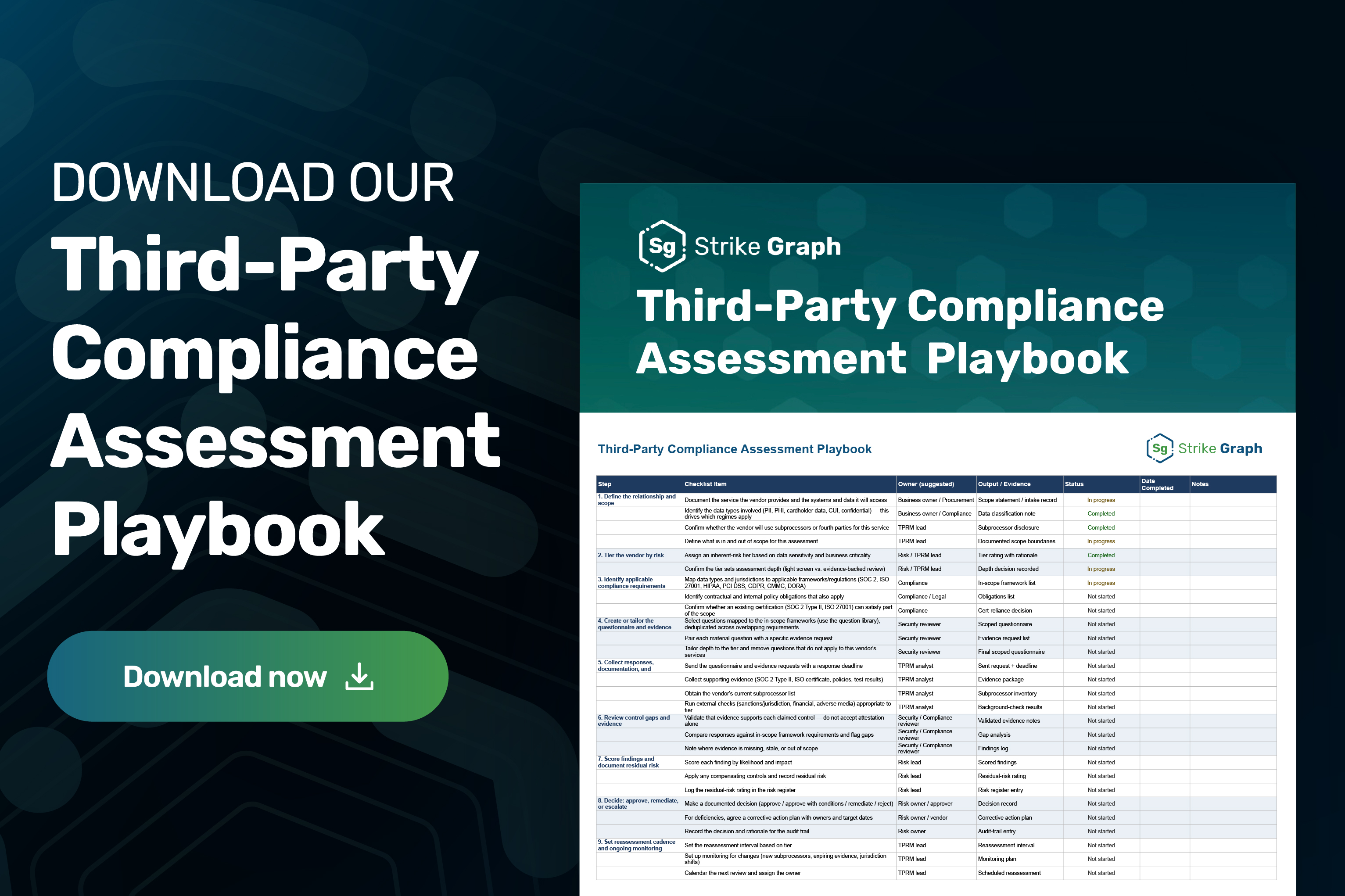
Download our free Third-Party Compliance Assessment Playbook
Implementing a structured playbook immediately standardizes vendor evaluations and prevents critical requirements from being overlooked. This spreadsheet will help you organize and keep track of your strategy by phase and core step, effectively breaking broad compliance goals into actionable subtasks. It provides a clear framework to map specific requirements, assign internal ownership, and establish target dates.
Example of a third-party compliance risk assessment
In Strike Graph, the vendor profile page serves as the comprehensive hub for third-party compliance risk assessment. Here, you can easily assign specific evidence items for a vendor to complete. As the example shows, tracking progress is straightforward, allowing you to instantly see when all uploaded documents have satisfied the necessary requirements.
Example of a vendor profile page for TPRM 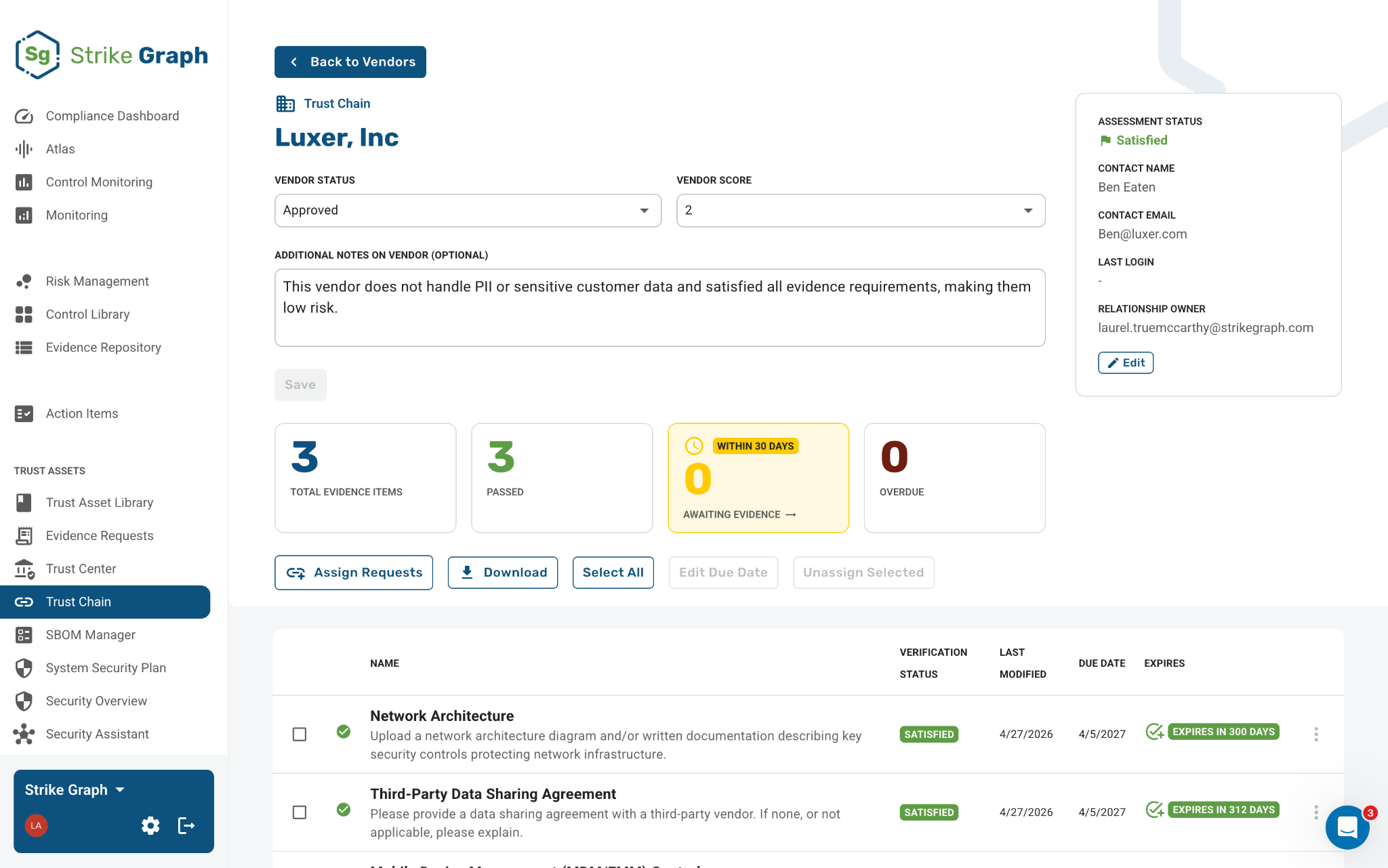 This is an example vendor profile screen from Strike Graph’s Trust Chain product for third-party risk management.
Once a vendor uploads their documents, Strike Graph’s Verify AI steps in to analyze the submissions against your stated requirements. When a document aligns perfectly, like a valid SOC 2 report, the system marks it with a "Looks Good" confidence rating. This automated verification instantly updates the status to satisfied, saving your team valuable review time while ensuring compliance.
Example of how AI assesses TPRM evidence: SOC 2 report 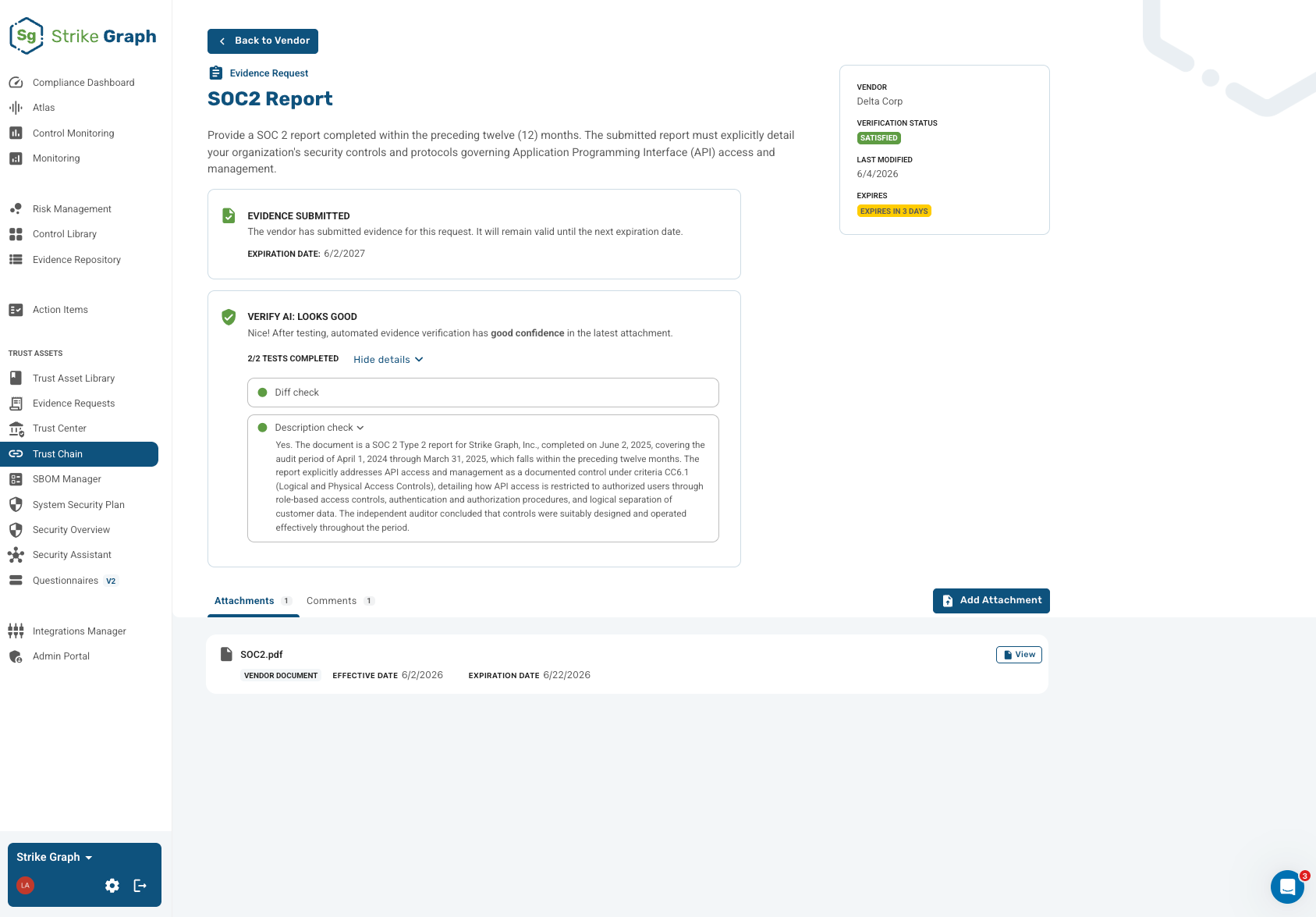 This screen from Strike Graph’s Trust Chain product for TPRM shows what it looks like when the Verify AI tool reviews a SOC 2 report and assesses the document against the description.
If Verify AI determines a document doesn't entirely meet the description's requirements, it flags the item as "Needs Attention." You then have full control to review the AI's detailed analysis. From there, you can request document access, start a comment thread for more information, or manually mark the requirement as satisfied if you deem the evidence acceptable.
Example of a TPRM evidence assessment: Penetration test report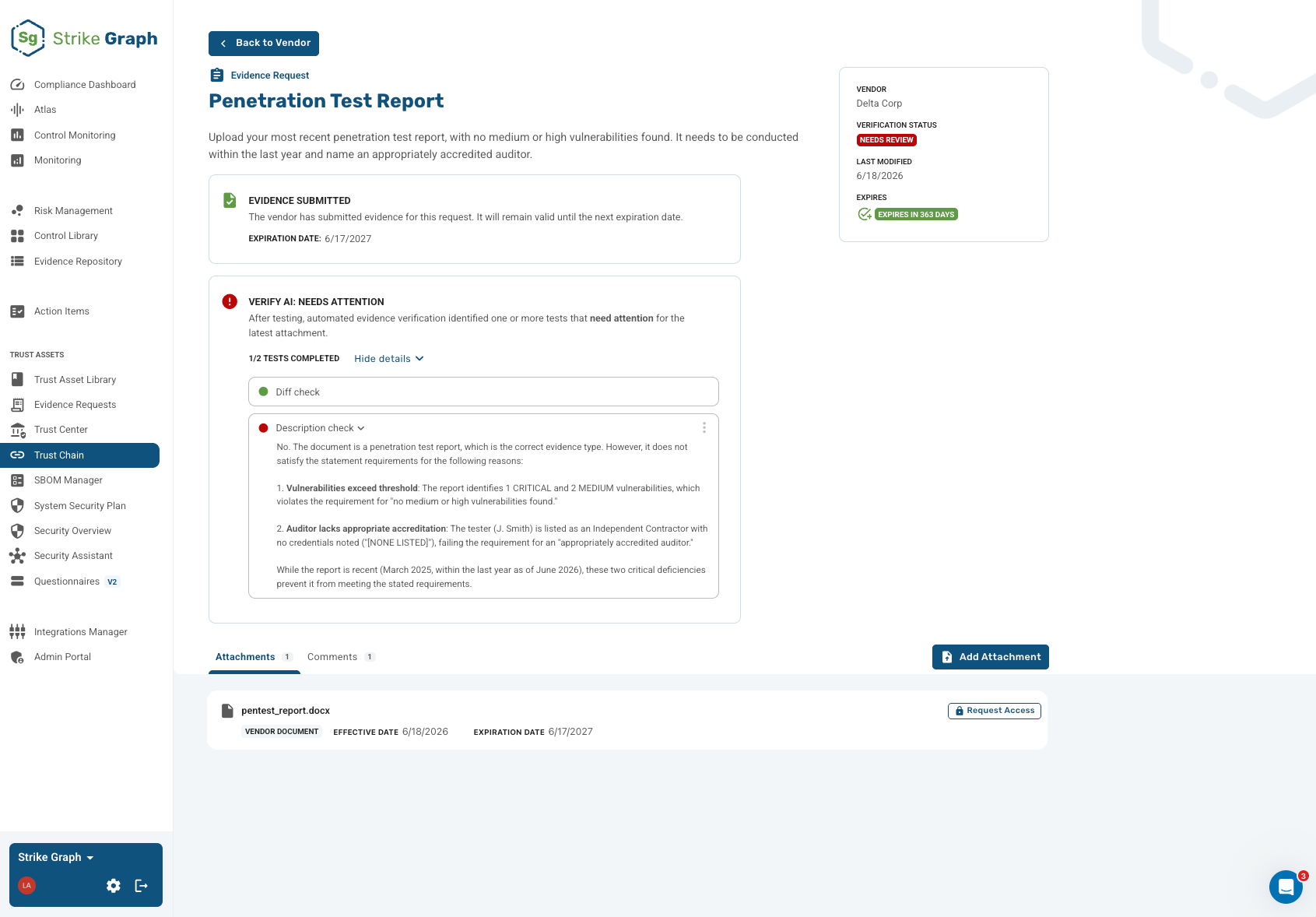 This screen from Strike Graph’s Trust Chain platform shows how it assesses a penetration report. The Verify AI tool has determined that the report does not fully meet the stated requirements in the description.
Customers can review this analysis and decide how to proceed. They can request more information, ask for document access, or start a conversation with the vendor in the comments. If they conclude the document actually meets the criteria, they can manually mark the requirement as satisfied.
Types of third-party compliance risks to account for in assessments
A good risk assessment considers all aspects of vendor risk, not just security checklists. If you rely solely on basic questions, your company could face legal, financial, or operational problems. Careful oversight of your whole supply chain helps you meet audit and governance standards.
Be sure to check these types of compliance risks to protect your data, meet regulations, and keep your business running smoothly:
- Data privacy and data handling risks: Check how vendors collect, store, and use your sensitive data. If they mishandle personal information, it can break privacy laws and hurt customer trust. Make sure they use strong encryption, access controls, and proper data retention to keep your data safe.
- Regulatory and industry-specific compliance risks: Check whether the vendor complies with industry-specific regulations, such as HIPAA for healthcare or PCI DSS for retail. If they don’t, your company could face significant fines or legal trouble due to their mistakes.
- Contractual and policy compliance risks: Ensure the vendor adheres to your company’s security policies and the terms of your data agreement. This helps ensure they honor breach notification obligations, maintain required insurance, and stick to the security promises made in your initial contract.
- Subprocessor and fourth-party risks: Investigate the external providers your vendor relies on to deliver their services. A vendor might maintain strong controls, but a weak link in their subprocessor inventory introduces hidden vulnerabilities.
As Kolasky puts it, "There's always been an aspect that you've owned your suppliers' risk a little bit. And by entering into the nature of a business relationship where you're working together to deliver something... that risk is part of your responsibility, especially if you give access to data. Now officially you own that risk."
- Geographic, sanctions, and cross-border risks: Check where the vendor operates and physically stores your data. Moving information internationally triggers complex legal issues. Make sure you execute lawful cross-border data transfer protocols and avoid working with companies in restricted regions to prevent severe penalties and operational disruptions.
- Ethics, labor, and ESG-related risks: Check the vendor’s impact on the environment, how they treat workers, and their business practices. Working with unethical companies can hurt your reputation. Make sure they follow ESG standards, act responsibly, and meet new social responsibility rules.
Best practices for third-party compliance risk assessments
To conduct effective third-party compliance risk assessments, you must enforce contractual audit rights and require independent assurance, such as a SOC 2 Type II report or ISO 27001 certification. Strengthen your program by automating evidence collection, standardizing exception management, and routinely updating questionnaires to reflect new regulations.
Moving away from manual, static methods is critical for long-term security. The dangers of relying solely on manual reviews are highlighted in a 2021 paper titled, "Third-Party Vendor Risk Assessment and Compliance Monitoring Framework for Highly Regulated Industries." As the paper notes, "A static approach leaves organizations exposed to significant risk for extended periods, as a vendor's security posture can change rapidly due to new vulnerabilities, system changes, or a breach."
Kolasky frames the shift plainly: "Nobody wants just a moment in time, either a binary yes or no, but a commitment to continue to actively manage risk and be flexible around that. The easy mantra is to get rid of checklists and replace checklists with a sort of dynamic process that can be automated and regularly checked against."
Use these best practices to improve your third-party compliance risk assessments:
- Enforce audit rights in vendor contracts: Contractual representations mean little without enforcement. Always embed strict audit rights within your vendor agreements before finalizing the contract. This practice guarantees you the legal authority to independently verify a partner's self-attestation, ensuring their compliance controls actually function as promised during a regulatory inquiry.
- Require independent compliance certifications: Never rely solely on a vendor's internal claims regarding their security posture. Mandating independent validations, like an updated SOC 2 Type II report or ISO 27001 certification, provides objective proof that external auditors rigorously tested and verified their compliance controls against established industry standards.
- Automate evidence collection and review: Handling evidence by email can be messy and unreliable. Use automated tools to send questionnaires and gather documents in one place. This keeps your data organized and helps your team find control gaps faster.
- Standardize your exception management: Some vendors won’t meet every compliance rule. Set up a clear process to document these issues, add extra controls, and track fixes. This way, leaders know about any leftover risks before starting work.
- Update your assessments to match new regulations: Laws change often, so old questionnaires can quickly become outdated. Regularly refresh your assessment questions to match the latest rules. This keeps your reviews accurate and up to date.
Tools for implementing vendor compliance risk assessments
Modern tools for third-party compliance replace manual spreadsheets with centralized platforms that automate questionnaire distribution, evidence collection, and audit logging. These solutions provide real-time visibility into vendor gaps and allow teams to manage risks at scale without increasing administrative overhead.
A 2024 paper in the Journal of Mathematical & Computer Applications highlights the value of these technologies. The paper, titled "Developing New Framework for Vendor Risk Assessment by Comparative Analysis," says, "Automated tools can significantly streamline the vendor risk assessment process, making it more efficient and reducing the potential for human error."
Moving from static documents to dynamic software allows organizations to maintain a living record of their supply chain security. Automated workflows ensure that evidence, such as SOC 2 reports or insurance certificates, is collected and reviewed systematically, reducing the likelihood of human oversight during the intake process.
Platforms like Strike Graph integrate these third-party assessments directly into a broader governance framework. This approach enables you to map vendor controls to specific regulatory requirements automatically, which helps maintain audit readiness and ensures that external partners remain aligned with your internal security standards.
How to streamline your third-party compliance risk assessments
Instead of juggling multiple tools, Strike Graph’s Trust Chain brings your entire third-party compliance assessment process into one AI-native GRC platform. Match vendor evidence to compliance frameworks automatically and stay audit-ready year-round.
Strike Graph makes it simple to use AI for third-party risk management in these ways:
- Automate evidence checks and framework mapping: Strike Graph’s Verify AI collects and tests vendor evidence automatically, matching controls to frameworks like SOC 2, ISO 27001, and CMMC. This removes extra manual work and quickly finds important control gaps.
- Skip questionnaires with Trust Chain: Traditional security questionnaires don’t provide reliable evidence or real proof of compliance. With Strike Graph’s Trust Chain, vendors upload actual documentation and Verify AI checks them against your requirements, giving you far more confidence than a standard survey.
- Scale assessments while maintaining human accountability: Strike Graph’s AI Security Assistant handles the tedious work of evaluating vendor artifacts and scoping audits. While the platform automates these complex compliance workflows, it intentionally keeps judgment-based risk decisions with your internal subject-matter experts, ensuring rapid scalability and strict executive oversight.
Ready to see it in action? Book a Strike Graph demo today.







/ebook-ctas_340x500_in-house-ai-compliance.webp)
.png?width=600&height=600&name=Blog%20Featured%20Image%20600x350px%20(32).png)