
February 9, 2023

Strike Graph vs. Vanta: Technical Review for Decision-Makers
Strike Graph is built for organizations that need a long-term GRC system, while Vanta is geared more toward first-audit automation. This technical analysis compares how each platform handles complexity, evidence, AI, scale, and total cost.
Executive summary:
Strike Graph is built for organizations that need a broader GRC system: multi-framework compliance, deeper evidence collection, distributed ownership, enterprise scale, and demanding regimes such as CMMC, TISAX, and FedRAMP. Vanta is a strong fit for small SaaS companies pursuing a first SOC 2 audit with a standard tech stack. The biggest differences are architectural. Strike Graph’s risk-control-evidence model, flexible integrations, and AI-driven internal audit capabilities support more complex programs with lower long-term operational overhead. For decision-makers comparing long-term scalability with short-term speed, that distinction matters.
The fundamental difference between Strike Graph and Vanta
The compliance automation market has bifurcated into two distinct categories: point-solution auditing tools designed to automate a single, well-defined certification process; and operational compliance management platforms built to become the system of record for an organization's entire security, privacy, and risk posture.
Vanta pioneered the first category and solved a real, painful problem: getting a SaaS startup through a first SOC 2 audit quickly and cheaply. Thousands of companies have successfully used Vanta to achieve their first compliance certification. For companies in the 1–50 employee range with a standard SaaS stack and a single compliance goal, Vanta remains a legitimate and well-proven option.
But as organizations grow beyond that initial footprint, the constraints of Vanta's original design become a significant operational liability. Vanta was built to answer: "How do we automate evidence collection for a predefined set of SOC 2 controls?" Strike Graph was built to answer a fundamentally different question: "How do we build and operate a sustainable, enterprise-grade security and compliance program that scales across frameworks, teams, organizational complexity, and demanding regulatory environments like CMMC, TISAX, and FedRAMP?"
This comparison covers 12 dimensions, such as platform architecture, integration depth, the risk-control-evidence ontology, AI capabilities, enterprise scalability, pricing, and coverage of complex compliance regimes. It is written for organizations in the 50–50,000 employee range that have moved beyond their first audit and need a GRC platform that scales with them.
Strike Graph vs. Vanta
-
Strike Graph: Built for organizations scaling past their first audit into multi-framework, multi-entity compliance (validated at Sanmina, Fortune 500, ~39,000 employees, 23 countries)
-
Vanta: Optimized for companies seeking only 1 framework, SOC 2 automation, SaaS startups.
|
Comparison Dimension |
Strike Graph |
Vanta |
|
1) Target buyer |
Purpose-built for 50 to 50,000+ employee organizations managing multiple frameworks, facilities, or regulatory regimes |
Strongest fit is 1 to 50 employee SaaS companies pursuing a first SOC 2 Type II with a standard cloud stack |
|
2) Data model |
Composable risk-control-evidence ontology; one control satisfies multiple frameworks, eliminating "partial compliance" |
Test-centric model; predefined tests map to predefined controls per framework, with duplicated work across frameworks |
|
3) Integration architecture |
Four paradigms (Basic, Terraform, Bridge, Evidence API) reaching effectively unlimited data points, including custom and legacy systems |
375+ OAuth integrations collecting a fixed, pre-mapped set of data points; no path for custom or legacy systems |
|
4) AI capabilities |
Verify AI (patent-pending) runs automated internal audits and evidence sufficiency analysis; models are self-hosted |
AI focused on policy drafting (2 to 6 minutes) and capped questionnaire automation (25 to 288 per year); routes through third-party AI |
|
5) Complex framework support |
Native CMMC (all levels), TISAX, and FedRAMP/NIST 800-53 support, including SSP and POA&M generation |
CMMC, TISAX,and FedRAMP support limited; POA&M workflows still limited. |
|
6) Responsibility model |
Distributes control ownership across engineering, HR, legal, and facilities with per-owner accountability tracking |
Concentrates compliance work in a small technical team; interface reviews are mixed |
|
7) Enterprise scalability |
Federated architecture allows separate scopes per subsidiary or facility under one consolidated view |
Workspaces feature adds multi-entity support, but doesn't resolve underlying framework-centric limitations (per Gartner reviewers) |
|
8) Pricing and 3-year TCO |
All-inclusive pricing bundles Trust Center and vendor risk management with no per-add-on fees; ~$111K estimated 3-year TCO for a 150-person org |
Lower entry price, but add-ons (Trust Center, vendor risk management, per-framework fees) push 3-year TCO to ~$202K for the same scenario |
|
9) Full capability comparison |
Flexible GRC platform architecture built for cross-framework compliance management. |
More predefined automation model optimized for early compliance milestones with limited flexibility |
|
10) Vulnerability scanning |
Built into evidence collection (5,000+ data points), auto-linked to controls and Action Items |
Depends on separately configured Inspector or Defender; returns no data silently if misconfigured |
|
11) Support and advisory |
Platform support with compliance advisors available for CMMC, TISAX, FedRAMP, and more. |
Support limited to business hours (M-F) and platform troubleshooting; no compliance consulting |
|
12) SBOM |
Native SBOM Manager pulls CycloneDX/SPDX from CI/CD pipelines and auto-maps CVEs to compliance controls |
No SBOM capability; requires a separate tool with manual correlation |
Dimension 1: Target buyer for Strike Graph vs. Vanta
Vanta is designed primarily for smaller SaaS companies seeking to complete a first SOC 2 audit quickly with a standard cloud stack and a limited compliance scope. Strike Graph serves organizations that need a broader compliance operating model spanning multiple frameworks, teams, facilities, and regulatory environments.
Here’s a closer look at each company’s target market.
Who is Vanta built for?
Vanta's strongest fit is a SaaS company with 1–50 employees that needs to achieve its first SOC 2 Type II quickly. The platform's pre-built control library, automated evidence collection, and auditor marketplace are optimized for exactly this scenario. Vanta has earned strong reviews within this segment; G2 rates the product 4.6/5 and users consistently cite speed to first audit as the primary value.
This is a genuine strength. For a 20-person startup whose primary compliance goal is clearing a security questionnaire for an enterprise sales deal, Vanta's opinionated, fast-start design is appropriate.
The challenge is that this design calcifies as organizations grow. The pre-built control library that makes Vanta fast to start becomes a straightjacket when organizations need to customize their program, add frameworks, manage multiple products or geographies, or tackle regulatory requirements that don't fit Vanta's SOC 2-centric model.
Who is Strike Graph built for?
Strike Graph is purpose-built for the 50–50,000 employee range — organizations that have either graduated from a first-audit tool or are entering compliance with enough complexity that a point solution will not serve them. This includes:
-
Mid-market SaaS companies managing SOC 2 alongside ISO 27001, HIPAA, or PCI DSS
-
Defense contractors and supply chain participants facing CMMC Level 1, 2, or 3
-
Automotive industry suppliers and OEM partners requiring TISAX assessment
-
Healthcare technology companies with multi-framework obligations (HIPAA + SOC 2 + ISO 27001)
-
Federal contractors pursuing FedRAMP authorization
-
Multi-national enterprises managing GDPR, NIS2, DORA, and regional privacy obligations
-
Manufacturing companies with compliance obligations spanning multiple facilities, geographies, and product lines
|
Strike Graph customer example: Sanmina Corporation |
|
Sanmina is a Fortune 500 electronics manufacturing services company with approximately 39,000 employees, operations in 20+ countries, and annual revenue of $8.1 billion (FY2025). Sanmina uses Strike Graph to manage security compliance and risk management across 23 countries, multiple facilities, and a complex web of frameworks, including CMMC. The scale of this deployment — 600+ evidence artifacts per manufacturing plant and five successful CMMC assessments — demonstrates that Strike Graph's architecture is validated at the extreme end of enterprise complexity. |
"We've used Strike Graph for five CMMC assessments and passed all five. The platform was instrumental in helping us collect, organize, and evaluate over 600 artifacts of evidence per plant — something I can't imagine doing without Strike Graph. Our C3PAO assessors consistently praised our evidence collection and organization, which directly contributed to our assessment success and positioned us to compete for critical DoD contracts."
— Head of Security, Sanmina Corporation (Fortune 500, ~39,000 employees) | BusinessWire, October 2025
Dimension 2: Risk-control-evidence ontology of Strike Graph vs. Vanta
The most consequential architectural difference between Strike Graph and Vanta is not the number of integrations or the sophistication of the AI. Rather, it is the underlying data model on which the platform is built. Strike Graph's risk–control–evidence (RCE) ontology is the foundation that makes everything else possible.
A compliance platform's data model determines what it can and cannot express about your security program. Vanta's data model is test-centric: a predefined set of automated tests maps to a predefined set of controls, which map to a predefined set of frameworks. You inherit Vanta's interpretation of what your compliance program should look like.
Strike Graph's RCE model treats risk, controls, and evidence as independent, fully composable objects that customers define, relate, and reuse across their entire compliance landscape. This distinction has profound operational implications.
How the Risk-Control-Evidence ontology works
-
Risks: In Strike Graph, the customer defines risks to reflect their actual operational context rather than a generic library of "typical" risks. A defense contractor facing CUI exfiltration risk defines it differently than a healthcare SaaS company facing PHI breach risk. Strike Graph accommodates both without forcing either into a pre-built template. Risks can be scoped, scored, and linked to the specific controls that mitigate them.
-
Controls: The customer defines the operational activities that describe what their organization actually does to manage risk. Because controls in Strike Graph are not tied to a single framework, a single control, such as "Multi-factor authentication is enforced for all administrative access," can simultaneously satisfy requirements across SOC 2, ISO 27001, HIPAA, NIST 800-171, CMMC Level 2, PCI DSS, and any other applicable framework. Define it once; it works everywhere. This is the engine of Strike Graph's cross-framework efficiency. In a test-centric platform like Vanta, each framework has its own test for MFA, and each test needs its own evidence. In Strike Graph, one control, supported by one set of evidence, satisfies every framework it maps to.
-
Evidence: In Strike Graph, you collect evidence against a control, not a test within a specific framework. This means evidence is inherently cross-framework. A screenshot of your Okta MFA configuration, collected once, is simultaneously evidence for SOC 2 CC6.1, ISO 27001 A.9.4, NIST 800-171 3.5.3, and CMMC Level 2 IA.3.083. Evidence collection effort is not multiplied by the number of frameworks; it is multiplied only by the number of unique controls.
Strike Graph’s AI-native control-evidence efficacy analysis
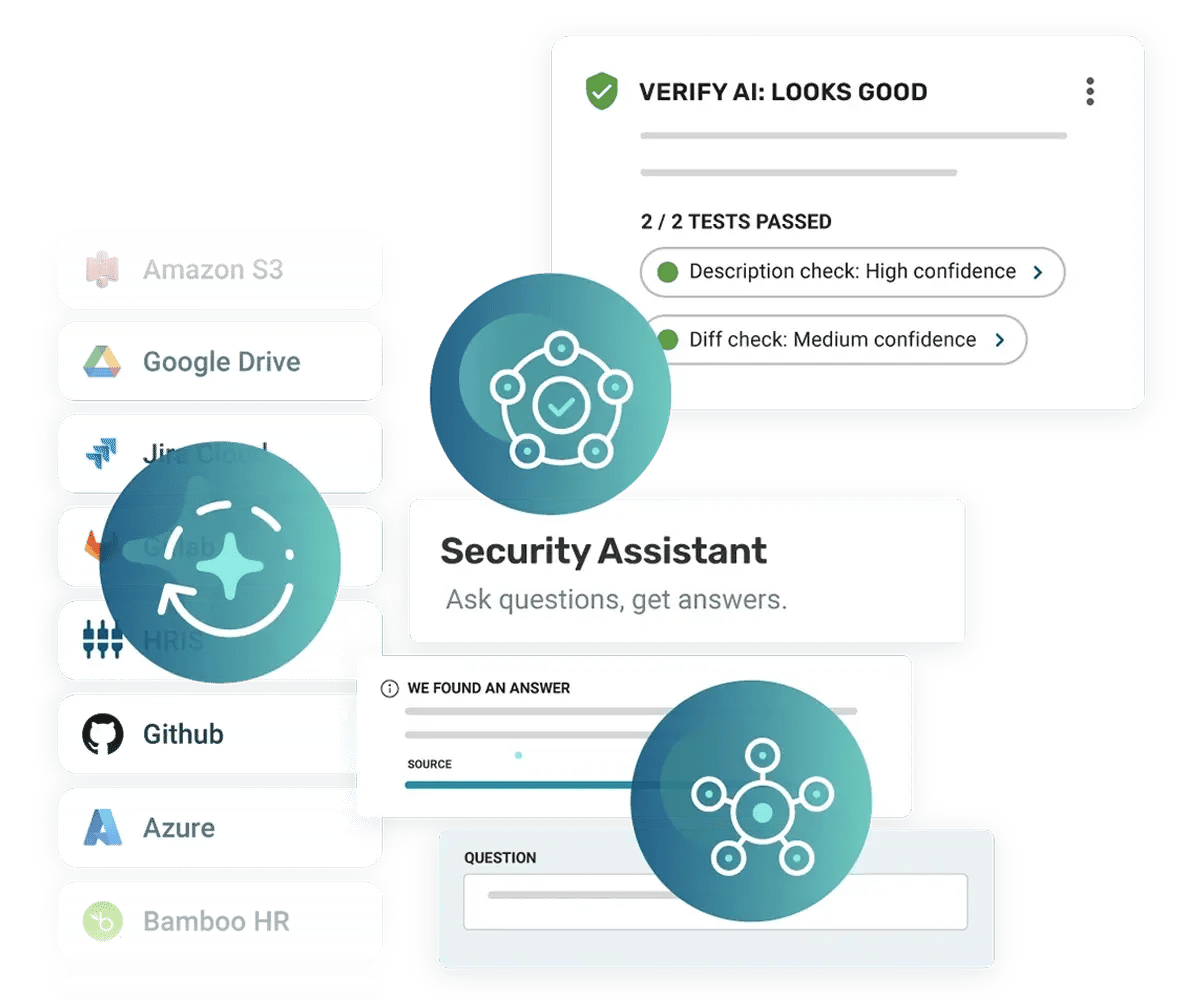
Strike Graph's “Security Assistant” feature goes beyond integration assistance; it actively analyzes the quality and sufficiency of control-to-evidence mappings. When evidence is collected and attached to a control, the Security Assistant evaluates whether the evidence is sufficient to demonstrate the control's effectiveness within the associated frameworks.
This is a capability that Vanta does not offer. Vanta tests whether a binary signal from an integration passes or fails. It does not analyze whether the evidence you've collected is the right kind of evidence, whether it sufficiently demonstrates control operation, or whether gaps exist in your mapping logic. Security Assistant fills this gap, acting as a continuous quality reviewer for your compliance program's technical foundation.
In practical terms, this means a GRC manager using Strike Graph can receive feedback like: "The evidence attached to this access review control demonstrates completion but does not include evidence that exceptions were tracked or escalated — consider adding the exception log as a secondary evidence item." This class of guidance is simply not available in Vanta.
You are never ‘partially compliant’ with Strike Graph
One of the most damaging concepts in compliance management is "partial compliance." That’s when a platform shows you as 70% compliant with a framework because pre-built tests cover only a subset of applicable requirements, and the rest fall into a gray zone. This creates audit anxiety, misrepresents program status, and forces organizations into reactive remediation during the audit process.
Because the platform allows customers to define any risk, define any control, map any evidence, and relate these objects to any framework requirement, there is no scenario in which your program scope exceeds what the platform can represent. If a framework requirement exists, you can build a control for it. If a control exists, you can map evidence to it. If evidence can be collected, it can be attached — whether via integration, manual upload, or the Evidence API.
The result is a compliance program where the platform's representation of your security posture is always complete and accurate, not an approximation bounded by what a vendor chose to pre-build. When your auditor reviews your Strike Graph workspace, they see your entire program, not the 80% of it that Vanta's fixed test library happens to cover.
|
RCE key insight: efficiency and effectiveness, tuned by you |
|
The RCE ontology means Strike Graph customers can fine-tune both the efficiency and the effectiveness of their compliance program. |
Dimension 3: Integration architecture and evidence collection for Strike Graph vs. Vanta
Strike Graph gives teams more ways to collect evidence, including Terraform, API, and configurable integrations, so they can reach deeper into cloud environments and pull from custom or legacy systems. Vanta’s integrations are fast to deploy but limited to the data points it already supports.
Vanta's integration model: fast but fixed
Vanta connects to 375+ tools via OAuth-based integrations that collect a predetermined set of data points from each connected system. This model provides rapid time-to-value for organizations whose compliance needs match the data Vanta chose to collect. For a standard SOC 2 stack — AWS, GitHub, Okta, Google Workspace — Vanta's integrations are well-built and reliable.
The limitation becomes apparent when organizations need evidence beyond what Vanta pre-mapped. Analysis of Vanta's own help documentation across 1,200+ articles reveals recurring patterns: HRIS integrations that cannot verify account deactivation automatically, device monitoring requiring manual agent deployment, GitLab integrations missing project-level permissions, and cloud integrations that provide troubleshooting guides for configurations that don't match Vanta's expected model.
When a configuration is unsupported, Vanta's documentation consistently redirects customers to manual evidence collection, which defeats the purpose of an automated compliance platform and reintroduces the exact overhead the tool is supposed to eliminate.
Strike Graph's 4 integration paradigms
Most compliance platforms force a tradeoff: fast setup with shallow visibility, or real depth with a heavy technical lift. Strike Graph's four integration paradigms exist to remove that tradeoff and power your instance with real evidence to work with. Strike Graph uses these four types of integrations:
-
Basic integrations
Plug-and-play OAuth connections to common platforms: Jira, Google Drive, Office 365, GitHub, Slack, and many more. These operate similarly to Vanta's model and provide fast initial connectivity. -
Terraform integrations
This is Strike Graph's most significant integration differentiator. Using HashiCorp Terraform as an underlying technology, Strike Graph can collect evidence from virtually any data point within a supported cloud provider or SaaS tool, not just the data points Strike Graph chose to pre-build.
As documented in Strike Graph's help center: "The flexibility of this integration is limited only by what is available from Terraform in terms of data sources supported by their AWS provider." (help.strikegraph.com) This means Strike Graph customers can collect evidence from hundreds of AWS resource types — IAM policies, Security Groups, CloudTrail configurations, Inspector findings, S3 bucket policies, KMS key configurations, GuardDuty findings, WAF rules — versus the fixed ~20 checks Vanta provides. Importantly, customers do not need to run Terraform in their own infrastructure; Strike Graph runs it on their behalf. -
Bridge integrations
API-level direct integrations with platforms like ServiceNow, ClickUp, and others. Bridge integrations use OAuth authentication but allow configurable data collection parameters — giving customers more control than fixed OAuth integrations while remaining approachable for non-technical users. -
Evidence API
Strike Graph's Evidence API is a REST interface allowing organizations to push compliance evidence from any system — custom applications, legacy infrastructure, proprietary tools, SaaS platforms without commercial integrations — directly into their compliance repository.
Strike Graph CEO Justin Beals described the strategic intent: "Enterprise organizations have been constrained by the limitations of traditional compliance tools that not only integrate with only a handful of popular systems, but also provide limited breadth of data points from those systems. Our Evidence API eliminates these barriers entirely, enabling companies to push evidence from any source — whether it's a custom-built application, legacy system, or cutting-edge cloud platform — directly into our AI-powered compliance analysis engine." (Strike Graph, Internal Documentation)
Strike Graph vs. Vanta integration depth comparison
|
System |
Strike Graph can collect |
Vanta can collect |
|
AWS |
Any of 300+ Terraform data sources: IAM, EC2, S3, RDS, Lambda, CloudTrail, Inspector, WAF, GuardDuty, KMS, and more |
Fixed set of ~15–20 pre-built IAM, EC2, S3 checks |
|
Azure |
Azure AD, DevOps, Kubernetes, Defender, Container Registry, SQL, Key Vault via Terraform |
Fixed AD / subscription-level checks; 8-step setup; 24-month secret expiration |
|
GitHub / GitLab |
All access controls, branch protections, Actions configs, deployment environments, dependency graph, secrets scanning results |
Repository settings, access controls, vulnerability alerts (GitLab misses project-level users) |
|
Custom / Legacy |
Any system with a REST API via Evidence API or Bridge |
Not supported — manual upload required |
Strike Graph’s AI-native integration configuration
Strike Graph's Security Assistant can generate Terraform integration code from plain-English descriptions. A GRC manager with no infrastructure expertise can describe what evidence they need — "collect all IAM roles with AdministratorAccess in our AWS organization" — and receive a working, validated Terraform configuration. The AI accesses live Terraform provider documentation to ensure accuracy.
This capability is documented in Strike Graph's internal product roadmap (Confluence). It says the Security Assistant "accepts natural language prompts about integration requirements and returns structured code configurations" with access to "Terraform provider and other API documentation." This removes the technical barrier that historically required a DevOps engineer to be involved in compliance evidence configuration.
Vanta offers no comparable capability. Its integrations are fully pre-built; there is no mechanism for extending them.
Dimension 4: AI capabilities of Strike Graph vs. Vanta
Strike Graph applies AI to internal audit work itself, analyzing whether evidence is sufficient, identifying gaps early, and helping teams strengthen controls before an external assessor does. Vanta also uses AI, but mainly for drafting policies and accelerating questionnaires rather than validating audit readiness.
Vanta's AI for policy generation and questionnaire automation
Vanta has invested significantly in AI, primarily in two areas. Its AI-powered policy generator can draft policies in 2–6 minutes. Its questionnaire automation feature can pre-fill security questionnaire responses from existing compliance data, with capacity ranging from 25 to 288 questionnaires per year depending on pricing tier.
These are useful, time-saving capabilities — particularly for early-stage compliance teams who spend disproportionate time on repetitive documentation tasks. They do not, however, address the harder problem: whether your compliance evidence is actually correct, complete, and sufficient for audit purposes.
Strike Graph’s Verify AI for automated internal audits and more
Strike Graph's most distinctive AI capability is Verify AI, a patent-pending agentic AI engine that performs automated internal audits. Verify AI received patent-pending status in January 2025.
Vanta tells you whether an automated test passed or failed. Verify AI asks a more important question: Is the evidence you've collected actually adequate to demonstrate control effectiveness to an auditor? This distinction matters enormously in practice. A test that passes because a binary integration signal returns "enabled" does not guarantee that an auditor will accept the evidence as sufficient; it only means the integration worked. Verify AI closes this gap.
According to Strike Graph's internal documentation, Verify AI provides:
-
Evidence coverage analysis: reviews control requirements against multiple frameworks, ensuring adequate coverage for audit readiness
-
Automated security questionnaire completion: drafts responses utilizing evidence-based compliance data
-
Real-time gap analysis: identifies missing evidence and control deficiencies immediately upon evidence collection
-
Security Assistant insights: provides specific, actionable feedback to strengthen evidence definitions
-
Continuous monitoring: 24/7 automated internal audit across all collected evidence
Strike Graph CPO Micah Spieler described the capability: "The combination of unlimited evidence ingestion through our API with AI-powered analysis creates a compliance monitoring capability that has never existed before. Organizations can now achieve true continuous compliance monitoring across their entire technology landscape, with AI providing the intelligence to turn raw data into actionable compliance insights." (Strike Graph internal documentation)
The ROI of Strike Graph’s internal audit automation
For organizations preparing for a SOC 2 Type II, ISO 27001, or CMMC assessment, a significant portion of the pre-audit engagement with external auditors is remedial. The auditor identifies evidence gaps, the organization scrambles to fill them, and multiple review cycles occur. This process typically costs organizations:
-
External auditor time: $150–400/hour for additional review rounds
-
Internal staff time: 20–100 hours per audit cycle of evidence remediation
-
Audit timeline delays: additional weeks added to timelines by gap remediation
Verify AI eliminates or dramatically reduces this cycle by identifying evidence gaps before the external auditor sees them. A conservative estimate: eliminating two rounds of auditor review cycles ($5,000–15,000 per cycle) provides direct ROI that pays for Strike Graph's premium over Vanta in the first audit alone.
Strike Graph’s AI data security with self-hosted models
Strike Graph's AI models are self-hosted within Strike Graph's own secure cloud environment. Sensitive compliance documentation — policies, evidence, configuration data, control descriptions — never passes through third-party AI processing services. For security-conscious buyers and organizations with data residency requirements, this architecture is a material differentiator over platforms that route customer data through external AI APIs.
Dimension 5: Complex compliance handling in Strike Graph vs. Vanta
Dimension 5: Complex compliance handling in Strike Graph vs. Vanta Strike Graph is better suited for prescriptive regimes such as CMMC, TISAX, and FedRAMP because it supports deeper evidence mapping, more flexible scoping, and the documentation rigor these assessments demand. Vanta is more limited when frameworks extend beyond the fixed logic of SOC 2-style automation.
Why complex frameworks expose Vanta's limitations
SOC 2 is a flexible, principles-based framework. It can be implemented broadly or narrowly, and the evidence acceptable to auditors covers a wide range of demonstrations. This flexibility is why Vanta's pre-built test library works reasonably well for SOC 2; the framework accommodates the constraints of a fixed control model.
CMMC, TISAX, and FedRAMP are different in kind. They are highly prescriptive, technically specific frameworks with mandatory controls that must be implemented in specific ways, documented through specific artifacts, and assessed against specific criteria. Pre-built tests that approximate control satisfaction are not acceptable. Auditors — C3PAOs for CMMC, ENX Association assessors for TISAX, Third Party Assessment Organizations for FedRAMP — are examining precise, defined evidence. There is no room for "close enough."
How Strike Graph handles CMMC compared with Vanta’s limits
Cybersecurity Maturity Model Certification (CMMC) is a mandatory framework for organizations handling Federal Contract Information (FCI) or Controlled Unclassified Information (CUI) within the U.S. Department of Defense supply chain. The DFARS Final Rule, effective November 2025, makes CMMC requirements applicable to over 337,000 contractor entities — prime contractors and subcontractors alike.
Strike Graph is purpose-built for CMMC compliance across all three levels. The platform provides:
-
Complete NIST 800-171 and NIST 800-172 control mappings for Levels 1, 2, and 3
-
Integrated Self-Assessment with automated SPRS score calculation and tracking
-
System Security Plan (SSP) generation and automated export for C3PAO submission
-
Plans of Action and Milestones (POA&M) management with action item tracking
-
Verify AI automated evidence validation against CMMC control requirements
-
Multi-facility, multi-subsidiary deployment supporting separate scopes per plant or business unit
Sanmina's use of Strike Graph across its defense manufacturing operations provides the clearest real-world validation of the platform's CMMC capabilities. With five successful assessments and 600+ evidence artifacts per plant, Sanmina demonstrates that Strike Graph scales to the demands of the most rigorous CMMC implementations.
A 2024 DoD review found that 70% of organizations claiming CMMC compliance failed their assessments, primarily due to misunderstandings about the scope of CUI and its derivative information. Strike Graph's flexible RCE model allows contractors to define their CUI scope precisely, map controls to that scope, and collect evidence that specifically demonstrates CUI protection, rather than relying on generic controls that may not address the specific technical requirements C3PAO assessors examine.
Vanta offers CMMC support as a framework option, but its fixed control and test model constrains the depth of evidence collection and the flexibility needed to address the full range of CMMC Level 2 technical requirements.
How Strike Graph's TISAX support compares to Vanta
The Trusted Information Security Assessment Exchange (TISAX) is the automotive industry's information security assessment standard, maintained by the ENX Association and required by major OEMs, including BMW, Volkswagen, Mercedes-Benz, and their global supplier networks. TISAX is based on VDA ISA (Verband der Automobilindustrie Information Security Assessment) and maps closely to ISO 27001, but includes automotive-specific requirements around prototype protection, connected vehicle security, and supply chain information handling.
Strike Graph is one of the few GRC platforms that natively supports TISAX, reflecting the platform's broader coverage of specialized, industry-specific frameworks beyond the mainstream SOC 2/ISO 27001 tier. Because Strike Graph's RCE model maps controls to framework requirements — not the other way around — the overlap between TISAX and ISO 27001 is automatically captured: organizations pursuing both assessments collect evidence once and satisfy both simultaneously.
Vanta added TISAX as a generally available framework in December 2024. Standard TISAX requirements are covered out of the box, but doesn't address the automotive-specific requirements the VDA ISA catalog adds on top. These "high" and "very high" protection needs, the tier where automotive-specific requirements like prototype protection apply and exactly what TISAX assessors are checking for, require customers to build custom controls themselves. Similar to how Vanta manages SOC 2 and ISO 27001, they use the same fixed control and test model that applies across its catalog, making it less accurate to specific outcomes.
Strike Graph handles this differently with a risk-control-evidence model that doesn't split coverage. A control built to satisfy ISO 27001 automatically extends to the matching TISAX requirement, and the automotive-specific controls TISAX adds are built the same way as every other control on the platform, not bundled in as a separate framework module.
How Strike Graph handles FedRAMP vs. Vanta’s limits
The Federal Risk and Authorization Management Program (FedRAMP) authorizes cloud service providers to operate within US federal agency environments. It is among the most demanding compliance frameworks in existence; it’s built on NIST 800-53, with hundreds of controls, extensive documentation requirements, and a rigorous Third Party Assessment Organization (3PAO) review process.
Strike Graph's support for the NIST 800-53 framework and flexible evidence architecture provides the depth required for FedRAMP-scale implementations. The platform's ability to manage complex control hierarchies, track implementation status at the individual control level, and generate documentation artifacts aligns with FedRAMP's documentation-intensive requirements.
Vanta's SOC 2-centric architecture is not well-positioned for FedRAMP. The framework's technical specificity and documentation requirements exceed what Vanta's pre-built test model can represent.
Framework coverage comparison of Strike Graph vs. Vanta
|
Framework |
Strike Graph |
Vanta |
|
SOC 1, SOC 2 |
✓ Full support |
✓ Full support |
|
ISO 27001 / 27701 / 42001 |
✓ Full support |
✓ Full support |
|
HIPAA |
✓ Full support |
✓ Full support |
|
PCI DSS v4 |
✓ Full support |
✓ Full support |
|
NIST CSF 2.0 |
✓ Full support |
✓ Full support |
|
NIST 800-171 / 172 |
✓ Full support (CMMC) |
Partial / limited |
|
CMMC Level 1, 2, 3 |
✓ Native support + SSP/POA&M |
Limited |
|
TISAX |
✓ Native support |
✗ Not supported |
|
FedRAMP |
✓ NIST 800-53 support |
Limited |
|
HITRUST CSF |
✓ Full support |
✓ Full support |
|
GDPR / CCPA / DORA / NIS2 |
✓ Full support |
Partial |
|
ISO 9001 (Quality Management) |
✓ Supported (2025) |
✗ Not supported |
|
Custom Frameworks |
✓ Enterprise customers can build any framework |
Limited via custom tests |
Dimension 6: User experience and distribution of responsibility for Strike Graph vs. Vanta
Strike Graph spreads ownership to the people closest to each control, giving engineering, HR, legal, and operations a defined role in keeping evidence current and programs audit-ready. Vanta concentrates more compliance work in a small technical team, which may be workable early on but harder to scale.
Vanta's UX: functional, but concentrated
Vanta's user interface is primarily oriented toward a small technical team, typically security engineers or a compliance manager, who configure and maintain the platform. Its automated evidence collection model is designed to minimize the number of people who need to interact with it, which is efficient for a 20-person startup but creates a structural bottleneck as organizations grow.
User feedback on Vanta's interface is mixed. G2 reviewers note: "Vanta has made great progress on the overall bugs and user interface, but there is still a lot to be desired. It almost always opens a new tab so if you're really cranking on something, you end up with a million tabs. Also, their choice in buttons is kind of annoying and flat. You'll be looking for an upload button or something and it is hiding in the same color as everything else." (G2, 2025)
A more consequential limitation: because Vanta's compliance model concentrates activity in automated integrations managed by a technical team, it does not engage the broader organization in compliance ownership. When evidence cannot be automatically collected, which happens regularly, it falls to the same small team. This creates a compliance function that is fragile, difficult to scale, and invisible to most of the organization.
Strike Graph's distribution of responsibility model
Strike Graph was designed from the ground up to distribute compliance responsibility across the organization. The control assignment model allows evidence ownership to be assigned to the person closest to the system or process. An engineer owns their infrastructure control, HR owns their personnel security controls, Legal owns privacy controls, Facilities owns their physical security controls.
Automated reminders, evidence expiration alerts, and accountability tracking operate at the individual owner level. A compliance manager can see, in real time, which controls are healthy, which have expiring evidence, and which owners haven't responded to reminders, without having to individually chase each one.
This model enables compliance programs that are genuinely distributed: 30 people each managing 3–4 controls creates a more resilient, higher-quality program than one person managing 100 controls. It also creates organizational security awareness. When engineers are accountable for specific controls, they develop a clearer understanding of what their security responsibilities actually are.
"I couldn't have pulled together everything needed for our SOC 2 audit in a short period of time without Strike Graph. I was able within a few weeks to complete a Risk Assessment using the tool, select the associated controls to mitigate the risks, and assign the controls to team members. I can't say enough about the ease of the interface."
— Strike Graph customer, G2 Review
Dimension 7: Enterprise scalability for Strike Graph vs. Vanta
Strike Graph is designed for enterprise scale. It supports distinct scopes, shared controls, local variation, and centralized visibility across subsidiaries, facilities, products, or regions. Vanta’s workspace approach helps address multi-entity needs, but it does not resolve the deeper constraints of a framework-centric architecture.
Vanta's enterprise limitations
Vanta introduced a Workspaces feature to address multi-entity organizational needs. In principle, this allows separate subsidiaries or product lines to have distinct compliance instances under a single parent account. In practice, user feedback reflects that Workspaces adds significant configuration complexity and does not address the underlying architectural limitations of Vanta's framework-centric model.
A verified Gartner enterprise reviewer summarized the experience: "Vanta has a product with good potential — overall, there are definitely some benefits to implementing it. That said, there are still some notable immaturities and shortfalls in the product (some of which may seem surprising for a fully fledged GRC tool). It is certainly not (in my opinion) the absolute gamechanger that it is advertised/sold as." (Gartner Peer Insights, 2025)
Specific enterprise-scale limitations include risk management. From another review: "The risk management module has a number of immaturities and limitations. Current risk is automatically calculated by Vanta and it is not possible to produce this score yourself. It goes from 'zero to hero' just like that, which is often not an accurate reflection of your real, current risk score." (Gartner review)
Strike Graph's federated enterprise architecture
Strike Graph is architected for enterprise federated compliance from the ground up. Different organizational units — products, geographies, subsidiaries, manufacturing facilities — can maintain separate compliance scopes and control sets while feeding into an enterprise-level consolidated view.
For Sanmina, this means that each manufacturing facility manages its own CMMC compliance scope — with its own set of 600+ evidence artifacts — while Sanmina's central security team maintains visibility across all 23 countries and multiple facilities through a single platform. The controls applicable to a facility in Malaysia handling ITAR-adjacent materials are not the same as the controls applicable to a facility in Sweden handling EU customer data. Strike Graph accommodates both within a unified program structure.
Strike Graph's enterprise content management capability allows common controls and evidence to be defined once at the corporate level and distributed to subordinate organizational units, while still allowing local customization for unit-specific requirements. This is the compliance equivalent of a franchise model: common standards centrally defined, locally implemented and monitored.
Strike Graph’s rollout methodology for large organizations
Strike Graph’s rollout model starts with core controls and integrations, then expands responsibility across teams, frameworks, and business units in phases. That staged approach helps larger organizations build momentum early, avoid operational sprawl, and move into steady-state compliance without having to rework the program later.
Phase 1: Foundation (weeks 1–4)
-
Import or build an existing control framework in Strike Graph workspace
-
Connect primary integrations: cloud providers (AWS/Azure/GCP via Terraform), identity (Okta/Azure AD), DevOps tools
-
Assign initial control ownership to primary security team
- Configure cross-framework mappings for active certification obligations
Phase 2: Distribution (weeks 5–8)
-
Onboard control owners across engineering, HR, legal, operations, facilities
-
Configure automated evidence collection via Terraform integrations and Evidence API
-
Establish evidence review cadences and expiration policies
-
Activate Verify AI for ongoing automated internal audit
Phase 3: Optimization (weeks 9–12)
-
Add secondary frameworks with automatic cross-framework mapping
-
Implement Security Assistant for custom integration configurations and evidence review
-
Configure Trust Center for customer-facing compliance documentation
-
Establish executive dashboards for board and leadership visibility
Phase 4: Continuous operations (ongoing)
-
Quarterly evidence review cycles with distributed owner accountability
-
Annual cross-framework gap analysis via Verify AI
-
Continuous real-time compliance status monitoring
-
TPRM/Trust Chain activation for vendor compliance management
Dimension 8: Pricing and total cost of ownership for Strike Graph vs. Vanta
Strike Graph uses an all-inclusive pricing model that bundles capabilities such as Trust Center, vendor risk management, and multi-framework support. Vanta’s pricing often begins lower but expands through framework add-ons, additional modules, and operational overhead as compliance programs become more complex.
Vanta's pricing: opaque, escalating, and add-on heavy
Vanta's pricing structure is one of the most consistently cited concerns across G2, Capterra, and Gartner reviews. The core issue is a combination of non-transparent list pricing, per-framework surcharges, and features that are presented as part of the platform but are actually sold as separate add-ons.
Based on publicly reported buyer data and third-party pricing intelligence sources (Vendr, Wolfia):
-
Core package (one framework): $7,500–$11,500/year
-
Growth tier: $15,000–$25,000/year; additional frameworks at ~$5,000 each
-
Median subscriber spend: $19,800/year — but add-ons escalate this rapidly
-
Trust Center: ~$6,000/year additional
-
Vendor risk management: ~$11,200/year additional
-
Scale/enterprise plans: $30,000–$80,000+/year
Users report significant difficulty with Vanta's renewal process. One G2 reviewer wrote: "Our CSM was helpful until renewal. Then it went dark, and the price jumped 40% without warning." (Wolfia analysis, 2025) A Capterra reviewer noted: "We signed up for Vanta ultimately to end up not deriving any value from it and they forced us to continue our 2-year contract of almost $18,000.00 — even after we had never logged in or used the product for months." (Capterra, 2024)
Another pattern in buyer intelligence (Vendr): "You need to buy modules, and this thing is not mentioned during initial marketing and pre-sale phase." Users who priced Vanta based on published tier descriptions consistently encounter add-on costs that were not prominently disclosed during the sales process.
Strike Graph's transparent, all-inclusive pricing
Strike Graph includes in all plans the features that Vanta sells as premium add-ons:
-
Trust Center: included at all tiers (vs. Vanta's ~$6,000/year)
-
Vendor risk management (Trust Chain): included
-
Multi-framework support: included via cross-framework workspace architecture
-
Verify AI automated internal audit: included
-
Security Assistant: included
-
Custom frameworks: available to enterprise customers at no add-on cost
Strike Graph's workspace-based pricing model is also structurally better aligned with the distribution of responsibility model. Per-seat pricing creates a disincentive to engage broad organizational participation in compliance, as adding 30 engineers, HR managers, and legal team members as control owners becomes prohibitively expensive. Strike Graph's workspace model removes this barrier.
3-year total cost of ownership for Strike Graph vs. Vanta
The following model compares total cost of ownership for a 150-person organization pursuing SOC 2 Type II + ISO 27001 over three years. Figures are illustrative estimates based on publicly reported pricing data and industry benchmarks. Actual costs vary by organization.
Vanta 3-year cost estimate
|
Cost category |
Year 1 |
Year 2 |
Year 3 |
|
Base platform (Growth tier) |
$22,000 |
$24,000 |
$26,400 |
|
Trust Center add-on |
$6,000 |
$6,000 |
$6,000 |
|
ISO 27001 framework add-on |
$5,000 |
$5,000 |
$5,000 |
|
Vendor risk management add-on |
$11,200 |
$11,200 |
$11,200 |
|
Staff time — duplicate evidence, manual collection |
$15,000 |
$12,000 |
$10,000 |
|
Additional auditor review cycles (evidence gaps) |
$10,000 |
$8,000 |
$8,000 |
|
Annual Total |
$69,200 |
$66,200 |
$66,600 |
Strike Graph 3-year cost estimate
|
Cost category |
Year 1 |
Year 2 |
Year 3 |
|
Base platform (all-inclusive) |
$28,000 |
$30,000 |
$33,000 |
|
Trust Center (included in plan) |
$0 |
$0 |
$0 |
|
ISO 27001 (cross-mapped, no add-on) |
$0 |
$0 |
$0 |
|
Vendor risk management (included) |
$0 |
$0 |
$0 |
|
Staff time (cross-framework efficiency + automation) |
$6,000 |
$4,000 |
$3,000 |
|
Additional auditor cycles (Verify AI pre-screens gaps) |
$3,000 |
$2,000 |
$2,000 |
|
Annual Total |
$37,000 |
$36,000 |
$38,000 |
|
Estimated 3-year savings with Strike Graph: ~$91,000 |
|
Primary TCO drivers: absence of add-on charges, cross-framework control reuse eliminating duplicate evidence work, and Verify AI reducing external auditor engagement costs. Organizations pursuing three or more frameworks simultaneously see proportionally larger savings. |
Dimension 9: Full capability comparison of Strike Graph vs. Vanta
Strike Graph represents a flexible GRC platform architecture built for cross-framework compliance management, deep evidence collection, and enterprise coordination. Vanta represents a more predefined automation model optimized for early compliance milestones, where fixed tests and integrations help startups complete their first audit quickly.
Feature comparison of Strike Graph vs. Vanta
|
Capability |
Strike Graph |
Vanta |
|
Integration paradigm |
Terraform (deep, flexible) + Bridge (API) + Basic (OAuth) + Evidence API (open) |
OAuth-based (fixed, pre-defined data sets) |
|
Evidence data points per system |
Customizable; effectively unlimited within provider capabilities |
Fixed, pre-mapped; ~3–5x fewer per system |
|
Custom / legacy system support |
Yes — via Evidence API or Terraform |
No — manual upload required |
|
Cross-framework control mapping |
Native: single workspace, single control set serves all frameworks |
Framework-centric; controls and tests duplicated per framework |
|
Risk–control–evidence ontology |
Fully composable; customers define risks, controls, evidence freely |
Pre-built test library; limited customization |
|
"Partial compliance" exposure |
None — any requirement can be represented; program is always complete |
Yes — fixed test library bounds what can be tracked |
|
Verify AI (automated internal audit) |
Yes — patent-pending; evidence sufficiency analysis, gap identification |
No |
|
Security Assistant (evidence + control review) |
Yes — analyzes mapping efficacy; generates integration code |
No equivalent |
|
AI policy generation |
Yes |
Yes (2–6 min policy builder) |
|
AI questionnaire automation |
Yes |
Yes — capped (25–288/year by tier) |
|
AI data processing |
Self-hosted; no third-party AI |
Third-party AI services |
|
CMMC support (SSP, POA&M, SPRS) |
Native, full support all levels |
Limited |
|
TISAX support |
Native |
Not supported |
|
FedRAMP / NIST 800-53 |
Supported |
Limited |
|
Trust Center |
Included in all plans |
~$6,000/year add-on |
|
Vendor risk management (TPRM) |
Included |
~$11,200/year add-on |
|
Distribution of responsibility |
Native; designed for org-wide engagement across all roles |
Concentrated in small technical team |
|
Multi-entity / multi-facility |
Native federated architecture |
Workspaces — complex configuration |
|
Pricing model |
Workspace-based, all-inclusive, transparent |
Per-seat/per-framework; extensive add-ons; opaque |
|
Target company size |
50–50,000+ employees |
1–50 employees (optimal) |
|
G2 / Gartner rating |
Strong and growing |
G2: 4.6/5 | Gartner: 4.4/5 |
Dimension 10: Vulnerability scanning of Strike Graph (owned) vs. Vanta (dependent)
Strike Graph integrates vulnerability evidence directly into its compliance architecture, linking findings to controls and remediation workflows within the same platform. Vanta surfaces vulnerability findings from external scanning tools, meaning coverage depends on those upstream systems being properly configured and maintained.
Vanta scans through a dependency chain
Vanta does not own its vulnerability scanning capability. It reads findings from third-party tools — AWS Inspector for AWS environments and Microsoft Defender for Cloud for Azure — and surfaces them within its dashboard. Before Vanta can report any vulnerability data, a separate scanning service must first be correctly configured, enabled, and running independently.
For AWS, Vanta requires Inspector to be in “Running” status before retrieving any findings. Vanta's own help documentation states: 'Vanta can pick up the Inspector data once Inspector runs on the instance.' If Inspector lacks correct IAM permissions, is not enabled in specific regions, or is misconfigured in any way, Vanta returns no vulnerability data — silently. Multiple dedicated Vanta help articles exist solely to guide users through Inspector configuration failures, a reliable indicator of recurring operational friction. For Azure, Microsoft Defender for Cloud must be separately enabled at the subscription level, requiring an 8-step setup with client secrets that expire every 24 months and require ongoing maintenance.
The practical consequence: organizations can believe they have continuous vulnerability monitoring because Vanta appears connected, while actually receiving no active scanning data if the upstream service is misconfigured. This is a compliance risk in its own right — particularly for CMMC, which mandates continuous monitoring as a core control requirement.
Strike Graph's integrated vulnerability architecture
Strike Graph's vulnerability management is built into the evidence collection architecture, not bolted on as a passive reader of third-party outputs. Terraform integrations directly collect vulnerability-related configuration states from AWS, Azure, and GCP — such as IAM policy configurations, Security Group rules, GuardDuty alerts, Defender findings, Inspector data where enabled — and map them directly to compliance controls.
When a CVE affects a component in the environment, it is flagged against the specific compliance controls it impacts and generates an Action Item for remediation, tracked within the same workspace as all other compliance activities. For CMMC Level 2 Practice SI.2.214 — which requires organizations to identify, report, and correct information system flaws — this integrated, framework-linked approach provides a materially stronger compliance posture than a passive scan reader can deliver.
|
Aspect |
Strike Graph |
Vanta |
|
Scanning model |
Integrated into evidence collection architecture |
Reads from externally-configured Inspector / Defender |
|
Failure mode |
Integration health visible in platform dashboard |
Silent — no data if upstream tool is misconfigured |
|
Framework linkage |
Findings mapped to controls; Action Items auto-created |
Findings surfaced in UI; manual control mapping required |
|
CMMC continuous monitoring |
Native collection satisfies SI.2.214 |
Requires Inspector/Defender independently operational |
|
Remediation tracking |
Tracked within compliance workspace |
Remediation managed outside Vanta |
|
Data breadth |
5,000+ data points continuously |
Limited to Inspector/Defender output |
Dimension 11: Support model and compliance consulting with Strike Graph vs. Vanta
Strike Graph's platform pairs user-friendly software with available framework-aware compliance support, helping customers design programs, prepare for audits, and adapt to evolving regulations. Vanta primarily provides product support focused on platform usage, which works well for straightforward implementations but offers less advisory depth.
Vanta's support: business hours only, no compliance advisory
Vanta's documented support covers Monday through Friday only. Live chat runs Monday-Thursday 6 AM-8 PM ET and Friday 6 AM-7 PM ET. Outside these windows — including all weekend hours — customers interact with Ask Ilma, Vanta's AI support assistant, with human follow-up deferred to the next business day.
For organizations operating under DoD contract deadlines, navigating a CMMC assessment with a C3PAO arriving Monday morning, managing a security incident that surfaces Saturday evening, or running global operations across time zones, this model represents a real operational gap. An AI chatbot does not substitute for human expertise during high-stakes compliance scenarios requiring specific regulatory knowledge.
Vanta's support scope is confined to platform operation: resolving integration errors, troubleshooting platform issues, answering product questions. It does not extend to compliance consulting: how to scope a CMMC program, how to design controls for TISAX, how to respond to an auditor finding, or how to address new regulatory obligations. That expertise is not part of the Vanta offering.
"Our CSM was helpful until renewal. Then it went dark, and the price jumped 40% without warning."
— Verified Vanta customer, Wolfia Research (2025)
Strike Graph’s platform support and active compliance partnership
Strike Graph's support model operates on a different philosophy. The customer success team's documented mission is to ensure that customers successfully adopt and maximize the value of the GRC tool in order to meet their compliance goals. (Strike Graph Confluence, Customer Success Team). Meeting compliance goals, not just resolving platform tickets, reflects a service orientation that goes substantially beyond what Vanta provides.
Strike Graph customer success managers carry deep, framework-specific expertise across SOC 2, ISO 27001, HIPAA, PCI DSS, CMMC, TISAX, GDPR, NIST, and more, backed by dedicated internal playbooks for each major framework. When a customer is navigating a complex compliance obligation, they engage with a team member who understands the framework substantively, not just how to configure the software.
What Strike Graph's compliance consulting includes
-
Program design at onboarding: structuring the risk and control framework for the customer's specific obligations and organizational context from the outset, not retrofitting after gaps appear
- Framework expansion support: when adding CMMC, TISAX, FedRAMP, or a new privacy regulation, Strike Graph provides advisory resources to ensure the expansion is scoped and implemented correctly
- Audit preparation: working alongside customers ahead of assessments to verify evidence completeness, control documentation, and readiness; Verify AI's automated internal audit and CS team expertise work together during this phase
- New compliance objective navigation: as requirements evolve (DORA, NIS2, updated CMMC guidance, ISO 42001 for AI governance), Strike Graph advises on what new obligations mean for existing programs and how to address them efficiently
- Remediation guidance: when a control failure is discovered or an auditor raises a finding, customers access framework-knowledgeable advisors who can recommend the right remediation approach, not just technical steps in a platform
|
Compliance consulting as a force multiplier |
|
For organizations without a dedicated CISO or in-house GRC team, which describes most companies in the 50-500 employee range, access to compliance expertise alongside the platform is not a luxury; it is a prerequisite for program success. Strike Graph's combination of platform capability and human expertise means customers are never left interpreting complex frameworks alone. The investment in Strike Graph buys not just software, but a compliance partnership that scales with the organization's growing obligations. |
Strike Graph maintains dedicated implementation playbooks for specialized regimes including the CMMC Playbook for defense contractors navigating C3PAO assessments, ISO implementation guides, TISAX assessment protocols, and SOC 2 audit readiness procedures. This institutional knowledge compounds over the customer relationship, so as programs mature and new requirements emerge, the context from day one carries forward.
Dimension 12: Software Bill of Materials (SBOM) for Strike Graph vs. Vanta
Software supply chain security has moved from an engineering concern to a board-level compliance obligation. US Executive Order 14028 (May 2021) mandated SBOM adoption for software sold to federal agencies. High-profile attacks — SolarWinds (2020), Log4Shell (2021), XZ Utils (2024) — demonstrated how a single vulnerable or compromised dependency can cascade into a national security incident. As GitHub noted: organizations with up-to-date SBOMs could have detected unexpected components earlier in the SolarWinds attack. (GitHub, What is an SBOM, 2025)
SBOMs are now explicitly required or strongly implied by frameworks Strike Graph's target customers operate under: FDA Cybersecurity Guidance for medical device software, CMMC for DoD contractors, NIST CSF 2.0, PCI DSS v4, and Executive Order 14028 for federal software procurement.
For organizations selling software into healthcare, defense, federal government, financial services, or automotive markets, SBOM capability is transitioning from best practice to contractual requirement. Vanta has no SBOM capability; it is not present in Vanta's features, help documentation, or publicly visible roadmap.
Strike Graph SBOM Manager: native supply chain compliance
Strike Graph's SBOM Manager is a native platform feature that integrates supply chain tracking directly into the compliance evidence workflow. As documented by Strike Graph: “Our SBOM Manager aligns with frameworks like FDA Cybersecurity Guidance, Executive Order 14028, NIST CSF, CMMC, and PCI DSS to ensure your software supply chain meets compliance expectations. We compare your SBOM components against known vulnerability databases, flagging security risks and alerting your team when critical threats are detected.” (strikegraph.com/sbom-manager)
The SBOM Manager connects to GitHub and GitLab via Terraform integrations, automatically collecting CycloneDX and SPDX format files from existing CI/CD pipelines without requiring changes to development workflows. It is not a standalone tool with separate reporting requiring manual correlation; it is another evidence stream feeding into the same compliance workspace that manages controls, risks, and audit readiness.
Here’s a list of Strike Graph’s SBOM Manager capabilities:
-
Automated collection from CI/CD pipelines: CycloneDX and SPDX files pulled from GitHub and GitLab automatically, updating when repositories change
- Centralized component dashboard: all software dependencies, libraries, and third-party components visible in one view with current CVE exposure
- Continuous CVE monitoring: components compared against vulnerability databases with real-time alerts when critical threats are detected, without re-running pipelines
- Historical SBOM records: full audit trail maintained for compliance reporting, providing the traceability CMMC Level 2/3 and FDA assessors require
- Framework control linkage: SBOM findings mapped to FDA Cybersecurity Guidance, EO 14028, NIST CSF, CMMC, and PCI DSS controls with Action Items auto-generated for remediation
SBOM, CMMC, and the integration advantage of Strike Graph
For CMMC Level 2 and Level 3, NIST 800-171 Control 3.14.1 requires organizations to identify, report, and correct information system flaws. An automatically maintained, historically tracked SBOM linked to compliance control gaps and remediation activities is one of the most defensible implementations of this requirement, particularly for complex software environments where manual dependency tracking across multiple applications is operationally infeasible.
The strategic value is the integration. When a CVE is detected in a software component, it surfaces in Strike Graph as an Action Item linked to the specific compliance controls it affects — the same Action Item system that tracks all other control deficiencies. The security team, engineering team, and compliance team share one unified view of supply chain risk with no manual correlation between a standalone SBOM tool and a separate compliance platform.
|
Vanta has no SBOM capability |
|
For organizations selling software into regulated markets — federal government, defense, healthcare, automotive, financial services — the absence of SBOM support in Vanta is not a minor gap. It means a core and increasingly mandatory compliance obligation cannot be managed within the platform at all. Organizations using Vanta must acquire, configure, and maintain a separate SBOM tool, then manually correlate its findings with their compliance program. Strike Graph's native SBOM Manager eliminates this fragmentation, keeping supply chain compliance inside the same system of record as all other compliance activities. |
Buyer guidance on Strike Graph vs. Vanta
Choosing between Strike Graph and Vanta depends on whether the priority is rapid first-audit automation or a long-term compliance operating platform. Strike Graph supports scalable, multi-framework programs, while Vanta remains a strong option for smaller teams pursuing an initial SOC 2 certification.
When Vanta is the right choice
Vanta delivers genuine value for a well-defined, narrow use case: a SaaS company in the 1–50 employee range with a standard cloud technology stack, pursuing its first SOC 2 certification, with no near-term plans to expand to additional frameworks or organizational complexity. In this context, Vanta's predefined control library, automated evidence collection, and auditor marketplace provide real time-to-value. If your compliance program will fit entirely within Vanta's model and you do not anticipate growth beyond it, Vanta's speed advantage at the starting line is genuine.
When Strike Graph is the right choice
Strike Graph is the appropriate platform for any of the following situations:
-
Your organization has more than 50 employees, or is growing toward that threshold with increasing compliance requirements
-
You are managing or planning to manage multiple compliance frameworks simultaneously
-
You need to pursue CMMC, TISAX, FedRAMP, or other demanding regulatory frameworks that require deep technical evidence and documentation
-
Your technology environment includes custom applications, legacy infrastructure, or configurations that fall outside Vanta's predefined integration model
-
You need to distribute compliance responsibility across your organization rather than concentrating it in a small technical team
-
You require AI-powered internal audit — not just test pass/fail signals — to ensure evidence quality before engaging external auditors
-
You operate across multiple facilities, subsidiaries, geographies, or product lines with distinct compliance scopes
-
You are evaluating 3-year total cost of ownership, particularly if features like Trust Center and Vendor Risk Management are requirements
|
The strategic question every GRC buyer should ask |
|
The fundamental question is not "What do I need to pass my next audit?" but "What platform will serve as a sustainable foundation for my compliance program over the next three to five years?" Vanta answers the first question well for small, standard SaaS organizations. Strike Graph answers the second for organizations that have moved beyond the startup compliance paradigm — or plan to. |
Sources and references for this article
-
Sanmina Corporation G2 Review and BusinessWire Press Release, October 2025 (businesswire.com)
- Sanmina Corporation company profile: sanmina.com/company-profile/ | Revenue $8.1B FY2025, ~39,000 employees, Fortune 500
- Strike Graph Help Center: help.strikegraph.com (Terraform Integrations, Evidence API documentation)
- Strike Graph CMMC Platform: strikegraph.com/nist-800-171
- Strike Graph Internal Product Documentation: Security Assistant for Integrations POD; Evidence API Press Release; Verify AI documentation (accessed via Atlassian Confluence integration)
- Vanta Help Center: Analysis of 1,200+ help articles (batches 1–150, help.vanta.com)
- G2 Reviews: Vanta (4.6/5, 1,000+ reviews); Strike Graph (positive trend, growing)
- Capterra Reviews: Vanta (4.2/5)
- Gartner Peer Insights: Vanta (4.4/5) — enterprise user feedback on limitations
- Vendor Pricing Intelligence: Vanta median deal data and add-on costs
- Wolfia Research: Vanta Reviews, Pricing & Alternatives (wolfia.com, February 2026)
- 6clicks Blog: Understanding Vanta's Limitations (6clicks.com, April 2025)
- ComplyJet Blog: StrikeGraph Review (complyjet.com, 2025)
Final note: This comparison is published by Strike Graph for marketing and educational purposes. All third-party product capability descriptions reflect publicly documented features and verified user feedback. Pricing data reflects publicly available buyer intelligence; contact vendors directly for current quotes.
Built for teams that take compliance seriously
Strike Graph is your customers' trusted compliance platform

.svg)
.svg)
.svg)
.svg)

Used by security and compliance leaders in SaaS, HealthTech, FinTech, and more

Designed by compliance practitioners, not consultants

Built to scale from first framework to enterprise compliance
“The vendors that we've rolled this out to have liked it. Because instead of 300-600 questionnaires, they're really only looking at some 40 pieces of evidence that they upload. They feel better represented if they're being analyzed from a security effectiveness perspective against competitors."
“Easy to use platform, excellent support and guidance.”
Matt C.
President/CEO
"Streamlined Compliance with Intuitive Interface. I really appreciate how Strike Graph simplifies and structures the entire compliance process."
Vivek S.
Associate Engineer, Enterprise company
"Strike Graph is an Enterprise Governance, Risk, and Compliance (GRC) tool that has improved Sanmina's security compliance and risk management across 23 countries, multiple locations, and various frameworks. By centralizing operations and replacing manual tracking, it has significantly simplified compliance, enhanced security, and improved our risk matrix documentation."
Larry F.
VP IT Security, Enterprise company
"We were looking at doing [third-party risk management] manually, but Strike Graph appeared, and it helps automate what we were struggling to plan."





See the full Strike Graph GRC platform in action
You’re already seeing the value for third-party risk.
Let us show you how the full Strike Graph GRC platform brings everything together — tailored to your program, your frameworks, and your goals.
Ready to see Strike Graph in action?
Fill out a simple form and our team will be in touch.
Experience a live customized demo, get answers to your specific questions , and find out why Strike Graph is the right choice for your organization.
Fields marked with a star (*) are required
By submitting this form, you agree to receive promotional messages from Strike Graph about its products and services. You can unsubscribe at any time by clicking on the link at the bottom of our emails.
Fill out a simple form and our team will be in touch.
Experience a live customized demo, get answers to your specific questions , and find out why Strike Graph is the right choice for your organization.
Ready to see Strike Graph in action?
Fill out a simple form and our team will be in touch.