Quick summary:
To set up continuous security posture monitoring for CMMC, go beyond checking off individual controls and instead create a unified operational approach. Start by linking monitoring activities to specific control families, setting baselines for normal activity, and defining clear alert thresholds. Tools like SIEM and EDR collect the necessary data, which compliance platforms map to controls as evidence. With structured playbooks and automation, defense contractors and managed service providers can keep security plans current and maintain a strong security posture year-round.
Framework for CMMC continuous security posture monitoring
A CMMC continuous monitoring framework has four parts: the requirements you monitor, the tools that monitor them, the evidence those tools produce, and the posture it all rolls up to. At Levels 2 and 3, a specific CMMC requirement (CA.L2-3.12.3) calls for ongoing monitoring to confirm security controls stay effective.
The requirements you monitor depend on your CMMC level: at Level 1, FAR 52.204-21 applies; at Level 2, NIST SP 800-171 applies; and at Level 3, NIST SP 800-172 enhancements are added.
To see how this framework works in practice, connect operational actions with the compliance artifacts they generate, following standards like NIST SP 800-137 for continuous monitoring. You monitor the controls in your baseline using technical tools, such as security information and event management platforms. These systems continuously monitor your environment and capture raw telemetry. Ultimately, these tools generate the logs and alerts that, once reviewed and organized, serve as evidence your safeguards are working.
Your security posture is what you get when you roll that evidence up. Each monitoring activity produces a signal for a specific requirement: the scan passed or failed, the log review happened or didn't, the access recertification is current or stale. Those signals set each requirement's status, requirement status sets the health of each control family, and the family view is the posture leadership acts on.
Under the DoD Assessment Methodology, that posture also has a number: start at 110 and subtract 1, 3, or 5 points for each requirement that isn't met. Tracking requirement status continuously tells you what your SPRS score would be today, not just what it was on assessment day. CMMC status itself is a point-in-time determination, valid for three years with annual affirmations, but continuous tracking turns that snapshot into something you can maintain and verify between assessments.
 Bob Kolasky, Senior Vice President for Critical Infrastructure at Exiger and founding Director of CISA's National Risk Management Center, says the same shift from snapshot to continuous verification is happening across federal risk programs, including FedRAMP.
"Nobody wants just a moment in time, a binary yes or no, but a commitment to continue to actively manage risk," Kolasky says. "The easy mantra is to get rid of checklists and replace them with a dynamic process that can be automated and regularly checked. The policy and regulatory framework is trying to make that mantra a reality."
Note: The CMMC Phase 2 pause suspended the mandatory third-party assessment requirement, but it did not suspend the underlying continuous monitoring obligation.
How to implement continuous security posture monitoring for CMMC, step by step
To implement continuous security posture monitoring for CMMC, scope your CUI environment, deploy logging and set baselines, assign control owners and cadences, configure alerts, run scans and drift checks, route findings to your plan of action, capture evidence, keep your SSP current, track metrics, and support SPRS submissions.
Follow these specific steps to build and sustain an effective continuous security monitoring program:
-
Scope your environment and map systems to required controls
Before employing any tools, determine which systems are involved in processing, storing, or transmitting Federal Contract Information or Controlled Unclassified Information, depending on the CMMC level that you need. Then, match those specific assets to the required CMMC control baseline. This first scoping process establishes where logging should be implemented and helps you avoid wasting resources monitoring out-of-scope networks. Remember that your monitoring tools themselves — such as your SIEM, log collectors, and scanners — must be regarded as Security Protection Assets and therefore fall within the assessment scope, even though they do not process CUI.
- Step logging and monitoring across the NIST SP 800-171 control families (or relevant CMMC level), and establish baselines for normal activity
Implement logging tools that capture system events within the requirement families applicable to your level, for example, Audit and Accountability at Level 2. After deployment, establish configuration baselines and baselines for normal network behavior. Without them, your teams will struggle to detect configuration drift accurately, identify anomalies, or prove that your safeguards remain effective.
- Set monitoring cadences and assign named control ownership
Security monitoring programs will fail if the duties involved are unclear. You must assign a particular, named individual to be in charge of each control and state how frequently they are to examine the relevant telemetry. Establishing strict daily, weekly, or quarterly routines ensures accountability and reduces the likelihood that important system alerts will be missed between formal inspections.
- Configure alert thresholds and response triggers against those baselines
Using your current baselines, set thresholds that trigger automated alerts whenever the system's behavior deviates from normal operations. Adjusting these triggers helps avoid alert fatigue and reduce false positives, so your team spends more time on real anomalies. As a result, incident response accelerates, and you detect unauthorized changes that could put your CMMC compliance status at risk.
- Execute scheduled vulnerability scans and configuration drift checks
Conduct authenticated vulnerability scans and regularly compare system configurations against your approved baselines. The ongoing technical verification yields key metrics, such as your patch compliance rate. By scheduling scans, you can detect unpatched software and unauthorized changes early and reduce the window in which malicious actors can exploit them, thus confirming the effectiveness of your Risk Assessment, Configuration Management, and System and Information Integrity controls.
- Route monitoring findings into the Plan of Action and Milestones and track them to closure
If monitoring tools identify a control gap, pass the finding to your remediation workflow, assign an owner, and set a fixed date, just as you would for any other tracked issue. Treat gaps found between assessments as temporary deficiencies and include them in your operational plan of action under requirement 3.12.2, which can hold any finding. However, the assessment Plan of Action and Milestones is a more limited tool: under CMMC, POA&Ms are available only at Level 2 and above, only for a specific, lower-weight subset of requirements, and only within a 180-day closure period linked to conditional status. By documenting gaps in the right plan and closing them on time, you demonstrate to assessors that you have a well-structured and proactive remediation process.
- Capture monitoring output as evidence for the self-assessment
To prove your controls work daily, you need to continually archive alerts, scan reports, and check records. Written policies are required, but assessors also expect tangible evidence that your controls operate. By automating evidence collection, you will have historical data on hand when it comes time for annual affirmations or formal Defense Industrial Base Cybersecurity Assessment Center (DIBCAC) or C3PAO assessments.
- Keep the System Security Plan matching the monitored environment as it changes
Update your System Security Plan promptly whenever you change network boundaries, upgrade software, or modify access rules. If the document is static, it can create a serious compliance gap by contradicting your current environment. Keeping your System Security Plan aligned with daily monitoring outputs keeps the documentation in line with operational reality.
- Track concrete metrics to measure control effectiveness
Establish definitive performance indicators, including the number of unresolved vulnerabilities, mean time to remediation, and failed login attempts. Tracking these concrete metrics quantifies your security posture over time and can reveal systemic weaknesses. This objective data allows leadership to allocate resources efficiently, optimize technical controls, and maintain verifiable compliance for government contracts.
- Support SPRS submissions and annual affirmations with monitoring evidence
Use your monitoring results to support your submissions to the Supplier Performance Risk System. SPRS is the government database that records your assessment results and annual affirmations. It is updated only when you complete an assessment or submit an affirmation, not continuously. When your continuous monitoring evidence supports those submissions, you give your affirmation a much stronger evidence base.
Playbook for CMMC continuous security posture monitoring
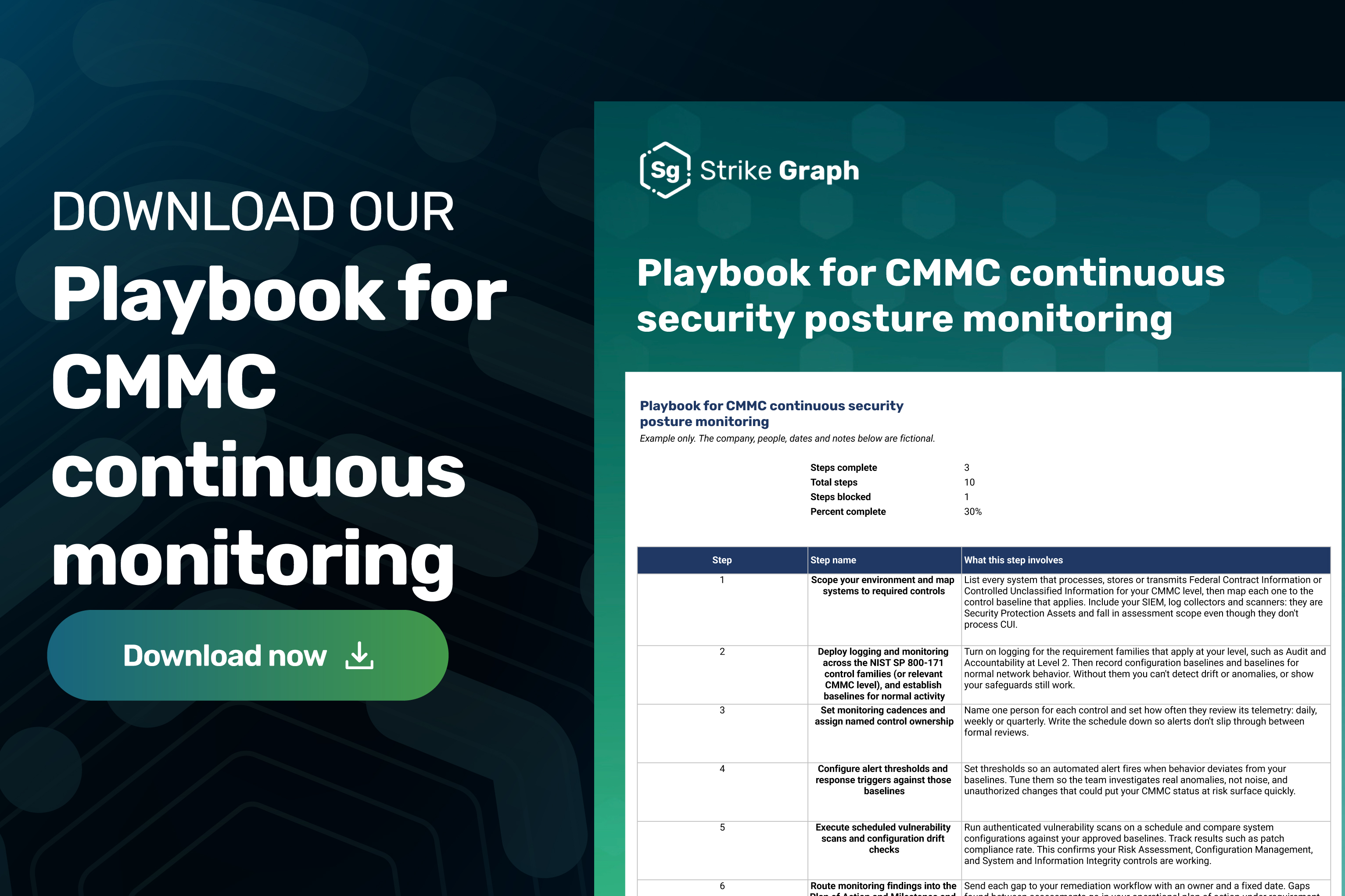
Our CMMC continuous monitoring playbook is a downloadable spreadsheet that turns the 10 implementation steps into a tracker. Each step includes guidance on what it involves, plus columns for a named owner, status, target date, completion date, and notes.
An example tab shows a fictional contractor partway through implementation, and progress counts update automatically as you change each step's status, so you can show leadership where the program stands before the annual affirmation.
Download our Playbook for CMMC continuous security posture monitoring.
Checklist for CMMC continuous security posture monitoring
This CMMC continuous monitoring checklist pairs each recurring monitoring activity with the requirement it supports, how often it runs, and the evidence artifact it produces. That last column matters most: assessors evaluate what your monitoring proves, not just whether it runs.
|
Monitoring Activity
|
Control family and requirement
|
Cadence / Trigger
|
Evidence Artifact Produced
|
|
Control effectiveness review
|
Security Assessment (CA.L2-3.12.3)
|
Quarterly / significant system change
|
Control assessment record
|
|
System monitoring for attacks and unauthorized use
|
System and Information Integrity (SI.L2-3.14.6, 3.14.7)
|
Continuous / SIEM or EDR alert
|
Alert disposition record
|
|
Boundary traffic monitoring
|
System and Communications Protection (SC.L2-3.13.1)
|
Daily / firewall or IDS alert
|
Firewall and IDS logs, alert disposition record
|
|
Vulnerability scanning
|
Risk Assessment (RA.L2-3.11.2)
|
Weekly / new vulnerability disclosed
|
Scan report, remediation ticket
|
|
Security log review
|
Audit and Accountability (AU.L2-3.3.5)
|
Daily / security alert
|
Signed review record, SIEM alert log
|
|
User access review
|
Access Control (AC.L2-3.1.1)
|
Quarterly / role change or departure
|
Access recertification document
|
|
Configuration drift check
|
Configuration Management (CM.L2-3.4.1, 3.4.2)
|
Daily / system change
|
Drift alert, baseline comparison report
|
|
Operational plan of action review
|
Security Assessment (CA.L2-3.12.2)
|
Monthly / new finding
|
Updated plan of action
|
|
System Security Plan updates
|
Security Assessment (CA.L2-3.12.4)
|
Quarterly / boundary or architecture change
|
Change ticket, version-controlled SSP
|
|
Physical access monitoring
|
Physical Protection (PE.L2-3.10.3, 3.10.4)
|
Daily / unauthorized or after-hours entry
|
Physical access log, visitor record
|
|
Incident response testing
|
Incident Response (IR.L2-3.6.3)
|
Annual / major change to IR plan or environment
|
After-action report, updated IR plan
|
|
Media protection review
|
Media Protection (MP.L2-3.8.3, 3.8.5)
|
Monthly / media disposal or transport
|
Sanitization log, media tracking record
|
Note: Cadences shown are common practice, not CMMC-mandated frequencies; set yours by risk and document them in your SSP. Also, note that requirement IDs combine the control family, CMMC level, and NIST SP 800-171 requirement number. RA.L2-3.11.2, for example, is Risk Assessment, Level 2, requirement 3.11.2.
Software for CMMC continuous security posture monitoring
Continuous security monitoring for CMMC relies on four tool categories: SIEM, EDR, vulnerability scanners, and SOAR. These tools generate telemetry across the Audit and Accountability, System and Information Integrity, Risk Assessment, and Incident Response families. A GRC platform sits above them, mapping that output to controls as evidence.
Here are details on each tool type:
- Security Information and Event Management (SIEM): SIEM platforms gather logs from your entire network and centralize the data for easier analysis. By connecting different events, these systems spot unusual activity that could mean a breach. This software is essential for meeting Audit and Accountability requirements, enforcing strict log retention, and keeping searchable records of what happens on your systems.
- Endpoint Detection and Response (EDR): EDR solutions continuously monitor your workstations and servers. They detect suspicious behavior, unauthorized file changes and threats a regular antivirus might miss. EDR tools can automatically isolate affected devices, helping you meet System and Information Integrity controls and giving you important data for investigations.
- Vulnerability scanners: These tools automatically scan your network and applications for known security issues and outdated software. By running on a regular schedule, they provide the information you need to manage risks before problems arise. They help you meet Risk Assessment requirements by finding known weaknesses so you can fix them sooner.
- Security Orchestration, Automation, and Response (SOAR): SOAR platforms link your security tools together to automate how you respond to incidents. If a SIEM or EDR detects a threat, SOAR automatically runs playbook-based actions to contain it. This teamwork helps you meet Incident Response requirements and reduces the time it takes to resolve issues.
Those four tools generate the telemetry. A GRC or compliance platform, such as Strike Graph, sits above them: it collects their output as evidence, maps each artifact to the CMMC requirements it supports, flags controls whose evidence is missing, stale, or failing, and rolls that status up into your overall posture. It doesn't replace your SIEM or scanner, and it doesn't need access to CUI to do this.
Common challenges when implementing continuous security monitoring for CMMC
Continuous monitoring may stall if organizations see it as simply buying software rather than an operational change. Buying a SIEM or vulnerability scanner alone is not enough to build a robust security program. To achieve compliance, you must combine these tools with well-defined workflows, human oversight, and robust governance.
Here are the most common implementation challenges and how to resolve them:
- Siloed security tools: Many organizations buy monitoring software that operates in isolation, leading to fragmented visibility. This makes it hard to keep a unified Information Security Continuous Monitoring (ISCM) strategy. To reduce this, centralize logs in your SIEM and connect your tools to a compliance platform that maps their output to controls.
- Alert fatigue: Default tool settings often generate more alerts than your team can review, so real incidents get buried among false positives. Tune your SIEM and EDR thresholds to match normal activity, so analysts spend their time on real anomalies.
- Delayed incident detection: Contractors whose contracts include DFARS 252.204-7012 must report cyber incidents affecting covered defense information to the DoD within 72 hours of discovery. Slow detection gives attackers more time inside the environment, and knowingly failing to meet monitoring and reporting obligations is one of the areas the DOJ Civil Cyber-Fraud Initiative targets. Automated alerting and response playbooks help teams spot incidents sooner and move from discovery to a submitted report well within the deadline.
- Static documentation: An SSP that no longer matches your environment is a finding against CA.L2-3.12.4 and gives assessors reason to question everything documented in it. To avoid this, you should link your continuous monitoring results directly to your documentation process and update the SSP each time you approve a system change.
- Overextended monitoring boundaries: Constantly monitoring your entire corporate network is expensive and complicated. If non-essential systems send telemetry, your costs can rise quickly. To manage this, create a separate CUI enclave and apply strict monitoring only to the systems that handle sensitive government data.
- Internal resource limitations: Many mid-sized contractors do not have enough staff to monitor networks around the clock. Building an internal security operations center is costly. To address this, partner with a managed security provider for 24/7 monitoring, and use compliance automation to collect and validate the evidence that monitoring produces.
Best practices for CMMC continuous security monitoring
Best practices for CMMC continuous security monitoring include using your posture view to guide resource decisions, matching monitoring to your DFARS contract requirements, treating monitoring results as legal evidence, building monitoring into your change process, and testing alerts and incident response at least once a year.
Implement these best practices to mature your continuous monitoring program:
- Use your posture view to make resource decisions. After you centralize your signals, use the combined view to guide decisions about resources, staffing, and budgeting for control gaps. This approach turns your security overview into a practical decision-making tool and provides leadership with solid support when they sign annual affirmations.
- Make sure your continuous monitoring matches your DFARS contract requirements. DFARS 252.204-7021 requires you to maintain the CMMC status your contract specifies for the life of the contract, including annual affirmations in SPRS. DFARS 252.204-7012 covers safeguarding and 72-hour incident reporting when your contract involves CUI. Knowing which rule applies to each part of your environment helps you avoid doing extra work and ensures you meet all legal requirements to keep your Department of Defense contracts.
- Remember that your data is legally binding. Misrepresenting your security posture can have serious legal consequences. Under the False Claims Act, knowingly misrepresenting your compliance, such as an SPRS score or affirmation your environment doesn't support, can bring treble damages and per-claim penalties. Treat your monitoring results as official evidence. This approach helps your security team focus on accurate reporting and quick fixes, protecting your organization from major legal and contract risks.
- Build monitoring into your change process. Before you approve a deployment or network change, check that it fits your approved baseline and stays inside your CUI boundary. After it goes live, confirm the running configuration matches what you approved, then update the SSP. This way, you catch unapproved or unintended changes the day they happen, not at the next scheduled scan.
- Test your monitoring alerts and incident response procedures at least once a year. Realistic tabletop exercises show whether your security team knows how to respond when your SIEM or EDR finds a real threat. These practice runs reveal any communication or process issues, so you can improve your response plans before a real cyberattack occurs.
Ongoing strategy for CMMC continuous security posture monitoring
Ongoing CMMC monitoring strategy comes down to who carries the operational load. SMBs typically narrow scope and buy the capacity they can't staff; MSPs standardize across clients while keeping each client's evidence and affirmation separate.
The best approach depends on your organization’s setup and technical skills. For example, a defense manufacturer’s needs differ greatly from those of an outsourced IT partner. That’s why the steps below are grouped by who will carry them out.
SMB strategies for CMMC continuous security monitoring
Most small and mid-sized businesses don’t have their own security operations centers. For SMBs, the order of steps is important: first, narrow your focus; next, automate what you can; then, outsource what you can’t handle in-house; finally, organize your documentation.
Follow these four steps to build and sustain monitoring with limited resources:
- Isolate sensitive data: Set up a restricted CUI enclave to cut down the number of endpoints and servers you need to monitor before you buy any tools. Clearly document the enclave boundary in your System Security Plan, because assessors will check if your stated scope matches what’s really happening on your network. A smaller enclave only helps if it’s accurate. Review the boundary regularly and whenever you add a new contract, system, or change how data moves between business units.
- Automate baseline reviews: Use configuration monitoring tools to compare systems against your approved baselines on a schedule. Send every detected deviation into the same remediation process you use for other monitoring findings, and triage each one first to confirm it isn't a security incident. Don't treat configuration drift as a separate workflow. A single process keeps your Configuration Management evidence consistent with the rest and gives you one place to show an assessor how findings are identified and closed.
- Outsource complex analysis: For the monitoring tasks that remain, you can work with specialized security firms to handle advanced threat hunting and 24/7 alert triage. This lets your internal staff focus on core operations. Make sure to confirm in writing whether the firm will access CUI directly or only manage Security Protection Assets like your SIEM, and document this division of responsibility in your SSP. If the provider doesn’t access CUI, its services are assessed as part of your scope, and it doesn't need its own CMMC assessment. If it does, it needs CMMC status at your level.
- Consolidate compliance tracking: Use a single platform to track remediation progress and create the evidence your Affirming Official needs for the annual affirmation. This includes scan reports, review records, POA&M status, and SSP version history, all with timestamps and linked to the relevant controls. Set this up well before your affirmation is due.
Managed service provider strategies for CMMC continuous security monitoring
Managed service providers should set up large-scale continuous monitoring programs across multiple client environments. Your approach has to standardize security operations while maintaining strict data segregation. By establishing repeatable, automated processes, you can provide defensible evidence of compliance for each client without increasing internal labor costs.
- Standardize the technology stack: Where possible, deploy a standard SIEM and EDR setup across all client environments to simplify analyst training and alert triage. A consistent technology stack ensures evidence artifacts are the same across clients and that the same log formats and detection rules always map to the same NIST SP 800-171A assessment objectives, speeding up both internal quality assurance and assessor evaluation. If a client's contract requires the use of specific tools, then record that as an exception rather than imposing standardization.
- Implement multi-tenant platforms: Use centralized software that maps each client's telemetry to their CMMC level while giving you a single management console. Keep each client's telemetry, evidence, and dashboards isolated from one another, since exposing one client's data to another would undermine the trust a multi-client monitoring practice depends on.
- Automate client reporting: Configure dashboards that translate technical telemetry into executive-level security posture summaries, so clients have the evidence they need when it's time to assess and affirm their compliance, such as submitting their self-assessment score to SPRS. The affirmation itself remains the client's responsibility, made by their Affirming Official. Your dashboards should support that step, not replace it.
- Codify incident response integration: Agree with each client on when analysts escalate an alert to them, so the client can meet the DoD's 72-hour incident reporting requirement under DFARS 252.204-7012. Clarify who is responsible for detection, who manages the reporting timeline, and who submits the report to DoD. Revisit these boundaries at renewal and after any incident.
- Work out your own level of CMMC exposure: Find out early whether client CUI touches your systems, including through log data your platform collects. If it does, confirm that your environment meets the requirements for handling it before you take on the work. Document the arrangement with each client in writing and revisit it whenever the scope changes.
Automating continuous security monitoring for CMMC
Automating continuous security monitoring for CMMC means connecting your security tools to a compliance platform so it collects, checks, and maps evidence to controls on a schedule rather than by hand. Spreadsheets can plan the work, but they depend on someone remembering every update.
AI compliance monitoring helps fill those gaps by connecting your security tools directly to your compliance goals. This way, evidence is collected automatically during daily work instead of being gathered manually. Kolasky explains that this is what makes continuous monitoring possible: "Technology is going to enable you to more continuously look at whether the risk has changed and how you're addressing it." As a result, your compliance records can stay up to date with changes in your environment, rather than falling behind until someone updates the tracker.
The first step is connecting your existing security stack to a compliance platform through read-only integrations. On a schedule matched to each control's review frequency, the platform pulls scan reports, configuration exports, and access records as evidence, removing the manual collection where entries get missed.
The platform then checks each artifact against the requirements it maps to (FAR safeguards at Level 1, the 110 NIST SP 800-171 requirements at Level 2, or the selected NIST SP 800-172 requirements at Level 3) and flags controls whose evidence is failing or stale, so gaps surface between assessments instead of at them.
Easiest way to automate continuous security posture monitoring for CMMC
The easiest way to automate CMMC security posture monitoring is to validate evidence as it's collected. Strike Graph pulls artifacts from your existing security tools on a schedule, and its Verify AI tool checks each one against the control it's meant to prove, flagging failures before your Affirming Official signs.
Instead of replacing your specialized security software, Strike Graph's GRC platform for CMMC serves as your centralized governance hub. Its automated evidence validation retests new and updated evidence as it arrives, so you always know which items are ready and which need attention. This continuous validation helps keep your compliance records current, so your daily technical outputs align with NIST SP 800-171 requirements without manual administrative mapping.
When your Affirming Official signs the required annual affirmation, Strike Graph provides the evidence to support that attestation. Stop managing compliance through spreadsheets and fragmented workflows.
Start with a free CMMC self-assessment, or book a Strike Graph demo to see how automated evidence validation can keep your self-assessment and annual affirmation defensible.