Strike Graph Logo

Independent research validates Strike Graph's trust assurance platform

GRC 20/20 Research evaluated Strike Graph through client reference calls, platform demos, and analyst review. Download the Solution Perspective to see what independent analysis found about how organizations are replacing fragmented compliance with continuous, control-centered trust assurance.
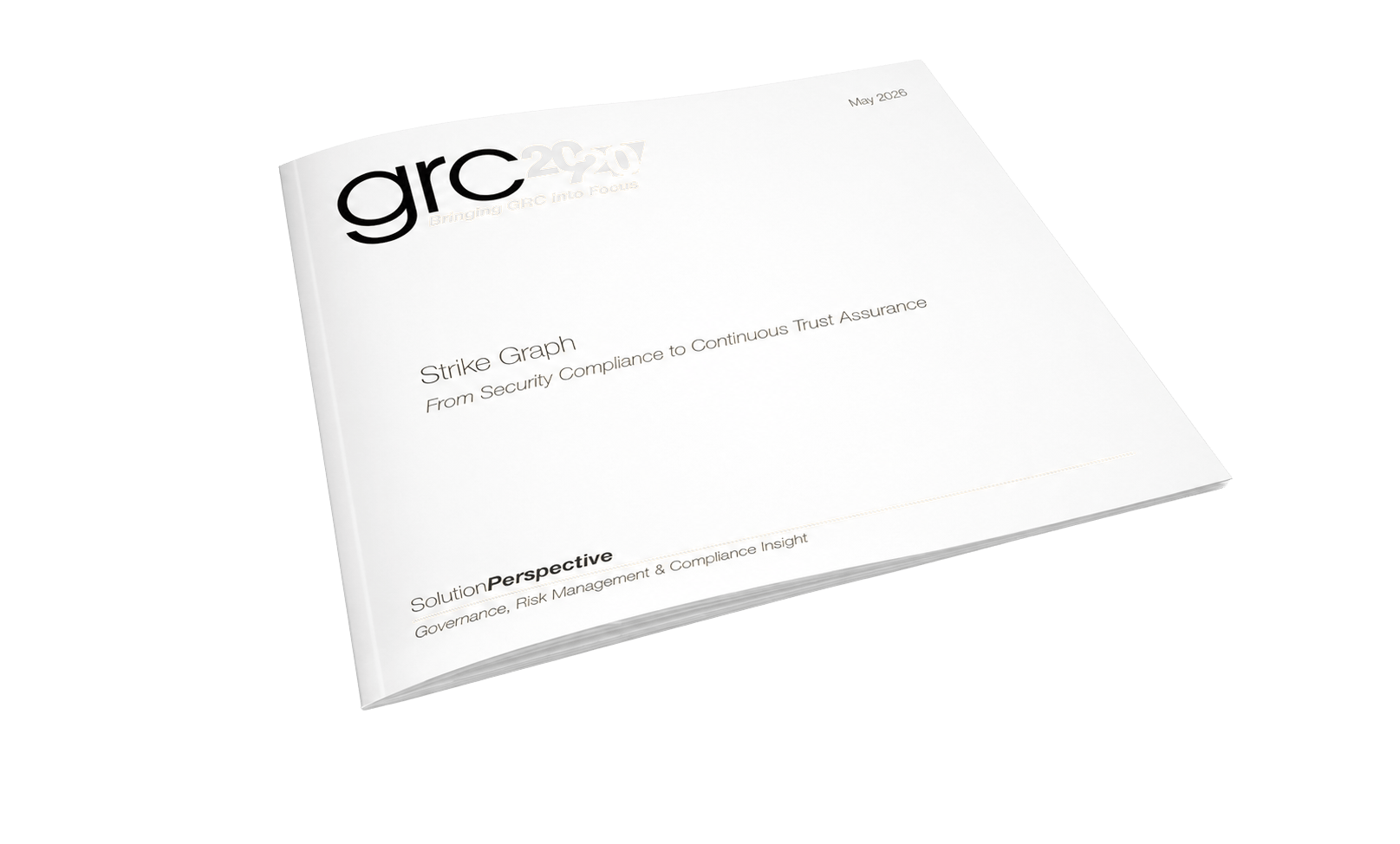
GRC 2020 Solution Perspective Cover image

Get the Research

Download the full GRC 20/20 Solution Perspective — free.

Polygon@2x 6-2

What GRC 20/20 found when they looked closely at Strike Graph

GRC 20/20 analyst Michael Rasmussen conducted structured client reference calls across industries and geographies to evaluate how Strike Graph performs in real operating environments. The findings go beyond feature lists — they surface what compliance programs actually look like before and after.

LP-icon-lightbulb-gear

How Strike Graph's control & evidence architecture performs across lean teams, distributed environments, and multi-framework obligations

LP-icon-magnifying

Where clients see the greatest gains: audit readiness, evidence discipline, executive visibility, and commercial credibility

LP-icon-lightbulb-continuous-monitor-shield-check

Why organizations are moving from point-in-time audits to living assurance — and what that shift requires operationally
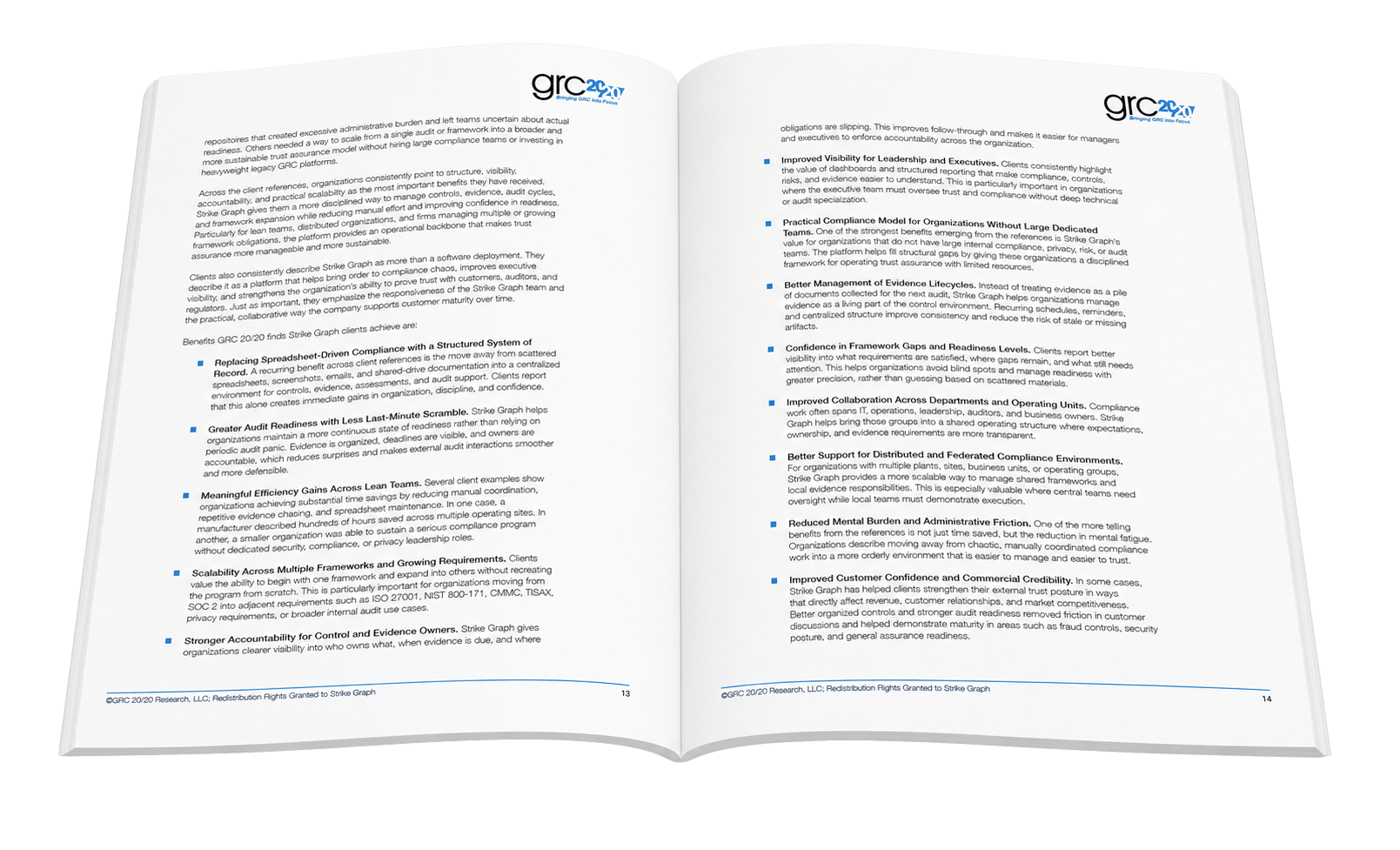
GRC 2020 Solution Perspective_open layout

Trust is operational, not episodic.

GRC 20/20 finds that organizations winning on trust aren't doing more audits. They're running compliance as a continuous discipline. This research shows how that shift happens in practice — and what results it produces.

Get the research
GRC 2020 Solution Perspective Cover image

Strike Graph gets you certified fast.

Forget traditional auditing firms. Strike Graph takes you all the way to certification faster and more affordably than traditional solutions.

STEP 1

Design

Assess risk and design a strong security program that fits your business with Strike Graph’s extensive repository of policy templates, audit-tested controls, and educational articles.

STEP 2

Operate

Use the compliance dashboard to distribute ownership of risks, security controls, and evidence automation across the whole team, ensuring your organization meets its security contributions efficiently and effectively.

STEP 3

Measure

Easily measure and monitor the status of your controls so you’re always in compliance and ready for audit. 

STEP 4

Certify

Give your partners and customers confidence you’re operating in compliance with all relevant regulations and industry-standard security frameworks with a Strike Graph compliance report.

What AI-native compliance delivers that traditional tools can't

strikegraph-icon_document-report_feature 1

Control-Centric Architecture

Compliance is structured around the controls that mitigate risk and the evidence that proves they're working — not static documents.

strikegraph-feature-pictogram_ai-security-questionnaire-dark

Multi-Framework Mapping

Map controls across SOC 2, ISO 27001, CMMC, NIST 800-171, HIPAA, and more — do the work once, apply it across every obligation.

strikegraph-feature-pictogram_compliance-dashboard-ui

Verify AI for Evidence Testing

Patent-pending Verify AI evaluates whether submitted evidence actually matches what was requested and flags material changes from prior submissions.

strikegraph-feature-pictogram_risk-assessment

Automated Evidence Collection

Integrations pull evidence directly from your existing tools, reducing manual coordination and keeping your compliance record current between audits.

strikegraph-feature-pictogram_framework-control-evidence-mapping

Federated Compliance Management

Enterprise teams define shared control structures while business units and sites manage their own evidence — centralized oversight, local execution.

strikegraph-feature-pictogram_penetration-testing-dark

Continuous Audit Readiness

Controls, evidence, deadlines, and owners are maintained in a living environment — so audit day is never a scramble.

Trusted by hundreds of fast-growing companies

image 6
image 7
image 9
image 10
image 11
image 13
image 14
image 15

What organizations are actually experiencing

Across four anonymized client reference calls spanning manufacturing, healthcare, financial services, and software, GRC 20/20 found a consistent pattern: organizations that adopt Strike Graph move from reactive, manually coordinated compliance into a more structured, accountable, and scalable operating model for trust assurance.

strikegraph-icon_audit-inspect-dark

Before Strike Graph

Scattered evidence folders, email-driven audit prep, spreadsheet tracking, and limited visibility into actual control status.

strikegraph-icon_pen-test-dark

After Strike Graph

Centralized controls and evidence, clearer ownership, smoother audits, and confidence in compliance posture across frameworks and teams.

strikegraph-icon_scale-chart-metric-graph-dark

What Analysts Say

GRC 20/20 finds Strike Graph transforms trust assurance from a reactive administrative burden into a continuous and operational business discipline.

Stay ahead of what's next in GRC

Get the latest on security compliance, trust assurance, and Strike Graph product updates delivered straight to your inbox. 

Frequently Asked Questions

What is a GRC 20/20 Solution Perspective?

A GRC 20/20 Solution Perspective is an independent research report produced by GRC 20/20 Research, LLC, a leading analyst firm specializing in governance, risk management, and compliance technology. Reports are produced through product demonstrations, analyst strategy sessions, and direct reference calls with real customers — not vendor-supplied case studies. GRC 20/20 evaluates platforms on consistent, objective criteria regardless of commercial relationship. A positive Solution Perspective represents genuine third-party validation of a platform's capabilities and real-world performance.

What is continuous trust assurance, and how is it different from traditional compliance?

Traditional compliance is episodic: organizations gather evidence, complete an audit, receive a certification, and then repeat the cycle a year later. Continuous trust assurance is an operational model in which controls are validated on an ongoing basis, evidence is kept current, gaps are identified before they become audit findings, and leadership has real-time visibility into the organization's readiness and exposure. GRC 20/20 frames this shift as a market-level change in expectations — organizations are no longer just expected to pass audits; they are expected to demonstrate that they are trustworthy on a continuous basis.

What frameworks does Strike Graph support?

Strike Graph supports 30+ security and compliance frameworks including SOC 2, ISO 27001, CMMC, NIST 800-171, HIPAA, PCI DSS, FedRAMP, NIS2, TISAX, and GDPR. The GRC 20/20 report specifically evaluates how the platform manages multi-framework compliance in real operating environments, including how controls are mapped across frameworks to reduce duplication and how organizations can expand from one framework into several without rebuilding their compliance programs from scratch.

What is Verify AI, and how does it work?

Verify AI is Strike Graph's patent-pending AI-powered evidence review capability. Rather than simply storing evidence, Verify AI evaluates whether submitted evidence actually matches what was requested for a given control, and whether current evidence materially differs from prior submissions in ways that warrant attention. GRC 20/20 describes this as moving the platform from evidence storage toward evidence intelligence — a meaningful distinction in how organizations think about the quality, not just the quantity, of their compliance documentation.

Is Strike Graph a good fit for organizations without large compliance teams?

Yes — and GRC 20/20 explicitly identifies this as one of Strike Graph's strongest practical advantages. The platform enables smaller or understaffed teams to run disciplined compliance and trust assurance programs that would otherwise require dedicated security, compliance, or privacy leadership roles. Client reference calls included a mid-sized healthcare organization without dedicated compliance leadership and a software provider where a very small team managed multiple audit obligations using Strike Graph as the primary operating system for compliance. In both cases, the platform provided the structure, accountability, and visibility that dedicated roles would otherwise supply.

How does Strike Graph compare to traditional legacy GRC platforms?

GRC 20/20 addresses this directly in the Solution Perspective. The analyst firm characterizes Strike Graph as particularly well suited to organizations that need more structure and scalability than spreadsheets and static trackers can provide, but that also want a more usable and practical approach than traditional heavyweight GRC platforms. Legacy GRC platforms tend to be complex, expensive to implement, and built for large enterprise compliance teams. Strike Graph is designed for organizations that need to operationalize trust assurance with lean resources, across multiple frameworks, in a way that actually gets used day to day.

Can’t find the answer you’re looking for? Contact our team!

Download the independent analysis on how organizations build trust assurance.

Strike Graph Logo
  • Terms
  • Privacy

Copyright 2026 Strike Graph